FAQPage vs QAPage schema comes down to who writes the answers: your team (FAQPage) or your visitors (QAPage). Schema is code that tells search engines and AI tools what a page contains, so answers get quoted accurately.
Quick answer: use FAQPage for a visible FAQ you wrote, and QAPage only for 1 question that visitors answer. Since May 7, 2026, Google shows no FAQ rich results, and its AI search guide asks for no schema.
Key Takeaways
- FAQPage vs QAPage schema splits on authorship. FAQPage fits a visible FAQ written by the site, while QAPage fits 1 question with answers submitted by users.
- Rich results, the expandable answers under a listing, vanished for FAQ pages on May 7, 2026. The QAPage rich result remains documented as current.
- Google’s AI search guide lists no schema requirement, so neither type works as an AI citation lever.
- The FAQPage vs QAPage schema choice depends on page type, not on keywords or habit.
- Putting QAPage on an FAQ page or blog post breaks Google’s guidelines, and mixing both types on 1 page adds confusion.
- Most small business sites need FAQPage at most, and some pages need no FAQ schema at all.
What Is the FAQPage vs QAPage Schema Difference?
FAQPage schema labels a page of questions that the publisher answers, with 1 official answer each. QAPage schema labels a page about 1 question that users answer, with an accepted answer and suggested ones.
The table below compares FAQPage vs QAPage schema across 6 factors. Here, mainEntity is the property that holds the questions.
| Factor | FAQPage | QAPage |
|---|---|---|
| Who writes answers | The site publisher | Visitors or community members |
| Questions per page | 1 or more | Exactly 1 |
| Answers per question | 1 official answer | 1 accepted, plus suggested answers |
| Typical page | Service FAQ, policy page, help article | Forum thread, community Q&A page |
| Google rich result, Oct 2026 | Ended May 7, 2026 | Still documented as current |
| Core markup | mainEntity list of Question items | mainEntity single Question, answerCount |
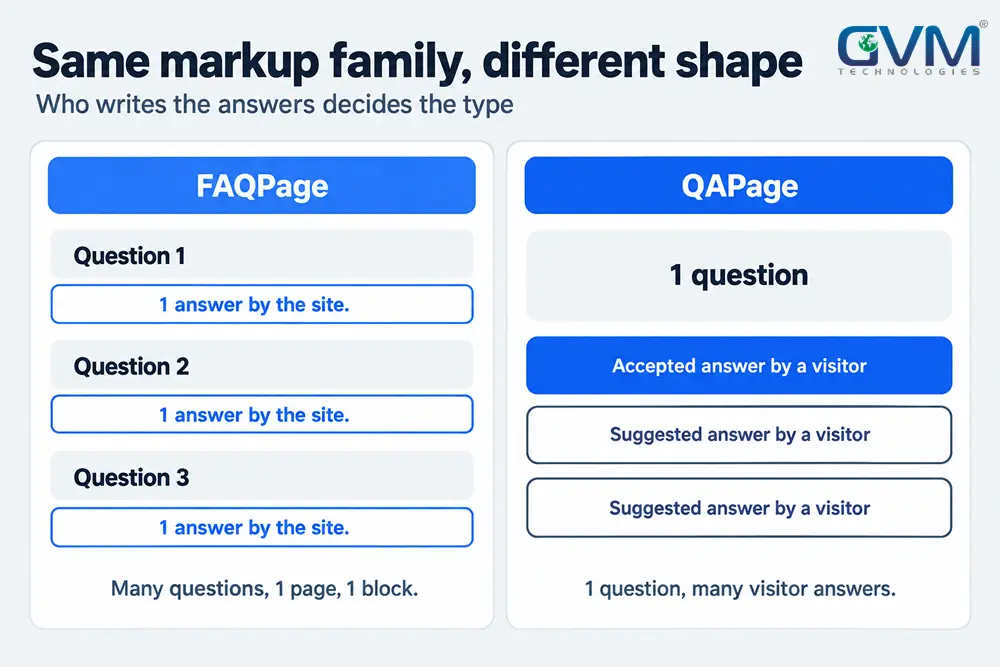
1. How FAQPage schema is built
schema.org defines FAQPage as a page that presents frequently asked questions. In practice, 1 block lists every visible question and answer. A roofing company with 6 repair questions on a service page adds 1 FAQPage block.
- The page carries 1 FAQPage, with all questions inside 1 mainEntity list.
- Each Question holds a name and an acceptedAnswer with the full text.
- Every question and answer also appears as visible text on the page.
FAQ blocks mainly serve answer engine optimization (AEO), 1 of 3 overlapping optimization types.
2. How QAPage schema is built
QAPage schema wraps 1 question and the replies it received, which makes it a type for user-generated content. A community thread titled “Why does my AC freeze up?” with 5 homeowner replies fits.
- The page carries 1 QAPage, and mainEntity holds a single Question.
- The Question needs a name, an answerCount, and at least 1 acceptedAnswer or suggestedAnswer.
- Google recommends upvoteCount, author, and datePublished on the question and its answers.
- Visitors need a way to post their own answers on the page.
3. Why FAQPage vs QAPage schema gets confused
Plenty of site owners get stuck for 4 reasons:
- The names FAQPage and QAPage sound interchangeable.
- schema.org’s QAPage entry is looser than Google’s rules, and even mentions FAQ-style pages.
- Google’s rule is stricter: a QAPage is no place for an FAQ list or any page with several questions.
- Old advice lingers. The 2023 limit to government and health sites covered the FAQ rich result display, not whether the markup was valid.
Calling FAQ schema a trick for AI answers adds more noise, because AI search extends classic SEO rather than replacing it.
Does Google Still Support FAQPage vs QAPage Schema in 2026?
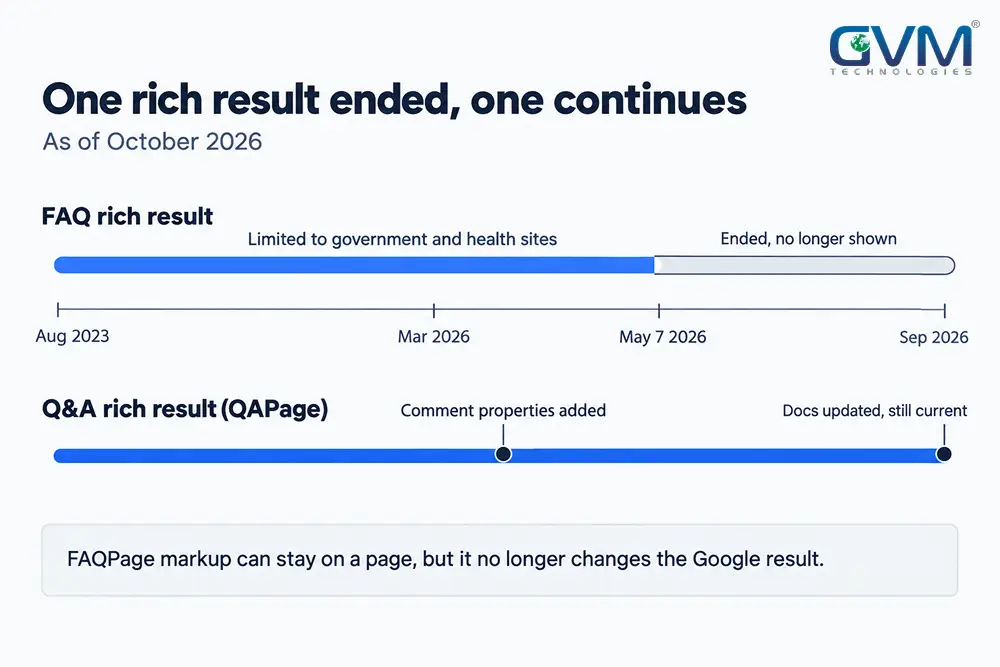
Google supports the QAPage rich result and has retired the FAQ rich result. FAQPage markup can stay on a page, but it no longer changes how your listing looks in Google Search.
The timeline shows how fast the FAQ side changed.
| Date | What happened |
|---|---|
| Aug 2023 | FAQ rich results limited mainly to government and health sites |
| Mar 24, 2026 | Google added QAPage comment-thread properties |
| May 7, 2026 | FAQ rich results stopped appearing in Google Search |
| Jun 15, 2026 | Google removed its FAQ rich result documentation |
| Sep 8, 2026 | QAPage documentation last updated, still current |
1. What ended for FAQPage
- Google Search no longer shows the expandable FAQ result under a listing, as Google’s FAQ documentation records.
- The Rich Results Test (Google’s markup checker) and the Search Console FAQ report (Google’s free site report) lost FAQ support in June 2026.
- Existing markup does not break, because the FAQPage vocabulary stays valid.
2. What still works for QAPage
Google still lists Q&A results as a live feature and points to Search Console and its Rich Results Test for checks. Eligibility is narrow, though.
Visitors need a way to post answers, and 1 question must be the page’s focus. Google also warns against applying QAPage markup sitewide.
3. What AI search does with FAQPage vs QAPage schema
- No AI platform we know of documents a FAQPage or QAPage requirement.
- In our experience, visible and standalone answers carry the weight, and markup only labels them.
- No public controlled test separates the 2 types, so read any claim of doubled citations as unproven.
- On 2026-10-09, Google AI Mode still described FAQ rich results as limited, not ended, so verify schema advice against Google’s documentation.
How AI search engines pick sources lists what vendors actually confirm. GVM Technologies treats FAQ schema as a labeling job that comes after the answers are clear.
Which FAQPage vs QAPage Schema Do You Actually Need?
Most business sites need FAQPage at most, and only when the page shows a real FAQ. QAPage fits only a page where 1 question collects user answers. Plenty of pages need neither.
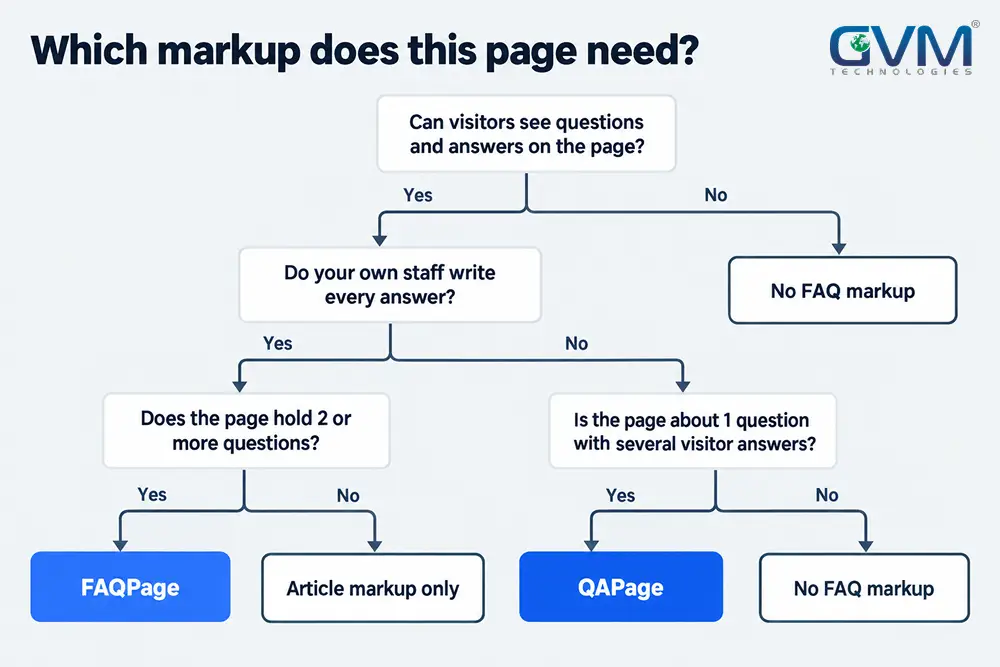
1. The 4-step FAQPage vs QAPage schema decision path
- Visible Q&A: if visitors cannot see the questions and answers, add no FAQ schema.
- Author: if your team writes every answer, go to step 3. If visitors write answers, go to step 4.
- Question count: 2 or more questions means FAQPage. A single question you answered needs only Article schema.
- Thread: 1 question with several visitor replies gets QAPage. A page of unrelated questions gets neither.
2. Page-type map for FAQPage vs QAPage schema
| Page | Best fit | Why |
|---|---|---|
| Service page with 6 visible FAQs | FAQPage | Your team answers every question |
| Blog post ending in a 5 question FAQ | FAQPage on that block | The questions are visible and authored |
| Forum thread with 1 question, 8 replies | QAPage | Visitors answer 1 question |
| Product page with 12 customer questions | Neither type | QAPage allows 1 question per page |
| Support article you wrote for 1 question | Article | No visitor answers exist |
| FAQ present only in markup | Neither type | Markup must match visible text |
3. When you need neither
- A page that asks 1 casual question inside an article.
- FAQ text that exists only in markup, never on screen.
- Questions written only to carry markup.
For many pages, the FAQPage vs QAPage schema question ends with neither. Visible questions plus Article schema already make a finished page.
Crawl access and rendering matter more, so GVM Technologies begins with the technical work that comes before markup.
4. The ask-the-expert edge case
Many “ask the expert” pages sit between the 2 types. Visitors submit questions, but only your staff answer. Because no visitor answers exist, QAPage does not fit.
Choose by layout instead:
- 1 page, many staff answers: FAQPage.
- 1 URL per question, visitors can reply: QAPage on each URL.
- 1 URL per question, staff reply only: Article, with FAQ schema optional.
FAQPage vs QAPage Schema Mistakes, With a Fix for Each
The most common FAQPage vs QAPage schema mistake is choosing the type by habit instead of by page. Google’s structured data guidelines require markup to match visible content, so a mismatch can cost rich result eligibility.
| Mistake | Why it fails | Fix |
|---|---|---|
| QAPage on a company FAQ | Google bars QAPage for FAQ pages | Switch to FAQPage |
| 1 FAQPage block per question | The page should hold 1 FAQPage | Merge into 1 mainEntity list |
| Markup lists 10 questions, page shows 4 | Markup must match visible text | Show all 10 or trim |
| FAQPage and QAPage on 1 page | The page has no single purpose | Pick the main purpose |
| Answers built only by script | AI crawlers may never see them | Put text in the HTML |
The plugin that marked 2 of 10 questions
A common complaint: an SEO plugin marked up 2 FAQs while the page shows 10. The plugin’s FAQ block marks only questions placed inside that block, and the other 8 sit in ordinary headings.
Fix it in 1 of 2 ways:
- Move all 10 questions into the plugin’s block.
- Edit the single FAQPage list by hand.
The number of Question items should equal the number of visible questions. Check the JSON-LD, the block of code that holds your schema, against what visitors can read.
Comments do not make a QAPage
Under FAQPage vs QAPage schema rules, a blog post with a comment section is still an Article. Google’s QAPage guidance excludes blog posts, so reader comments do not turn the page into 1 question with answers.
How to Add and Check FAQPage vs QAPage Schema
Write the visible questions first, add the matching type second, then validate after every edit. Schema labels content, so it cannot repair unclear answers.
Adding FAQPage vs QAPage schema therefore starts with the text, not the code. That order matches a sensible first month of GEO work.
1. Add FAQPage in 5 steps
- Collect 3 to 8 questions that buyers ask on sales calls and in support email.
- Answer each in its first sentence, then add detail.
- Print each question and its answer in the page HTML itself, beyond the markup.
- Add 1 FAQPage block that lists every question under mainEntity.
- Validate, publish, then recheck after each content edit.
2. Which validator checks FAQPage vs QAPage schema
- FAQPage: the Schema Markup Validator, because Google’s Rich Results Test dropped FAQ support.
- QAPage: Google’s Rich Results Test plus Search Console, per Google’s QAPage documentation.
- Both: the rendered page source, because script-built answers can stay invisible to AI crawlers.
3. Keep answers worth quoting
- Name the subject in every answer so the text works alone.
- Refresh answers when prices, policies, or dates change.
- Log whether AI answers quote you, using a repeat-prompt citation baseline.
4. Time, cost, and what to expect
- Time: in our experience, 1 FAQ section takes 1 to 2 hours, mostly spent writing answers.
- Cost: free tools cover everything: Schema Markup Validator, Search Console, and Rich Results Test.
- Results: Google does not guarantee any structured data feature, and QAPage results depend on page eligibility.
- Recrawl: expect days to weeks before a changed page reappears in a tool.
FAQPage vs QAPage Schema Myths, Checked
Most claims about FAQPage vs QAPage schema fail on 1 point: they credit the markup for work that visible content does. Here are 5 popular claims, checked against Google’s documentation.
| Claim | Verdict | Why |
|---|---|---|
| FAQ schema works only for government and health sites | Outdated | No site gets FAQ rich results now |
| FAQPage schema gets you into People Also Ask | Unproven | No Google page lists schema for it |
| AI engines cite only pages with FAQ schema | Unproven | Google’s guide lists no such rule |
| Use both types for double coverage | False | 1 page, 1 purpose |
| Delete all FAQ schema now | Too strong | Accurate markup is harmless |
Remove markup that is stale, hidden, or wrong. Leave accurate markup alone and spend the saved time on the visible answers.
A vendor promising citations from schema alone is selling something unproven. Why guaranteed citations deserve suspicion applies here too.
FAQs
1. Can I use FAQPage and QAPage on the same page?
No. In FAQPage vs QAPage schema, 1 page gets 1 type, chosen by the page’s main purpose. Google bars QAPage on multi-question pages, so a thread’s side FAQ stays plain text.
2. Is FAQ schema still worth adding in 2026?
Only when the page shows a real FAQ. Google no longer displays FAQ results, so add FAQ schema for machine clarity, not for a visible result. Existing markup that matches the page can stay.
3. Does QAPage work for blog posts or product pages?
No. Google excludes blog posts and FAQ pages. A product page with many customer questions has several questions, so it does not fit either.
4. Do I need FAQPage or QAPage for ChatGPT Search, Perplexity, or Google AI Mode?
No documented requirement exists, and Google’s guide names no markup for AI Overviews or AI Mode. Clear visible answers and crawler access do the work, and honest AI visibility reporting shows whether they do.
5. Why did my FAQ dropdown disappear from Google results?
On May 7, 2026, Google ended that display for every site. Nothing on your page broke, and your FAQ schema stays valid.
Conclusion
The FAQPage vs QAPage schema decision is about authorship: answers you wrote, or answers your visitors wrote. For most sites, the honest choice is FAQPage on a visible FAQ, or no FAQ schema at all.
Here is the order to follow:
- Today: list every page that carries FAQ schema or Q&A schema, with its type.
- This week: match each block to visible text, and fix any QAPage on a non-community page.
- This month: merge duplicate FAQPage blocks, then validate each type with the right tool.
- Every quarter: reread Google Search Central’s structured data documentation, because FAQ rich results ended within 6 weeks of the notice.
Expect more schema types to lose display roles. Clear, visible answers tend to outlast every markup change.
Fix Markup That Validates but Misleads
Your FAQPage vs QAPage schema passes a validator, yet nobody can say whether it still matches the page. Each stale block keeps describing answers you may have changed months ago.
The free audit from GVM Technologies covers 4 checks:
- Technical SEO health: crawling, indexing, and rendering of your key pages
- Crawler readiness for AI: structured data, consistent brand facts, and FAQ coverage
- Content gaps: buyer questions your pages leave unanswered
- Fix list: a ranked action plan and schedule, walked through on a call
Founded in 2012, GVM Technologies runs SEO plus generative engine optimization through 1 team under 3 ISO certifications, and its published case studies include a floral e-commerce store, a real estate group, and a trucking insurer.
You leave knowing which markup to keep, fix, or delete.
Entity clarity is how reliably search and AI systems can identify your business, place it in the right category, and confirm which facts about it are true. It underpins generative engine optimization.
Quick answer: entity clarity decides whether an AI names the right business with the right facts. It cannot force a citation, but a blurred name gets skipped or mixed up with another company.
Key Takeaways
- Entity clarity means 1 name, 1 category, and the same core facts on every page and profile that describes you.
- Google’s guide to AI features in Search never uses the word “entity”, so this is a practical aim, not a documented ranking factor.
- Google does say Organization markup helps it tell similar organizations apart in results.
- In our test, ChatGPT named the right parent company but listed SEO and GEO as 1 of 8 services and never named this site.
- The usual cause is drift: our own homepage showed 2 site names, 2 founding years across GVM pages, and 3 Organization entries with no shared ID.
- Fix owned pages first, then profiles, then earn independent coverage. Bought mentions and llms.txt do not produce AI citations.
What Is Entity Clarity, and Is It Just Entity SEO?
Entity clarity is the state you want: 1 identity that machines can match to the right facts. Entity SEO is the work that gets you there.
| Term | Plain meaning | Example |
|---|---|---|
| Entity | A distinct thing a system tracks | A company, author, product, or city |
| Entity clarity | How cleanly that thing is identified | Same name and category everywhere |
| Entity SEO | The work that improves it | Schema, profile cleanup, consistent copy |
| Disambiguation | Telling it apart from lookalikes | Your firm versus a same name firm |
| Knowledge graph | A database of entities and links | Wikidata or Google’s own graph |
People often assume “entity” means a Wikipedia page. It does not. Any business with a name, a category, and a website already has an entity, clear or blurred.
2 meanings get mixed up in search results:
- Brand entity: you, your business, and your authors. This guide covers it.
- Topic entity: the concepts a page discusses, such as schema or Wikidata. That is a content planning job, not an identity job.
You will also see this work filed under AEO, GEO, and LLMO. The labels differ, but GEO, AEO, and SEO all sit on the same identity layer.
Why Entity Clarity Matters for Getting Cited by AI
An AI answer can only name or link you if the system first matches your name to the right pages and facts. When that match is shaky, the answer names a competitor, hedges, or leaves you out.
The 3 Levels of Entity Clarity
Every AI answer about a business rests on 3 questions. Each fails in a different way.
| Level | Question the system faces | What breaks it |
|---|---|---|
| Resolve | Which thing does this name mean? | A same name rival or a renamed brand |
| Describe | What category and offer does it have? | Vague copy and 8 services with no lead |
| Corroborate | Do independent sources agree? | Old listings and stale profiles |
Rule of thumb: fix Resolve first, Describe second, and Corroborate third. Outreach before the first 2 only spreads a blurred name wider.
The same 3 questions come up on every AI surface, from ChatGPT to Claude to Google’s AI Overviews, though each retrieves differently. A name can resolve and still fail at Describe, which is where our test below broke.
Our reading: embedding based retrieval matches meaning, so 2 same name firms with similar copy can sit close together. Place and category words pull them apart.
What Google Confirms and What It Does Not
| Level | Claim | Proof |
|---|---|---|
| Confirmed | Organization markup helps Google disambiguate organizations | Google documentation |
| Confirmed | Google AI features need no extra markup beyond normal SEO | Google documentation |
| Confirmed | Inauthentic mentions help less than they appear to | Google documentation |
| Confirmed | llms.txt neither helps nor harms Google Search | Google documentation |
| Reported | Brands that resolve cleanly earn more AI citations | Small tests, cause unproven |
| Unknown | How much entity clarity is enough | No public causal test found |
Google’s guide to AI features in Search does not use the word entity, so entity clarity is an industry term, not a named Google factor. Organization structured data is the 1 place Google names disambiguation.
Caution: treat reported correlations carefully. A test on 1 new brand over a few weeks cannot separate a clear identity from the reputation that usually comes with it.
In our AI ranking algorithm test, Gemini listed entity clarity as a ranking factor. Google’s guide makes no such claim.
Our Entity Clarity Test: 1 Company, 2 Founding Years, 3 Organization Entries
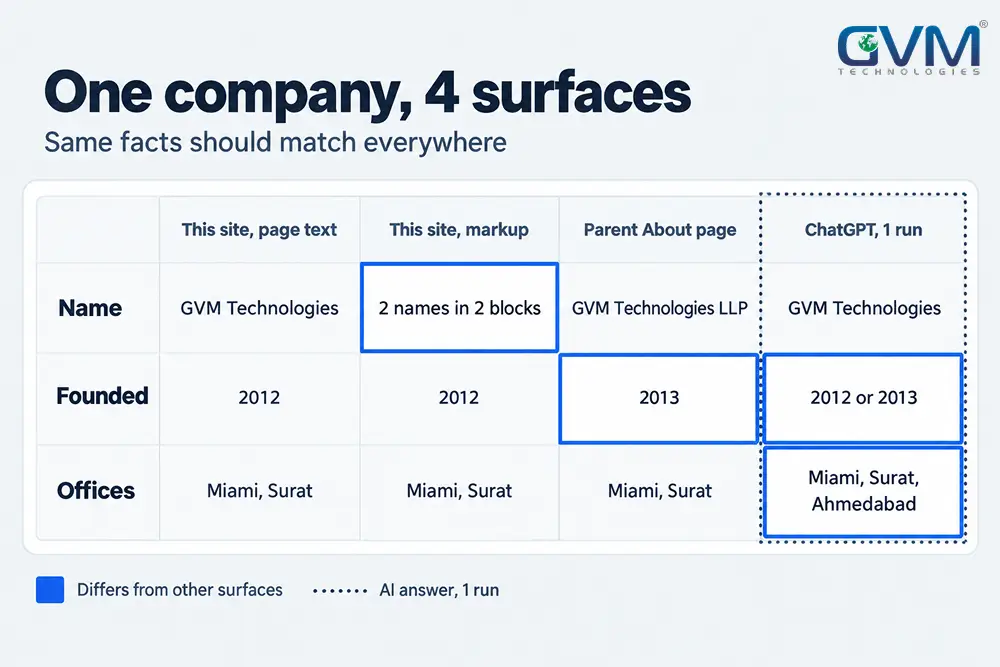
We checked GVM Technologies the way a buyer or an AI would, on 2026-10-07. The parent company resolved, but the category blurred and our own markup disagreed with itself.
What ChatGPT Said About GVM Technologies
We asked signed out ChatGPT “What is GVM Technologies and what does it do?” once. The answer cited 3 sources: the company’s own site, LinkedIn, and a university page.
| Check | Result |
|---|---|
| Right entity named | Yes, the parent company |
| Right category | Partly: SEO and GEO was 1 of 8 services |
| Right facts | Partly: gave 2012 or 2013, and added an Ahmedabad office |
| This microsite named | No |
What Our Own Markup Showed
The disagreement sat on our side. We compared the homepage text, its JSON-LD (the code block that labels facts for machines), and the parent company’s About page.
| Item | What we found |
|---|---|
| Names for 1 business | A plain name in 1 block, a longer site name in another |
| Page title | A third wording, with no company name |
| Founding year | 2012 on the homepage, 2013 on the About page |
| Organization entries | 3, with no shared @id |
| sameAs profiles | Listed in 1 entry, missing from the others |
Our reading: the answer hedged on the founding year because the sources disagreed. That is a guess, not a proven cause.
What This Test Cannot Prove
- It is 1 prompt, 1 run, and 1 platform. Answers change between runs.
- Every other platform went untested, from Perplexity and Claude to Copilot, Gemini, and Google AI Mode.
- The Ahmedabad office appears nowhere on the company’s contact page, and we do not know which source produced it.
A dated citation baseline repeats a prompt across weeks, which 1 run cannot do.
Where Entity Clarity Breaks: Symptoms, Causes, and First Fixes
Match what you see in the answer to a cause. Each symptom has a different first fix, and most start with a page you control.
| Symptom in the AI answer | Likely cause | First fix |
|---|---|---|
| A different company is named | Same name rival | Add place and category beside the name |
| Right company, old facts | Stale markup or listing | Rebuild markup from 1 source of truth |
| Right company, wrong category | Vague or mixed copy | Open every page with 1 category sentence |
| Facts conflict between answers | Drift between profiles | Run the drift check in step 2 below |
| Not named at all | No independent pages | Earn coverage and check crawler access |
| Parent named, sub brand missing | No shared ID or links | Point the sub brand at the parent @id |
Audits often turn up JSON-LD that nobody updated after the page text changed. Hours, prices, and founding years then disagree on the same URL.
Crawler access still comes first, because a clean identity on a blocked page reaches no buyer.
How to Build Entity Clarity in 6 Steps
These 6 steps are entity SEO at small business scale. Define 1 identity, fix the pages you own, add markup, align profiles, earn coverage, then recheck.
The loop: Define → Align → Mark up → Profile → Earn → Recheck, then repeat every quarter.
1. Write 1 Entity Statement
- Template: “[Name] is a [category] that [does what] for [whom] in [where].”
- Example: “GVM Technologies is an SEO and GEO agency with offices in Miami and Surat.”
- Keep it under 25 words, and reuse it as sentence 1 of your homepage, About page, and profiles.
2. Make Your Own Pages Agree
- List name, category, founding year, address, and phone in a spreadsheet, 1 column per surface.
- Surfaces to include: homepage, About, Contact, footer, JSON-LD, and author pages.
- Pick the correct value for each row, then change every other surface the same day.
3. Add Organization Markup With 1 Stable ID
Google lists name, url, logo, sameAs, address, description, alternateName, legalName, and foundingDate as recommended Organization properties. Give the organization 1 stable @id and refer to it from every other node.
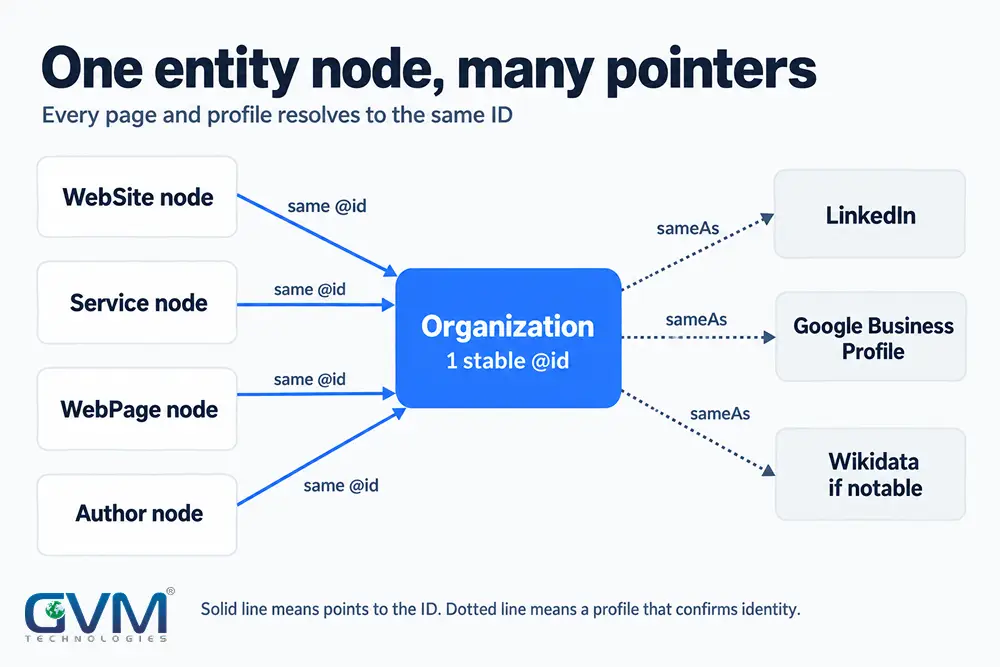
- The sameAs property points to a page that “unambiguously indicates the item’s identity.”
- Use the most specific subtype that fits, such as a LocalBusiness subtype for a shop with an address.
- A sub brand site points its WebSite and Service nodes at the parent’s @id.
4. Align Profiles and Listings
- Copy your entity statement and key facts to LinkedIn, Google Business Profile, and the directories in your category.
- Correct stale listings directly. Old profiles keep repeating the old name.
- Add a Wikidata item only if you meet Wikidata’s notability rules, which need a sitelink, serious public references, or a structural need.
5. Earn Independent Coverage
- Give reviewers and partners 4 facts to repeat: your name, category, location, and founding year.
- Skip bought placements. Google calls inauthentic mentions unhelpful, and a promised citation count is a warning sign.
- A name alone rarely earns a link, as our 3 run mentions test showed.
- Saying your name more often adds no fact, which is why repeating keywords for AI search fails.
6. Recheck With a Prompt Log
- Run 5 prompts 3 times each: what is [name], who is it for, where is it based, who founded it, and is it the same as [lookalike].
- Score each answer on 4 checks: right entity, right category, right facts, own site named.
- Repeat monthly, and report facts next to counts, using a GEO report that goes past citation tallies.
Entity Clarity by Situation: Local Business, Freelancer, Startup, Agency
Entity SEO looks different for a shop than for a freelancer. Your entity is whatever the AI must name, and the first fix differs for each.
| You are | Your entity is | First step |
|---|---|---|
| Local business | 1 business at 1 address | Match name, address, phone on site and profile |
| Freelancer or blogger | You as an author | Build 1 author page with Person markup |
| Startup | A new brand, few mentions | Publish the statement, then earn coverage |
| Parent with sub brands | 1 parent, several sites | Give the parent 1 @id and link each site |
| Agency | Your clients, not you | Audit each client’s drift before writing |
A new brand gains little from markup alone, because markup only repeats what the page says. SEO still underpins GEO, so crawlable, indexed pages come first.
Entity Clarity Pitfalls, Tools, Cost, and Timing
Most entity clarity pitfalls come from touching the markup before the page. The table pairs each pitfall with a better first move.
| Pitfall | Why it backfires | Better first move |
|---|---|---|
| Adding schema to a blurred brand | Markup repeats the page | Fix page copy first |
| Renaming without updating profiles | Old listings keep the old name | Update all profiles that week |
| Counting on llms.txt | Google says it changes nothing | Spend the hour on drift |
| Buying mentions | Google calls them unhelpful | Earn coverage instead |
- Tools: a spreadsheet, the Schema Markup Validator, and your prompt log.
- Cost: the core fixes take hours, not licences. Paid tracking tools are extra, and typical retainer ranges sit in what a retainer typically costs.
- Timing: no platform gives a schedule. We plan to retest monthly for 3 months and treat results as a pattern, not a promise.
FAQs
1. Is entity clarity the same as entity SEO?
No. Entity clarity is the condition of being clearly identified. Entity SEO is the set of tasks, such as markup and profile cleanup, that improves it.
2. Do I need a Wikipedia page or Wikidata entry?
No. Wikidata needs public references or a sitelink, so many small businesses do not qualify. Build consistent owned pages and independent coverage first.
3. Does schema alone fix entity clarity?
No. Google says AI features in Search need no extra markup. Markup repeats what the page says, so fix the copy first.
4. Why does ChatGPT describe my business wrongly?
The sources it retrieved usually disagree or are stale. Compare your site, markup, and profiles 1 fact at a time, then fix the mismatched source.
5. Does entity clarity help classic rankings too?
Possibly in part, but no source we found proves a ranking lift. Consistent names and clear page purpose help users and crawlers either way.
6. Can a brand new business get cited at all?
Yes, if its pages are crawlable and state checkable facts. Progress is slower, because few independent pages describe it yet.
Conclusion
Entity clarity is the work of making 1 identity easy to match to the right facts. It does not guarantee AI citations, but a blurred identity weakens every other GEO effort.
- Today: write your entity statement and run 5 prompts 3 times each.
- This week: list 5 facts across 6 surfaces and fix the odd ones.
- This month: add Organization markup with 1 @id and align profiles.
- Every quarter: rerun the prompt log and refresh stale facts.
Retrieval systems will keep shifting, yet a consistent identity stays easy to match. When hiring help, ask an AI SEO specialist these questions and use a checklist for judging agencies on drift.
Stop Letting AI Guess Who You Are
You search your own name in ChatGPT and get the wrong category, the wrong year, or a competitor. A buyer who reads that answer may shortlist someone else.
GVM Technologies runs 4 identity checks inside its free SEO + GEO audit:
- Identity: your name, category, and key facts across site, markup, and profiles
- Markup: Organization, Person, and sub brand nodes sharing 1 stable ID
- Answers: what AI platforms say about you across repeated runs
- Sources: which independent pages describe you, and where they disagree
With 13+ years of SEO behind it, GVM Technologies now delivers generative engine optimization services from that same foundation, plus ISO certified processes and case studies from 3 industries, covering trucking insurance, real estate, and floral e-commerce.
AI brand mentions are the times an AI answer names your business in its text. A citation is different: a link to a page the answer used. Generative engine optimization tracks them apart.
Quick answer: no. AI brand mentions alone do not earn citations. In our 3-run test, 7 makers were named and only 1 had its own site linked.
Key Takeaways
- AI brand mentions and AI citations come from different steps, so 1 does not cause the other.
- In our test, 6 of 7 named makers never had their own site linked, and 2 were named only to be ruled out.
- A citation attaches to a page an engine can retrieve and quote, not to a name.
- A mention helps when it sits on an independent, specific, retrievable page, and the link then goes to that page.
- Google and Bing reports cannot count AI brand mentions, so keep your own prompt log.
- Google says seeking inauthentic mentions is not as helpful as it might seem, so earn coverage instead of buying it.
What Are AI Brand Mentions, and How Do They Differ From AI Citations?
An AI brand mention is your name appearing in an answer’s text. An AI citation is a link to a page the answer used as evidence, and the 2 can happen independently.
| Term | What you see | Where it comes from | What it earns |
|---|---|---|---|
| Mention | Your name in the answer text | Model memory or a retrieved passage | Awareness and a shortlist spot |
| Citation | A link to a page | A retrieved page that backs a sentence | A click path and source credit |
| Recommendation | Your name offered as a pick | A mention plus a favorable judgment | A buying consideration |
Many website owners struggle because trackers fold AI brand mentions, citations, and recommendations into 1 score. A name can even appear only to rule you out, as our test below shows.
The difference between GEO, AEO, and SEO explains why each outcome needs its own measure.
Do AI Brand Mentions Alone Get You Cited? What the Evidence Shows
We found no public evidence that adding AI brand mentions causes citations. What exists is official guidance, how retrieval works, and correlations that cannot separate cause from reputation.
We asked ChatGPT this question on 2026-10-06, signed out with search on. It said no, not by themselves. Perplexity needed a sign-up and Google AI Mode errored, so only ChatGPT was tested.
The 4 Proof Levels Behind AI Brand Mentions
| Level | Claim | Proof |
|---|---|---|
| Confirmed | A page must be indexed and snippet eligible to be linked | Google documentation |
| Confirmed | Seeking inauthentic mentions is not as helpful as it seems | Google documentation |
| Follows from retrieval | A link goes to the page retrieved, wherever your name sits | Mechanism, not published |
| Reported correlation | Brands named on many independent pages get named more | Correlation, cause unproven |
| Unknown | How many mentions it takes to earn a citation | No public test found |
Google’s own guide says seeking inauthentic mentions across the web “isn’t as helpful as it might seem.”
Its AI features can still show what blogs, videos, and forums say about products. They also rest on core ranking systems, which is why SEO still underpins GEO.
Why Public Numbers on AI Brand Mentions Disagree
Public counts of the mention and citation gap disagree because “a brand appears” has no standard definition. Trackers count it 3 different ways:
- Domain linked: the brand counts even if its name never appears in the text.
- Name in text: the brand counts even if no page of its own is linked.
- Product name: the brand counts only if the tracker knows its products.
Any single percentage is true only under its own matching rule, so build your own log.
Our 3-Run Test of AI Brand Mentions: 7 Named, 1 Linked
We ran 1 buyer question 3 times in signed out ChatGPT with search on. The 3 answers named 7 makers, and only 1 had its own site linked.
The prompt, run on 2026-10-06, was “What are the best luxury alternatives to a jet ski under 5 meters?” The answers priced in rupees, so the session read as India based.
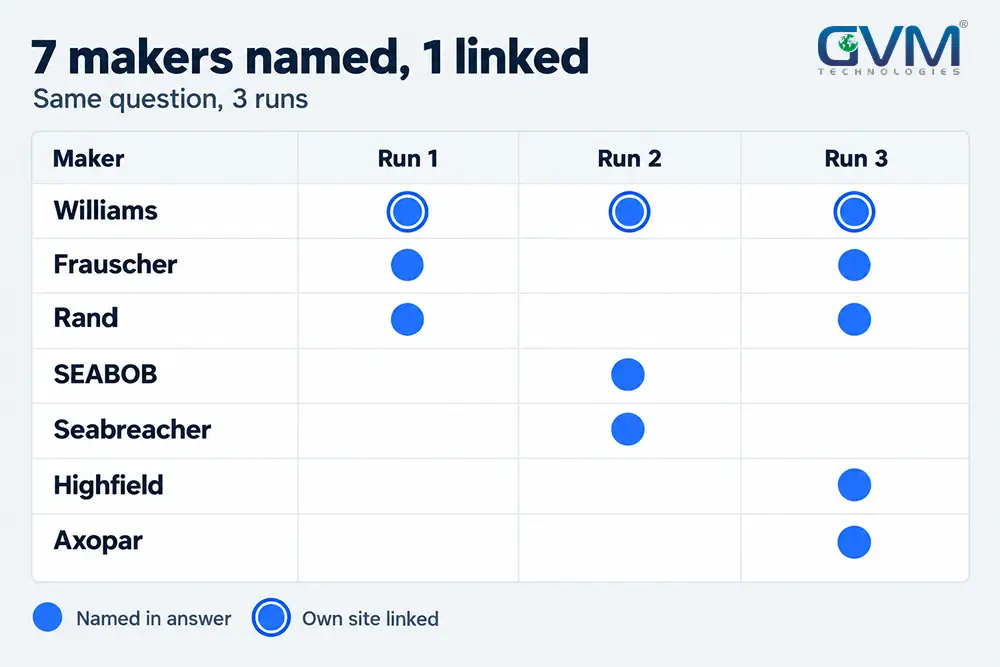
| Maker | Runs named (of 3) | Own site linked |
|---|---|---|
| Williams | 3 | Yes, in all 3 runs |
| Frauscher | 2 | No |
| Rand | 2 | No, named as over the size limit |
| SEABOB | 1 | No |
| Seabreacher | 1 | No |
| Highfield | 1 | No |
| Axopar | 1 | No, named as over the size limit |
What the 3 Runs Show
- Only 1 maker appeared in all 3 runs, and the shortlist changed each time.
- 6 of 7 makers were named without their own site being linked.
- 2 makers were named only to be ruled out, so AI brand mentions are not recommendations.
- Links went to the maker’s own pages, a distributor page, and boating media pages.
- A screenshot shared with us listed makers that none of our 3 runs named.
What the Test Does Not Show
Our reading is that the linked maker’s pages held the figures the answers kept quoting: length, power, speed, and seats. No platform documents that rule.
This is a probe, not a benchmark: 3 runs of 1 prompt on 1 platform. A dated AI-citation baseline repeats it across weeks.
Why AI Brand Mentions Rarely Turn Into Your Own Citation
A mention attaches to a name, while a citation attaches to a page the engine retrieved and could quote. That is why a name can travel without your link.
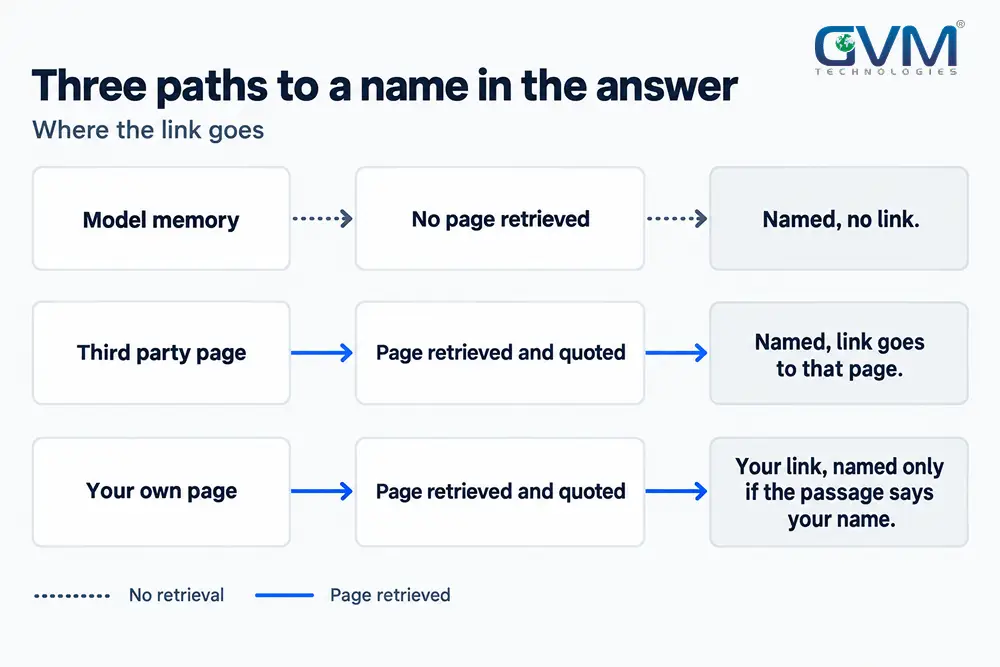
- It came from memory. An engine answering without a search can name a brand it learned in training. With no page retrieved, there is nothing to link.
- It sits on someone else’s page. A roundup or review backs the sentence, so the link goes to that publisher. The retrieval and selection layers of AI search decide which page wins.
- Your page cannot qualify. Google requires a page to be indexed and eligible for a snippet as a supporting link. Sites opted out of OAI-SearchBot are not shown in ChatGPT search answers.
- Your page backs no specific sentence. Engines link pages that support a claim, and repeating your name adds no fact. Add the fact, and the name has something to attach to.
Rule of thumb: an AI brand mention is something said about you. A citation is something an engine found on a page.
When AI Brand Mentions Help: The 3-Part Test
A mention can lead to a link when it passes 3 tests: independent, specific, and retrievable. Failing any 1 leaves you named without a link.
| Test | Pass looks like | Fail looks like |
|---|---|---|
| Independent | An editor or reviewer wrote it | You or a rival wrote it |
| Specific | It states a checkable fact about you | It says “a leading provider” |
| Retrievable | Indexed, crawlable, snippet allowed | Blocked, noindexed, behind a login |
Independent has degrees. Our test linked a distributor page, which sells the product it describes, so check who benefits before you chase a placement.
- Google’s spam policies count attempts to manipulate generative AI responses as spam.
- The same policy prohibits buying links for ranking.
- Paying for planted AI brand mentions has no documented return.
At GVM Technologies, we start with the pages that already answer your buyer questions, then check whether you appear on them. That beats outreach to pages no engine retrieves.
Anyone selling a fixed number of mentions as a result is selling a guaranteed citation, which is a red flag.
Diagnose Your AI Brand Mentions Gap With the 4-Outcome Grid
File each answer into 1 of 4 outcomes: named and linked, named only, linked only, or absent. Each outcome points to a different first fix.
| Outcome | What it means | First fix |
|---|---|---|
| Named and linked | Your name and your page both surfaced | Protect the page and log it weekly |
| Named only | The name came from memory or a third party page | Make your page quotable and crawlable |
| Linked only | Your page supplied a fact, but your name stayed out | Put the name beside the fact |
| Absent | Neither surfaced | Check crawler access, then earn independent coverage |
A common mistake we see in audits is treating “named only” as a win. The name may come from memory, so nothing you published moved it.
“Linked only” is the quiet leak: your page informs the answer while a competitor’s name gets the buyer.
GVM Technologies files every audited prompt into this grid before recommending any outreach. Run each question 3 times, and check crawler access first, because AI optimization starts with access.
How to Track AI Brand Mentions and Citations Separately
Track AI brand mentions and AI citations as 2 separate fields: your name in the text, and your page linked. Repeat each prompt 3 times, because answers change between runs.
1. Why Official Reports Cannot Count AI Brand Mentions
- Bing’s AI Performance report shows total citations, cited pages, and grounding queries.
- Search Console’s generative AI reports count impressions when a link to your page appears.
- Neither counts a name written in the answer text.
So mention counts come only from your own log. Reporting beyond citation counts shows how to present both.
2. The Prompt Log in 6 Columns
- Prompt: the exact wording, with and without your brand name.
- Platform and date: engine, signed in or out, location.
- Run: 1, 2, or 3.
- Named: pick, excluded, or listed.
- Linked: your domain, a third party, or none.
- Sources: every domain the answer cited.
Count prompts that name your brand separately. A name inside the question all but guarantees a mention, so those numbers flatter you.
3. Mistakes, Tools, Cost, and Timeline
| Mistake | Why it misleads | Do this instead |
|---|---|---|
| Counting every name as a win | Excluded names inflate the count | Tag each mention pick or excluded |
| Judging from 1 run | Our 3 runs gave 3 different shortlists | Keep the pattern across runs |
| Tracking only the company name | Engines often name the product | Log products and misspellings |
| Buying mentions | Google lists AI manipulation as spam | Earn independent coverage |
- Tools: a spreadsheet works. Paid trackers are optional; see what SEO and GEO work costs.
- Timeline: OpenAI says robots.txt changes take about 24 hours to apply. Earned coverage takes months, and no platform publishes a timeline.
- After a mention: buyers often search your name next, so analytics files the visit under branded search. Ask new leads how they found you, and add an AI option.
GVM Technologies treats the first 30 days as access and measurement work before outreach. See the first 30 days of GEO work.
FAQs
1. Do AI brand mentions help get cited at all?
They can, when they sit on independent, specific, retrievable pages. No public test shows mentions cause citations, and the link goes to the page that carries the mention.
2. Is a citation worth more than a mention?
They do different jobs. A citation gives a click path, while AI brand mentions put you on the shortlist. A citation without your name can send the buyer to a competitor.
3. Do unlinked mentions beat backlinks for AI?
No public test isolates one from the other. Google says its AI features rely on core ranking systems, so treat links and mentions as 2 inputs, not rivals.
4. Should I pay for mentions or sponsored placements?
Not to manipulate answers, because Google counts that as spam. Ask any seller the 7 questions to put to an AI SEO specialist first.
5. Why does ChatGPT name my competitor but link my page?
That is the linked only outcome. Your page supplied a fact, but the passage never named you. Put your name beside the fact, and keep naming consistent across pages.
6. Does schema or llms.txt turn a mention into a citation?
No. Google says structured data is not required for its generative AI features, and Google Search does not use llms.txt. Access and quotable facts matter more.
Conclusion
AI brand mentions and AI citations are 2 separate events, and a name alone does not earn a link. Earn independent, specific mentions on pages engines can retrieve, and make your own pages worth quoting.
- Today: run 5 buyer questions 3 times each and file every answer in the 4-outcome grid.
- This week: confirm key pages are indexed, crawlable, and snippet eligible in Google and Bing.
- This month: list the independent pages engines cite for your questions, and check whether you appear on them.
- Every quarter: rerun the log, compare outcomes, and drop any outreach that moved nothing.
Engines will keep changing what they retrieve, but a page that states a checkable fact stays easy to quote. Before hiring help, vet any GEO or SEO agency on how it measures both.
Stop Guessing Whether AI Is Naming You, Linking You, or Neither
You are named in some answers and invisible in others, and nobody can say whether your pages, your coverage, or your access is the cause. Each month of guessing hands that answer to a competitor.
In your free SEO + GEO audit, GVM Technologies checks:
- Outcomes: your buyer questions filed as named, linked, both, or absent
- Access: crawler access and Google and Bing indexing for key pages
- Sources: which independent pages engines cite instead of yours
- Passages: which sections of your pages can be quoted on their own
GVM Technologies has built SEO and generative engine optimization services together since 2012, with ISO-certified processes and named client results in insurance, real estate, and e-commerce.
Keyword stuffing in AI search is repeating a target phrase past what a reader needs, hoping an AI answer will pick the page. Generative engine optimization does not reward it.
Quick answer: yes. Google’s spam policies now cover its AI responses, and repetition gives a model nothing new to quote. Natural use of a phrase is not the target.
Key Takeaways
- Keyword stuffing in AI search is a documented risk, because Google’s spam policies cover generative AI responses.
- No platform has published that its model flags repeated phrases. The proven harm is a spam demotion, plus passages that add no facts to quote.
- Modern stuffing hides in FAQ blocks, city lists, keyword sections, and one page per query variant.
- Keywords still belong in titles, headings, and first sentences as labels, not quotas. No official density threshold exists.
- Fix a stuffed page with the 4-step Delete Test, then check Search Console and Bing Webmaster Tools.
What Is Keyword Stuffing in AI Search?
Keyword stuffing in AI search is loading a page with a target phrase or term lists to steer which pages an AI answer picks. Google defines the classic version as an attempt to manipulate rankings.
Google’s spam policies name 3 forms:
- Phone numbers listed with no added value
- Text blocks listing cities or regions a page wants to rank for
- Words or phrases repeated so often the copy sounds unnatural
Many website owners struggle because nobody agrees on a number. Google defines stuffing by manipulation and unnatural reading, not by a percentage.
A paragraph of city names is stuffing. A keyword in several headings of a recipe post is usually just structure.
Inside Google Search, the same spam rules cover classic results and AI features. The 3 targets of SEO, AEO, and GEO differ, but the definition of keyword stuffing in AI search does not.

Does Keyword Stuffing in AI Search Still Hurt You?
Yes, keyword stuffing in AI search hurts in 4 ways, with different levels of proof. Google documents a spam penalty. The effects on retrieval and passage selection follow from how AI answers work but are not published.
We asked Google AI Mode and ChatGPT whether keyword stuffing in AI search still hurts. We ran it on 2026-10-05, signed out, from the US. Both said yes.
AI Mode added that AI punishes stuffing more harshly than classic search, which no vendor documents. ChatGPT pointed to Google’s policy, the strongest source in either answer.

| Layer | What stuffing does | Proof level |
|---|---|---|
| Google spam systems | Can demote the page or trigger a manual action | Confirmed in Google’s policy |
| Retrieval | Repeated phrase may still match literal searches | Mechanism, not published |
| Passage selection | Repetition adds no fact to quote | Mechanism, not published |
| Reader trust | Stuffed copy reads as spam and gets skipped | Visible in engagement data |
1. What keyword stuffing in AI search costs under Google’s rules
Google says violating pages can rank lower or drop out of results. Automated systems and human review both find them.
The policy’s opening now says the rules also cover attempts to manipulate generative AI responses.
2. Why repetition fails at passage selection
An AI answer is built from passages retrieved for several rewritten searches. A passage that repeats a phrase but states no fact has low information density and gives the model nothing specific to quote.
In our GEO audits, a named expert quote and a checkable statistic raise citation odds. Stuffing is one of the few edits we see lower them.
3. What nobody has proven about AI and stuffing
No platform has published that its model flags repeated phrases. Claims that AI detects stuffing, or punishes it harder than Google, are assertions.
Results also change between runs, so 1 test proves little. That is why a guaranteed AI citation is a red flag.
How Keyword Stuffing in AI Search Looks in 2026
Keyword stuffing in AI search rarely repeats 1 phrase 20 times anymore. It hides in FAQ blocks, location lists, keyword sections, and near duplicate pages. Google’s policies target the intent, not the format.
The 6 modern forms of keyword stuffing in AI search
These 6 keyword stuffing examples are the ones we meet most often.
| Form | Example | Why it fails |
|---|---|---|
| Keyword section | Pipe separated term list at the bottom | Lists terms without adding information |
| FAQ stuffing | 15 questions that repeat the phrase | Answers share no new facts |
| Location list | 40 city names in a footer | Matches Google’s own example |
| Variant pages | 1 page per fan-out search | Google’s AI guide warns against it |
| Hidden “for AI” text | Copy shown to crawlers, not visitors | Breaks hidden text and cloaking rules |
| Schema stuffing | Markup for services you do not offer | Misleads and can mislabel the brand |
Google’s generative AI guide says separate content for every search variation, made to manipulate rankings, breaks its scaled content abuse policy.
Why keyword blocks on profiles backfire
Marketplace profiles show the same habit: a closing block of 25 pipe separated terms. Those platforms run their own search with unpublished rules, so Google’s policy does not govern them.
We still treat the block as a readability cost. A client reading it sees a list, not a person.
Warning: An “AI only” page or footer block is not a shortcut. Hidden text and cloaking rules cover content shown to crawlers but not people. AI optimization starts with access.
Why Stuffed Pages Still Seem to Win
Stuffed pages seem to win because ranking has many inputs. A page can rank despite repetition, thanks to age, links, and authority. Copying its repetition copies the risk without those strengths.
4 things create the illusion:
- Survivorship: You see the stuffed page that ranks, not the stuffed pages that dropped.
- Borrowed strength: A site with years of links can rank despite weak copy, so the repetition gets the credit.
- AI drafts: Language models repeat the prompt phrase, and editors rarely count it.
- Relabeled advice: “Write for chatbots” tips, tiny page fragments, and AI only pages are old stuffing under a new name.
That last pattern is the same one behind the rebrand question. Google’s guide says AI features need no special files, markup, or chunking.
At GVM Technologies, the most common audit finding is a page that ranks for its headline phrase while its repeated wording adds no new fact.
Natural Keyword Use vs Keyword Stuffing in AI Search
Keywords still work as labels that tell retrieval what a passage covers. Keyword stuffing in AI search turns labels into quotas.
Fan-out searches run shorter and more literal than the prompt, so buyer phrases belong in titles, headings, and first sentences.
Where the phrase belongs
| Place | Use the phrase? |
|---|---|
| Title tag | Once, near the front |
| H2 and H3 headings | In some, where it fits |
| First 100 words | Once, beside the answer |
| Body paragraphs | Only where the sentence needs it |
| Image alt text | On 1 image, descriptive |
| Footer or hidden blocks | No |
Why there is no safe density for keyword stuffing in AI search
Google publishes no keyword density threshold, and a “2 to 5%” range in some SEO guides traces to no Google document.
GVM Technologies keeps the main phrase near 1 use per 100 words and cuts earlier when a sentence reads forced. This article follows that rule.
Google’s guide adds that you need not chase every long-tail variant, because its systems understand synonyms. Query fan-out rewrites the searches either way.
Google’s helpful content guidance also says it has no preferred word count. Padding a page with repeats to reach a length helps no one.
How to Fix Keyword Stuffing in AI Search: The Delete Test
Fix keyword stuffing in AI search by deleting repeated phrases until every sentence adds a fact, then verifying the result. That is also how to avoid keyword stuffing next time.
The Delete Test needs 1 editing pass and no paid tool.
1. The Delete Test for keyword stuffing in AI search, in 4 steps
- Read it aloud. Mark every spot where you stumble or sound like a brochure.
- Count the phrase. Use your browser’s find tool on the exact phrase, and mark each sentence that repeats it. Check AI written drafts first.
- Delete each marked sentence. If nothing is lost, it was filler. If a fact is lost, rewrite the fact without the phrase.
- Lift 3 passages out. Each must make sense alone and hold 1 fact a reader could check.
2. A before and after example
An illustrative local business passage:
Before: “Our Austin plumber is the best Austin plumber. Call our Austin plumber for plumber services in Austin.”
After: “We repair leaks, water heaters, and slab drains across Austin. Quotes are free, and you can book online.”
The before version repeats 1 phrase 4 times and states 0 facts. The after version names 3 services and 2 terms a reader can verify.
3. How to confirm the fix worked
- Confirm crawler access to the page first, because a blocked page cannot be cited at all.
- Request reindexing in Search Console and Bing Webmaster Tools.
- Log a dated prompt set before editing, as in an AI-citation baseline.
- Rerun it weekly and report the pattern, not 1 run.
- Watch Search Console’s AI performance reports and Bing’s AI Performance view.
- If Search Console shows a manual action, fix the pages, then file a reconsideration request.
Expect weeks to months. No platform publishes a recovery timeline, and no one can promise a citation.
4. Common mistakes, tools, and cost
| Mistake | Why it fails | Do this instead |
|---|---|---|
| Swap the phrase for 5 synonyms | Passage still states no fact | Add a fact to each passage |
| Delete every keyword | Retrieval loses its labels | Keep it in title and headings |
| Chase a density number | No official target exists | Use the read aloud test |
| Judge from 1 AI run | Answers change between runs | Track the pattern weekly |
The Delete Test, Search Console, and Bing Webmaster Tools cost nothing. Paid AI visibility trackers are optional, and the serious tiers run to several hundred dollars a month. See what SEO and GEO work really costs.
GVM Technologies treats the first 30 days as technical work before content. See what the first 30 days of GEO work should cover.
FAQs
1. Is there a safe keyword density?
No official number exists. Use the read aloud test instead: if a sentence sounds forced, cut the repeat. Our own ceiling is about 1 use per 100 words.
2. Does Google’s spam policy apply to AI Overviews and AI Mode?
Yes. The policy says it applies to generative AI responses in Google Search, so attempts to manipulate those responses count as spam.
3. Is a keyword in every heading keyword stuffing in AI search?
Not by Google’s definition, which targets manipulation and unnatural repetition. Still, vary the headings so each states its own point.
4. Can AI-written content cause stuffing?
Yes. Drafts often repeat the prompt phrase. Count the exact phrase in every draft before publishing.
5. Will cleaning a stuffed page get it cited?
It removes a risk and makes passages easier to quote. No one can promise a citation, and results vary between runs.
6. Do I need an AI-only page or llms.txt?
No. Google says AI features need no special files or markup, and a page shown only to crawlers risks the cloaking rules.
Conclusion
Keyword stuffing in AI search is a documented spam risk and an undocumented model effect, and both point the same way. Write for the reader, and give each passage a fact.
- Today: count your main phrase on your top 3 pages.
- This week: run the Delete Test on any page that repeats it.
- This month: log a prompt baseline and recheck Search Console and Bing.
- Every quarter: audit new pages and AI drafts for repetition.
Before you hire help, ask 7 questions of any AI SEO specialist. The platforms will keep changing, but a page full of checkable facts stays easy to quote.
Stop Guessing Whether Keyword Stuffing in AI Search Is Holding You Back
You rewrote the page, yet AI answers still name a competitor, and nobody can say whether repetition, access, or thin facts is the cause.
In your free SEO + GEO audit, GVM Technologies checks:
- Repetition: exact phrase counts, headings, and keyword blocks per page
- Passages: which sections can be quoted on their own
- Access: crawler access and Google and Bing indexing
- Source pages: what AI answers say about your brand today
GVM Technologies has built SEO and GEO services together since 2012, with ISO-certified processes and named client results in insurance, real estate, and e-commerce.
An AI search ranking algorithm would be a published formula that orders sources for an AI-written answer, the way PageRank orders links.
Quick answer: partly. Every AI search engine has its own answer-selection layer, but only some own an index, and none has published an AI search ranking algorithm. That is why GEO builds on SEO instead of replacing it.
Key Takeaways
- “Own” means 3 different things: own index, own retrieval ranking, and own answer selection. Most claims blur them.
- Google’s AI features rely on its core ranking systems, not a separate AI search ranking algorithm. Other AI search engines mix their own crawlers with outside sources.
- Query fan-out is a rewrite step, not an AI search ranking algorithm. It explains most “AI ranks differently” complaints.
- Ranking and citation are separate wins in every AI search engine. A page can win the first and lose the second.
- Nobody outside the labs knows how selection weighs passages, so treat any claimed AI search ranking algorithm formula as marketing.
What Is an AI Search Ranking Algorithm?
An AI search ranking algorithm would be a documented system that scores and orders sources for an AI answer. No AI search engine has published one.
What exists is a pipeline called retrieval-augmented generation (RAG): the AI rewrites your question, fetches current pages, then writes from them.
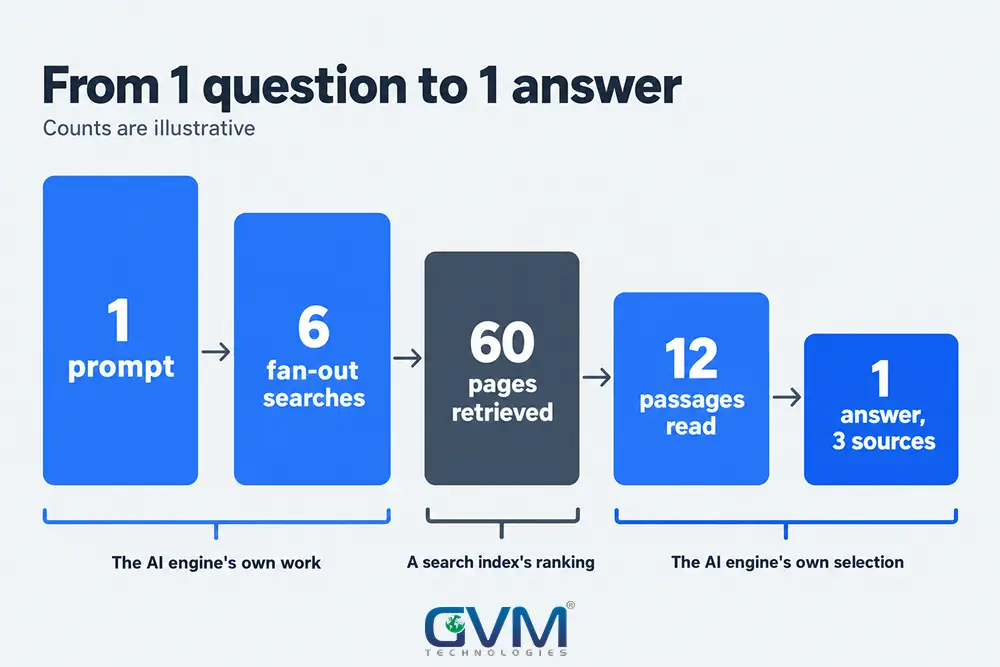
Most claims go wrong because “own” is not 1 thing. It is 3:
- Index: the engine crawls and stores the web itself.
- Retrieval ranking: the engine scores pages for each search.
- Selection layer: the model picks which passages and sources to quote.
Many website owners test 1 prompt, see a brand list unlike Google’s page 1, and decide the AI runs new ranking math. The cause is usually query fan-out.
The labels add noise. AI Optimization (AIO), GEO, AEO, and LLMO mostly name 1 goal.
Who Owns Each Layer of the AI Search Ranking Algorithm
Every AI search engine owns the selection layer. Ownership of the index and the retrieval ranking varies by platform, and no vendor publishes a full AI search ranking algorithm.
Vendors confirm less than marketers claim, so the table marks confidence as of 2026-10-01.
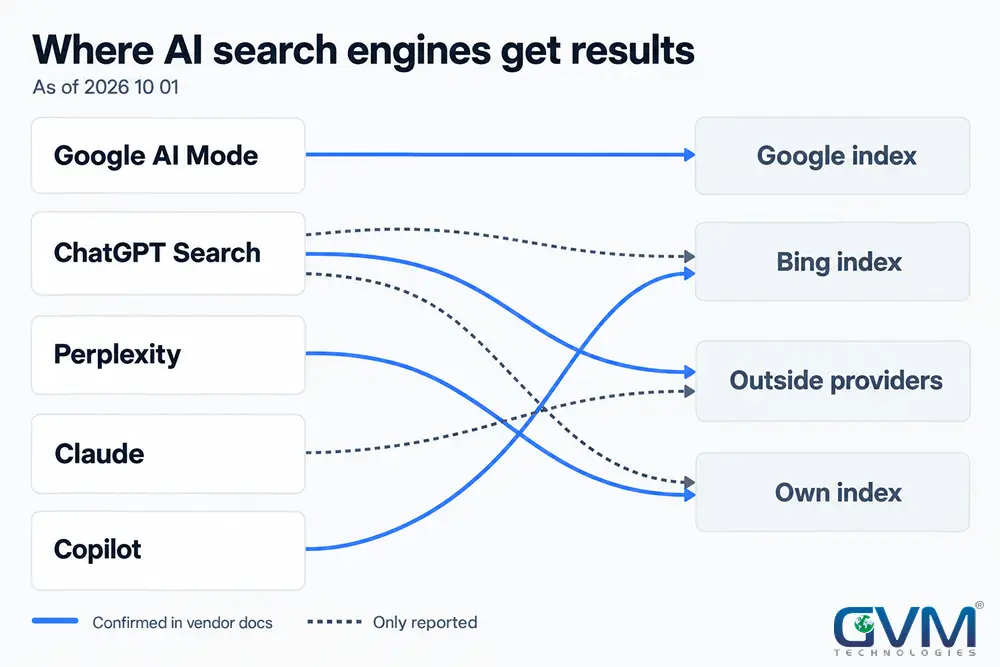
| Platform | Index | Retrieval ranking | Selection | Confidence |
|---|---|---|---|---|
| Google AI Overviews, AI Mode | Google’s | Core ranking systems | Gemini | Confirmed in Google’s docs |
| ChatGPT Search | Own index reported | Outside providers, partners | OpenAI model | Partly confirmed |
| Perplexity | Own crawler and API | Own ranked results | Perplexity model | Mostly confirmed |
| Claude | Not disclosed | Outside vendor reported | Claude | Crawlers confirmed |
| Microsoft Copilot | Bing’s | Bing ranking | GPT models | Documented in 2023 |
1. What vendors confirm about AI search ranking algorithms
- Google: AI features rely on core Search ranking systems, such as neural matching, passage ranking, RankBrain, and PageRank.
- Google, eligibility: a page must be indexed and snippet-eligible. No extra markup is required.
- OpenAI: OAI-SearchBot surfaces sites in ChatGPT search. GPTBot is a separate training crawler.
- Perplexity: PerplexityBot surfaces and links sites, and its Search API returns ranked web results.
- Anthropic: Claude-SearchBot improves search result quality. Blocking it may reduce visibility.
2. What is only reported about the AI search ranking algorithm
- ChatGPT results overlap heavily with Bing.
- ChatGPT runs a first-party retrieval index beside several outside providers. OpenAI has not confirmed this.
- Some AI products buy results from vendors that scrape Google, so a Google ranking can arrive second-hand.
- Claude’s search backend is Brave.
- Fresh pages on trusted sites can enter AI answers within days, because engines retrieve live results.
Treat each as a hypothesis. Checking Bing still costs nothing with Bing Webmaster Tools.
Whatever the backend, the work splits across the 3 targets of SEO, AEO, and GEO.
3. What AI search engines say about their ranking algorithm
We asked 4 AI search engines this exact question on 2026-10-01, signed out, from the US. All 4 answered yes.
- Google AI Mode listed 5 stages, including cross-encoder re-ranking and an authority filter. Google’s public documentation names neither.
- ChatGPT split the answer into retrieval ranking and answer selection, the 2 layers above.
- Perplexity answered yes in 2 sentences.
- Gemini listed schema markup as a ranking factor. Google says AI features need no special schema.
- Google AI Overviews did not appear for the question.
All 4 said yes because “own” is ambiguous. ChatGPT’s answer sits closest to vendor documentation.
4. What nobody outside the labs knows about the AI search ranking algorithm
- How selection weighs authority against freshness and clarity.
- How many fan-out searches each engine runs.
- Which passages the model drops, and why.
With 3 unknowns that large, a guaranteed AI citation is a red flag.
Query Fan-Out Is Not an AI Search Ranking Algorithm
Query fan-out is an AI search engine rewriting your question into several related searches before retrieval. Google describes AI Mode as issuing a multitude of queries at once.
It is a rewrite step, so it cannot be an AI search ranking algorithm. A model writes them when you ask, so they change between runs.
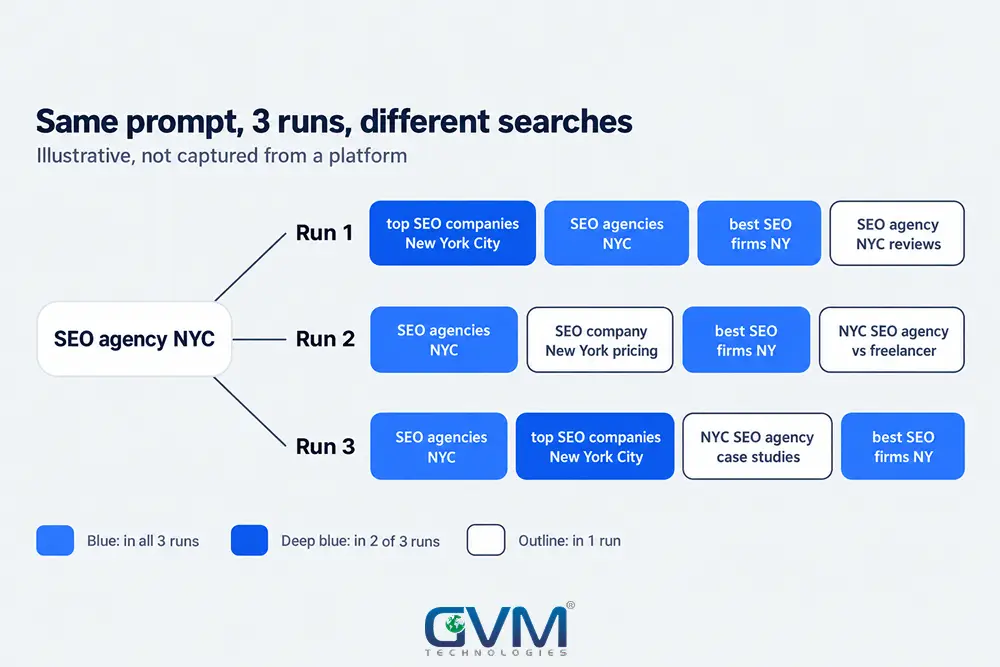
The 5 query fan-out rewrite patterns
These examples are illustrative, not captured from a platform.
| Pattern | Typed prompt | Fan-out search | Your page needs |
|---|---|---|---|
| Synonym swap | SEO agency NYC | top SEO companies New York City | Your wording variants |
| Added modifier | skincare for teen skin | best skin care 2026 | A fresh, dated answer |
| Constraint split | accountant for freelancers | accountant cost for freelancers | A section per constraint |
| Added comparison | CRM for 5 people | CRM vs spreadsheet small team | A comparison block |
| Trust check | hire a roofer | roofer reviews | Third-party reviews |
The query fan-out keyword-list trap
Sub-queries vary between runs, so a page per sub-query chases a moving target.
Group them into subtopics and cover each on 1 strong page. In our experience, 1 strong page per subtopic outlasts 6 thin variants.
Why keywords matter again in query fan-out
Prompts are conversational, but the fan-out searches are usually shorter and more literal.
Write natural answers, then put the literal phrases buyers search into your headings and first sentences.
Why a #1 Ranking Can Still Miss the AI Citation
A page can rank first for your typed query and still miss the AI answer, because the engine runs query fan-out and searches its rewrites.
The page must also be fetchable and quotable. Ranking enters you in the pool for 1 search, not all of them.
1. The 2-search test
Run each fan-out search in Google and Bing, then read the result:
- Ranks in neither: a retrieval problem. Fix coverage and authority.
- Ranks in both, never cited: a selection problem. Fix extraction and corroboration.
- Ranks in 1 only: an indexing gap. Fix the other index.
Log each result in a real AI-citation baseline so you can compare runs.
2. A worked example
Prompt: “Which accountant should a new freelancer in Austin hire for taxes?”
| Fan-out search (illustrative) | Who tends to win |
|---|---|
| freelance tax accountant Austin | Local firm pages |
| best CPA for self-employed Texas | Directories, roundups |
| accountant cost for freelancers | Pricing explainers |
| Austin accountant reviews | Review platforms |
A firm ranking #3 for the first line can be absent from the other 3. The answer tends to name sources that appear across several searches.
3. Citations can come from beyond page 1
Google says AI features identify more supporting pages, for a wider and more diverse set of links. A page ranking 14th for the typed query can win 1 sub-query and get cited.
GVM Technologies often sees the reverse gap: a page that ranks for the headline phrase and ignores the follow-up questions. A baseline across repeated runs shows which case you are in.
4. The symptom-to-layer map
| Symptom | Likely layer | First fix |
|---|---|---|
| Absent, ranking page 3 or lower | Retrieval | Cover the missing subtopics |
| Ranking top 5, never cited | Selection | Open sections with the answer |
| Cited with wrong facts | Source pages | Correct the pages retrieval returns |
| Cited on 1 AI product only | Index gap | Check Bing and crawler access |
| Cited once, gone next run | Non-determinism | Track the pattern, add corroboration |
If you see wrong facts, GVM Technologies starts with the source pages, not the AI answer.
AI Search Ranking Algorithm Myths, Checked
Both loud camps are partly wrong. “The AI search ranking algorithm has secret criteria” has no public evidence.
“AI is only Google with a chat window” ignores the selection layer and the AI search engines that run their own crawlers. The table scores 5 common claims.
| Claim | Verdict | Why |
|---|---|---|
| A secret AI search ranking algorithm replaced classic ranking | Unproven | No vendor has published one |
| AI search is just Google or Bing | Too strong | Selection is new; some run own crawlers |
| Rank #1 and you will be cited | Unreliable | Engines search rewrites, then select |
| Schema, llms.txt, or chunking gets you cited | Not required | Google says AI features need none |
| Fan-out is a fixed keyword list | Misleading | The searches change between runs |
“Unproven” is the honest label, because selection logic stays closed. That is also why people ask whether GEO is just rebranded SEO.
How to Optimize for the AI Search Ranking Algorithm
Optimize each layer of an AI search engine on its own: make pages reachable, win the fan-out searches, then make passages easy to select.
Start with access, because a blocked crawler beats every content fix. No separate budget or tool is needed to begin.
Rule of thumb: rank decides whether you are retrieved. Clarity decides whether you are quoted. Corroboration decides whether you are believed.
1. Fix access so the AI search ranking algorithm can reach you
- Index key pages in Google and Bing, and verify both.
- Allow OAI-SearchBot, Claude-SearchBot, and PerplexityBot in robots.txt.
- Check your CDN and security plugins. Some block AI crawlers by default.
- Remove nosnippet and tiny max-snippet limits from pages you want quoted.
- Keep key answers in the HTML, not behind JavaScript.
This layer is dull, checkable, and often broken. At GVM Technologies it is the first thing we test.
2. Run a query fan-out audit in 5 steps
- List 10 prompts your buyers type.
- Run each 3 times on 1 platform and note the searches shown.
- Group repeated query fan-out searches into subtopics, including buyer constraints like budget.
- Search each subtopic in Google and Bing, and record who ranks.
- Expand 1 existing page per gap. Build a new page only when none fits.
3. Audit what AI answers say about you
Grounded answers repeat what retrieval returns, including outdated or wrong pages about you.
- Run 10 prompts that name your brand.
- List every claim about pricing, services, and location.
- Trace each wrong claim to its source page, then fix or replace it.
- Keep brand and product names identical everywhere, because engines often name the product, not the company.
4. Measure the pattern, not 1 run
Run the same prompts weekly and track how often you appear, as GEO reporting beyond citation counts explains.
Google also reports AI-feature visibility in Search Console’s generative AI performance reports.
Mistakes, Timelines, and Costs
Most wasted effort comes from chasing an AI search ranking algorithm formula, judging from 1 run, and buying a tool before checking access.
Expect crawler fixes within days and authority gains over months. The first checks cost hours, not budget.
| Mistake | Why it fails | Do this instead |
|---|---|---|
| 1 page per query fan-out search | Searches change between runs | 1 strong page per subtopic |
| Blocking GPTBot to hide from search | OAI-SearchBot is separate | Set each crawler on purpose |
| Buying a visibility tool first | A score hides access gaps | Audit first, then pick tools |
- Access fixes: OpenAI says robots.txt changes take about 24 hours to reflect.
- Ranking gains: these follow normal SEO timelines, so expect weeks to months.
- Cost: Search Console and Bing Webmaster Tools are free. Paid tools are optional.
If a vendor sells you only a rank report, you are blind to 2 of the 3 layers. See the first 30 days of GEO work and SEO and GEO pricing for what a real engagement includes.
Before signing anyone, vet a GEO or SEO agency. GVM Technologies treats all 3 layers as 1 job, so SEO and GEO advice stays consistent.
FAQs
1. Do AI search engines have their own ranking algorithm?
Partly. Each has its own selection layer, but no public AI search ranking algorithm exists. Google’s AI features rely on core Search ranking systems, and other engines pair their own crawlers with outside or first-party sources.
2. Does ChatGPT use Google or Bing?
OpenAI has described outside search providers plus its own crawler. Earlier tests found heavy Bing overlap, and recent analysis reports a first-party index. The mix is shifting, so verify both indexes.
3. Is query fan-out the same as keyword research?
No. Keyword research starts from phrases people type, while query fan-out starts from searches the AI writes. Use it to find missing subtopics, not to build a page per query.
4. Can I influence an AI search ranking algorithm?
You cannot change the weights, but you can improve every input: be indexed, rank for fan-out searches, and write standalone answers.
No one can guarantee a citation, and hiring an AI SEO specialist should not change that.
5. Does an AI search ranking algorithm need schema or an llms.txt file?
Google says its AI features need no special schema, AI text files, or chunking, and ties them to helpful, people-first content. Keep schema for rich results, and treat llms.txt as optional.
Conclusion
No public AI search ranking algorithm exists, but AI search engines are not just Google with a chat box. They add a query rewrite before retrieval and a passage pick after it, and both stay closed.
The fix is a sequence, not a trick. Work through it in order:
- Today: confirm key pages are indexed in Google and Bing.
- This week: test robots.txt, your CDN, and nosnippet limits against the 4 search crawlers.
- This month: run the fan-out audit and the brand-fact audit.
- Every quarter: recheck the platform table, because vendors keep changing sources.
The sites that get cited are rarely the ones that guessed a formula. They are the ones that fixed the 3 layers while everyone else debated it.
Stop Guessing Which Layer Is Failing
You rank on Google, yet AI answers name someone else, and nobody can explain how the AI search ranking algorithm treats your site. Each month of guessing hands that answer to a competitor.
In your free SEO + GEO audit, GVM Technologies checks:
- Retrieval: indexing and crawler access across Google and Bing
- Fan-out: the buyer searches your pages miss
- Selection: whether your answers are built to be quoted
- Source pages: what AI answers say about your brand today
GVM Technologies has built SEO and generative engine optimization together since 2012, with ISO-certified processes and named client results in insurance, real estate, and e-commerce.
You leave with a clear answer on which layer to fix first.
Quick Answer: AI optimization (AIO) is the technical work that lets AI systems access, read, and correctly understand your site: crawler access, structured data, and a site architecture built for machine readers, not only human visitors.
Nothing else works until that layer holds, not content, not citations, not entity work. GEO depends on the same foundation, which is exactly why the 2 terms blur together.
You will also see “AIO” used more narrowly, for ranking specifically inside Google’s AI Overview box. Both meanings are real, and this guide covers the technical layer underneath both.
Key Takeaways
- AI optimization (AIO) means the technical work that lets AI systems access, read, and understand your site, not a content strategy or a citation-tracking dashboard.
- 3 layers decide AI optimization readiness: crawl access, rendering, and structure. A 4th, entity consistency, is where it hands off to GEO.
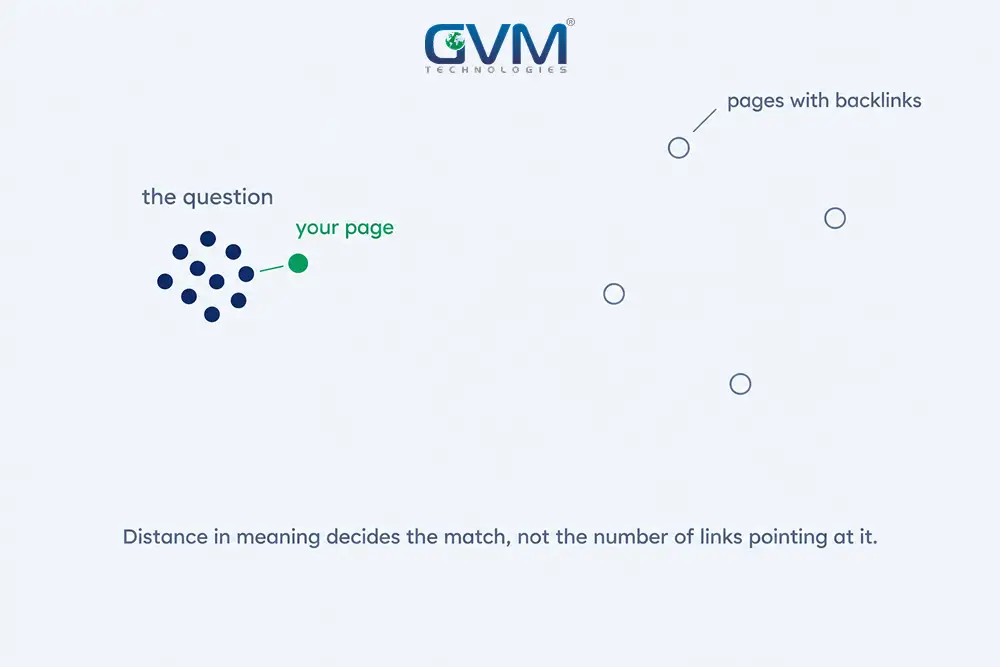
- AI systems retrieve by semantic match to the question, not by link count, so a clean, well-structured page can out-cite a heavily-linked one.
- Skipping a technical audit and going straight to content is the single most common gap we find in AI-optimization work.
- Passing the technical layer makes a page eligible for citation. It does not guarantee one, off-site signals still decide who wins.
- A guaranteed AI citation is a red flag, not a selling point, since no one controls a non-deterministic system.
What AI Optimization (AIO) Actually Means
GVM prices its own AI optimization work the way most practitioners now use the term: making a site legible to every AI system, not gaming one platform’s summary box.
The wider market has not settled on this yet, and mixing up the 2 meanings wastes budget.
The 2 meanings, side by side
| Meaning | What it targets | Who tends to use it this way |
|---|---|---|
| AI Overview Optimization | Ranking inside Google’s AI-generated summary box specifically | Vendors selling one Google-only feature |
| AI Optimization (this guide’s definition) | Crawl access, rendering, and structure, across every AI system | Practitioners, and how GVM prices its own AIO service |
This guide uses the second, broader definition throughout. If a provider pitches “AIO services,” ask which one they mean before signing anything.
AIO, AEO, and GEO in one pass
- AIO asks whether an AI system can reach, parse, and trust the page at all.
- AEO asks whether the page gets chosen as the short, direct answer.
- GEO asks whether the brand gets cited inside a longer, generated response.
The 3 overlap heavily in practice. The full GEO vs. AEO vs. SEO breakdown covers that comparison end to end. This piece stays on the layer underneath all 3.
Why the Technical Layer Comes First
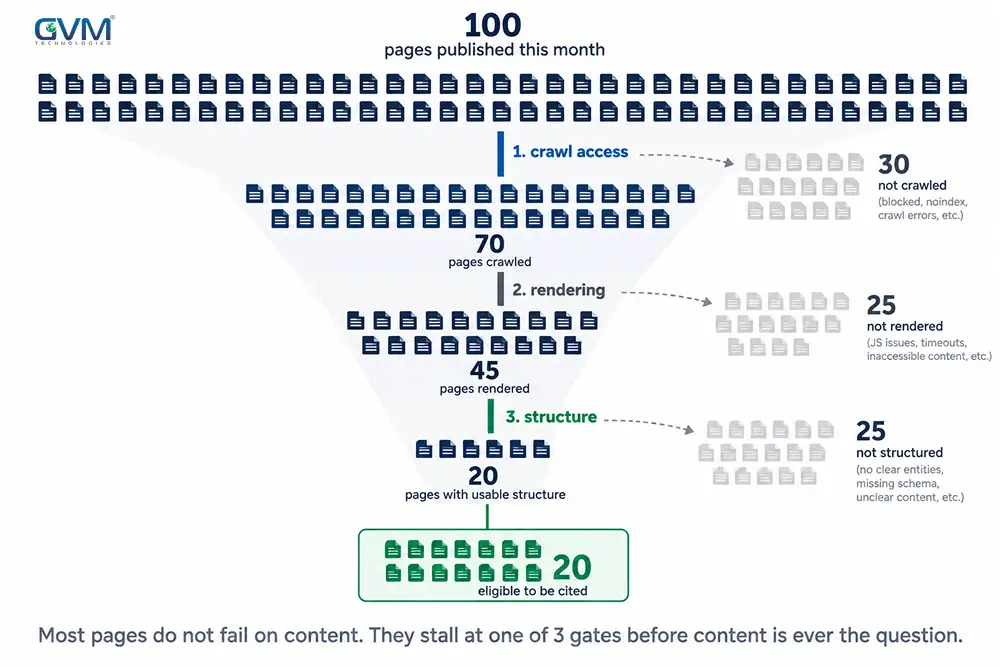
An AI system cannot cite a page it cannot fetch and read cleanly. That single fact is why AI optimization starts with 3 checkable layers, not a content brief.
| Layer | What it checks | What fails if it does not hold |
|---|---|---|
| 1. Crawl access | Can an AI crawler reach the page at all | The page is invisible, regardless of content quality |
| 2. Render and index | Does content actually load in the raw HTML | JavaScript-only content often reads as blank |
| 3. Structure and schema | Can a clean, standalone passage be lifted | Strong answers get buried and never quoted |
1. Crawl access
Robots.txt has to explicitly allow GPTBot, ClaudeBot, PerplexityBot, and Google-Extended. It is an honor-system request, not a lock, compliant crawlers respect it, but nothing technically forces a non-compliant one to.
- OpenAI alone runs 3 separate crawlers with different jobs: GPTBot trains on content, OAI-SearchBot builds ChatGPT’s live search index, and ChatGPT-User fetches a page live when someone clicks a citation.
- A site can allow search crawling while blocking training. Most AI optimization content treats “GPTBot” as the only one that matters and misses this entirely.
2. Render and index
AI systems generally read the raw HTML a page returns, not what a browser shows once JavaScript finishes running. Content that only appears after a script executes can be invisible to a crawler even though it looks complete to a visitor.
- Server-side rendering or static generation is the direct fix for any page meant to be an AI optimization priority.
- Bing indexation matters here too. A real share of what ChatGPT surfaces in search mode leans on Bing’s index, on top of its own crawler.
3. Structure and schema
AI systems pull short passages, not full pages. A passage earns reuse when its direct answer sits in the first sentence of a section and the section reads correctly on its own.
FAQPage schema still helps, but not for the reason most people assume. Google retired FAQ rich results in classic Search in May 2026, so a marked-up FAQ block no longer wins extra space on the results page.
It still gives an AI system a clean structure to parse. Treat it as an extraction aid, not a ranking tactic, and never swap it for QAPage, the schema meant for user-submitted questions.
Why Structure Beats Backlinks for AI Retrieval
Search engines and AI systems score content differently. That gap is why a lower-authority page can out-cite a bigger competitor.
Google’s ranking systems weigh backlinks and domain history heavily. AI retrieval weighs something else first: how closely your text matches the meaning of the question.
Retrieval systems convert the question and your content into numerical representations of meaning, then measure how close those sit to each other.
A clear, self-contained answer can match closely with zero backlinks. A page buried in scene-setting prose can match poorly even with a strong link profile.
| Signal | What decides a Google ranking | What decides an AI citation |
|---|---|---|
| Primary weight | Backlinks and domain authority | Semantic match to the question |
| Secondary weight | Engagement, historical trust | Passage clarity, corroboration |
| What it rewards | A well-linked page | A well-structured, standalone answer |
This is why a smaller site with tightly written answers regularly out-cites a bigger, better-linked competitor whose content was never written to be lifted out of context.
What Breaks When You Skip the Technical Layer
This is the most common pattern in an AI optimization audit that starts from zero. A site publishes strong content, adds an FAQ block, and starts tracking mentions across ChatGPT and Perplexity, then nothing moves.
- The content is rarely the actual problem.
- The crawler could not reach half the site’s key pages, or
- The pages it reached were still rendering client-side, invisible to anything that was not a browser running JavaScript.
We ran a full crawl-and-render audit before writing a single page for a commercial trucking insurance client. The technical gaps were larger than the content gaps, so crawl access came first.
The client case studies cover work built the same way, across insurance, real estate, and e-commerce.
The Technical-First AI Optimization Checklist
Work through this order before spending on content, schema wording, or a citation-tracking tool.
- Confirm robots.txt explicitly allows GPTBot, ClaudeBot, PerplexityBot, and Google-Extended.
- Load your top pages with JavaScript disabled and confirm real content still appears.
- Verify indexing in Bing Webmaster Tools, not only Google Search Console.
- Check Core Web Vitals against Google’s thresholds: LCP under 2.5 seconds, INP under 200 milliseconds, CLS under 0.1, at the 75th percentile.
- Confirm each section opens with a direct answer in its first sentence.
- Use FAQPage schema only for questions your own site wrote, never for user-submitted content.
- Match your business name, description, and facts across your site, listings, and reviews.
- Skip
llms.txtas a fix on its own. Current evidence shows no measurable citation effect from the file alone. - Re-run this checklist after any migration or redesign, since rendering can silently break during a rebuild.
Necessary, Not Sufficient: Where AIO Hands Off to GEO
Passing all 3 technical layers makes a page eligible to be cited. It does not make citation automatic.
Before repeating a claim about a business, an AI system checks whether the rest of the web agrees. That entity-consistency check is where GVM’s own service breakdown shifts from AI optimization work into GEO work.
- Your name, description, and core facts should read identically across your site, listings, and reviews.
- Recency outweighs volume. We have seen a business with hundreds of older reviews passed over for a competitor with a smaller, more recent set.
- A brand-new site can be technically flawless and still get skipped for an established competitor, simply because it has no off-site footprint yet to check against.
That gap closes with entity and off-site work, not more technical fixes on a site that already passes the audit.
How to Tell If an “AIO” Offer Skips the Technical Work
The market for “AI optimization” services is crowded, and quality varies widely.
A pitch that opens with a promised visibility score, before ever mentioning robots.txt, rendering, or Bing indexation, has usually skipped the layer that decides whether the rest of the work can succeed.
- What did you check first? A real audit names robots.txt, rendering, and indexation by name, not just “AI visibility.”
- What changes if my site is client-side-rendered? A provider who has not asked this has not actually audited a modern site.
- How will you prove the fix worked? A before-and-after crawl test beats a proprietary score you cannot verify yourself.
A guaranteed AI citation or ranking is a red flag, not a skill signal, since nobody controls what a non-deterministic system cites on a given run.
See our full agency due-diligence guide, or these 7 questions for hiring an AI SEO specialist, before you sign anything.
See exactly which layer is holding you back. GVM breaks its own AI optimization work into the same 3 checks this guide covers, priced line by line on our SEO, AEO, AIO, and GEO pricing page.
Book a free SEO and GEO audit for a straight read on your site before spending on anything else.
How Long the Technical Layer Takes to Fix
Robots.txt corrections and Bing submission can take effect within days. Rendering fixes depend on the build: a configuration change on an already-capable platform can ship in a week, a full move to server-side rendering takes several weeks.
Content and off-site entity work compounds over 2 to 4 months. Fixing the technical layer first is the fastest way to learn whether an AI system can see your site at all, before a much larger content budget gets spent chasing it.
FAQs
1. What does AIO stand for?
AIO stands for AI Optimization, the technical work that lets AI systems access, read, and understand a site. Some providers use it more narrowly, for ranking inside Google’s AI Overview box specifically, so confirm which meaning is meant before hiring for it.
2. Is AIO the same as AI Overview Optimization?
Not exactly. AI Overview Optimization targets one Google feature. AI optimization, as used here, covers crawl access, rendering, and structure across every AI system, including ChatGPT, Perplexity, and Google’s AI Overviews and AI Mode.
3. Is AIO the same as GEO or AEO?
They overlap but target different things. AIO is the readiness layer underneath both: can an AI system reach, parse, and trust the site at all. AEO targets being the short, direct answer. GEO targets being cited inside a longer response.
4. Why does technical SEO come before AIO content work?
An AI system cannot cite a page it cannot fetch and render cleanly. Crawl access and indexing gate everything built on top of them, including content, schema wording, and off-site mentions.
5. What technical fixes matter most for AI optimization?
In order: confirm robots.txt allows the major AI crawlers, verify content renders in raw HTML rather than only after JavaScript runs, confirm Bing indexation alongside Google’s, and keep business facts consistent everywhere they appear.
6. Do I need to rebuild my website for AIO?
Usually not. Most sites need targeted fixes: a robots.txt correction, a rendering fix for key pages, and consistency cleanup across listings. A full rebuild only applies when the whole site is client-side-rendered with no server-side fallback.
7. Can an agency guarantee my AI optimization results?
No. AI-generated answers are non-deterministic, meaning the same prompt can cite a different source on a different run of the same platform. A provider can fix the technical layer, but nobody controls what gets cited on a given run.
Conclusion
AI optimization is not one tactic, and it is not whatever a given provider decides to sell under that name. It comes down to 3 checkable layers, crawl access, rendering, and structure, plus the entity work that hands off to GEO once those 3 hold.
Skip that order and content work becomes a bet on a foundation nobody checked. Fix it first, and everything built afterward, content, schema, entity work, finally has a system that can actually see it.
GVM Technologies checks all 3 layers before recommending a single new page, priced the same way on its own SEO, AEO, AIO, and GEO pricing page.
One accountable team since 2012, ISO-certified, with named client work in insurance, real estate, and e-commerce. Get a free audit and see exactly where your own technical layer stands.
You signed with a GEO agency 3 weeks ago, and nothing looks different yet. No new pages, no ranking movement, no citation screenshot.
Quick answer: A real first 30 days with a GEO agency is mostly technical, not visible.
You should get clean account access, a dated AI-citation baseline, a full technical audit, and a written month-2 plan, before content publishes at scale.
Key Takeaways
- If month 1 is 100% content with no technical audit, that’s a checkable gap, not a style choice.
- You should leave month 1 with a dated AI-visibility baseline, not a promise.
- AI platforms are non-deterministic: the same prompt can cite a different source on 2 separate runs, so ranking or citation movement in month 1 is rare, and expected.
- A real day-30 report names specific fixes and a specific baseline. A vague one names activity with no artifacts.
- Part of a real month 1 is confirming AI search actually touches your buyers, before scaling content around it.
- Server-log checks and a dedicated AI-referral analytics view are 2 verification steps almost no GEO pitch mentions.
Why the First 30 Days Looks Slower Than It Should
A GEO engagement is really 3 jobs under 1 label: getting technically ready to be crawled, getting present where AI models pull answers from, and measuring both honestly. None of those 3 produce a visible result inside 30 days.
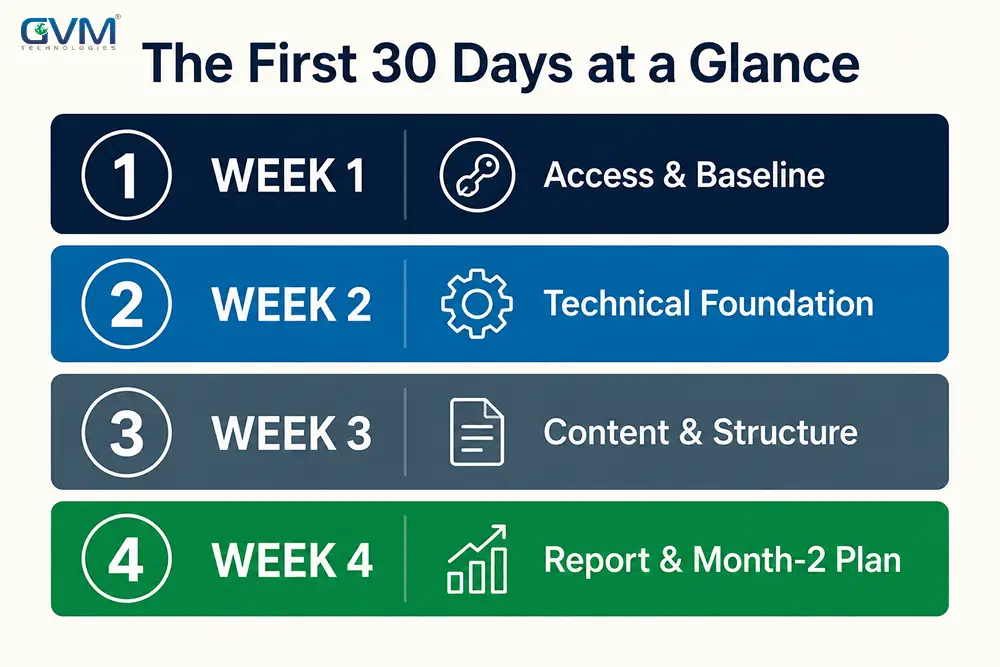
The reason is mechanical, not a delay:
- AI answers are non-deterministic. The same question, asked twice, can return a different cited source. One “we got cited!” screenshot is noise, not a result.
- A baseline has to exist first. You can’t claim visibility increased if no one recorded the starting point.
- Content built on an unverified technical layer inherits that layer’s gaps.
Note: We show clients a real, dated baseline before we bill for a single hour of ongoing work. Without one, neither side can honestly tell later whether anything moved.
Week 1: Access, Relevance, and the First Real Baseline
Week 1 covers 4 things, none of them content: clean account access, an industry-relevance check, a platform-priority decision, and the first dated AI-citation baseline.
1. Account and tool access, done cleanly
You keep ownership of your Search Console, Business Profile, and CMS access. The agency gets granted access, never the reverse. An agency insisting on its own login is a contract problem worth catching in week 1.
2. Confirming AI search actually matters for this business
Some categories, especially ones with an older buyer base, see very little real query volume through ChatGPT or Perplexity yet. A real week 1 checks this honestly before a full content plan gets built around chasing it.
3. Picking 1 platform to prioritize first
ChatGPT, Perplexity, and Google’s AI Overviews pull from different sources, so trying to move all of them equally in month 1 usually moves none of them.
- A technical B2B audience often shows up on ChatGPT and Perplexity first.
- A local or consumer audience often shows up on Google’s AI surfaces first.
4. Recording the first dated AI-visibility baseline
This is the step most GEO pitches skip. A real baseline needs:
- 15-25 real buyer questions, phrased the way a customer would ask them.
- Those exact questions run across the platform chosen above.
- Which source got cited for each, recorded plainly, with the date.
- The same list run again on a schedule, so movement is a trend, not a screenshot.
Red flag: If an agency skips to “we’ll start publishing this week,” ask where the baseline is.
Week 2: The Technical Foundation, Before Any Content Decision
Week 2 is invisible on purpose: crawlability, Bing indexation, schema, entity consistency, and an analytics view for AI-referred traffic. All of it decides whether week-3 content gets a fair chance.
1. Crawlability, and the crawler distinction most agencies skip
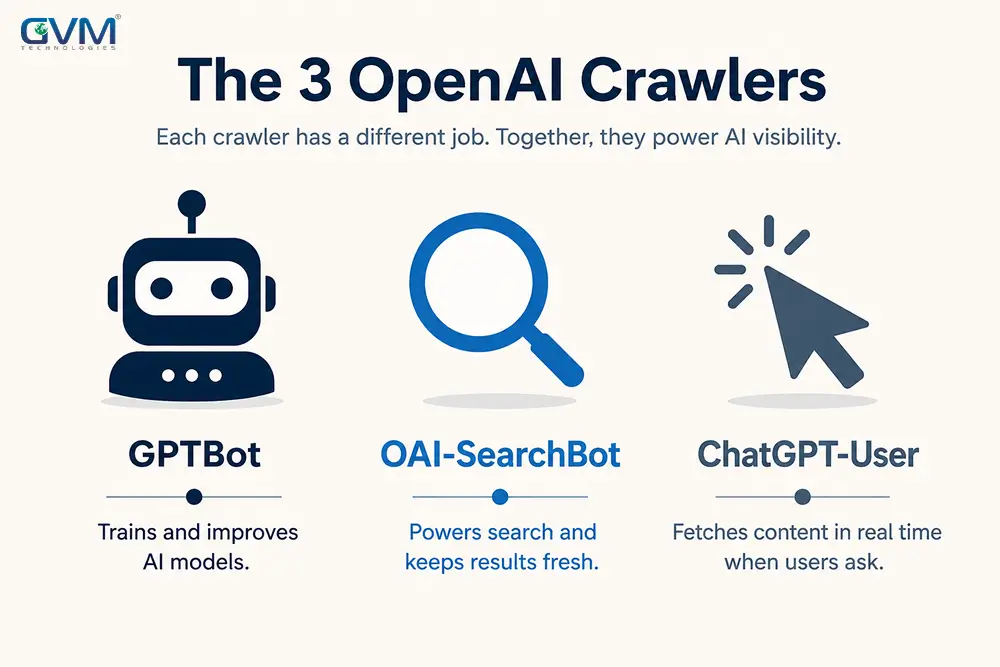
robots.txt is a voluntary, honor-system directive, not a lock. Most GEO pitches treat “GPTBot” as the only OpenAI crawler that matters.
There are 3:
| Crawler | What it does | Common mistake |
|---|---|---|
| GPTBot | Trains OpenAI’s models | Blocking it removes training visibility |
| OAI-SearchBot | Builds ChatGPT’s live search index | Blocking it removes ChatGPT search citations |
| ChatGPT-User | Fetches a page live on citation click | Rarely blocked by accident |
2. Bing indexation, checked and submitted
A meaningful share of what ChatGPT surfaces in search mode leans on Bing’s index, not Google’s. We check and submit every client’s sitemap to Bing Webmaster Tools in week 2, standard.
3. Schema and entity consistency, corrected
Structured data tells AI systems explicitly what a page is. FAQPage schema no longer wins a Google rich-result snippet, but a clean, self-contained Q&A section stays reliably extractable for an AI-generated answer.
If a brand’s description varies across its site and listings, an AI system struggles to build 1 confident picture of who that brand is.
4. Analytics and rendering, checked
We build a dedicated “AI assistants” channel grouping into every client’s analytics setup, so AI-referred traffic stops hiding inside “Direct.”
We also check for client-side rendering. Content that only appears after JavaScript executes can be invisible to an AI crawler, even when it looks fine to a human visitor.
Tip: Ask specifically whether the agency checks rendering separately. A standard SEO crawl often misses it.
Week 3: Turning the Baseline Into Content and Structure Work
Week 3 starts with restructuring existing pages, not writing from zero. The week-1 baseline becomes a question map, and a method called objection removal shapes what gets written first.
1. Building the question map from the baseline
The baseline already shows the gaps: which buyer questions got no citation, and which surfaced a competitor instead. That gap list drives content decisions, not a generic keyword-tool export.
2. Restructuring existing pages before writing new ones
A page ranking on Google but never pulled into an AI answer is usually a structure problem. AI crawlers extract only the first 25-30 KB of a page, roughly the opening few hundred words, so a buried answer is effectively invisible.
3. The objection-removal method
Ask the AI platform directly what it says is weak or unclear about the business, using the exact baseline questions. Then build content that answers that specific objection, not generic marketing copy.
Note: Removing a named objection consistently moves the needle more than adding another generic page on the same topic.
4. What gets written first
The highest-value keyword is usually the wrong first target, since it’s also the most competitive. The narrow buyer questions with zero citation make a cleaner proof point.
Week 4: The Day-30 Report, and What It Should Show
A real day-30 report contains a dated baseline, technical fixes, the first restructured content, and a written month-2 plan. It should not contain a ranking chart claiming meaningful movement.
1. What a legitimate day-30 report contains
| Report section | What it should show |
|---|---|
| Baseline | The exact prompt set, platforms tested, sources cited before work began |
| Technical audit | Crawlability, Bing indexation, schema, rendering findings |
| Content shipped | Specific pages restructured, tied to specific baseline gaps |
| Month-2 plan | What’s prioritized next, and why |
2. Why you probably won’t see movement yet
- 30-60 days: technical fixes and initial content go live.
- 60-90 days: the first real citation signals tend to appear.
An agency claiming a dramatic increase inside 30 days is reporting 1 lucky run as a trend.
3. What changes going into month 2
A server-log spot check (looking for GPTBot, OAI-SearchBot, and PerplexityBot requests) confirms crawlers actually visited, not just that a prompt cited the page.
Month 2 then shifts toward heavier content, off-site citation work, and the first repeat baseline run.
Green flag: A report that says plainly “here’s the baseline, here’s what we fixed, here’s what’s next” beats an upward chart with no baseline behind it.
The Day-30 Deliverables Checklist
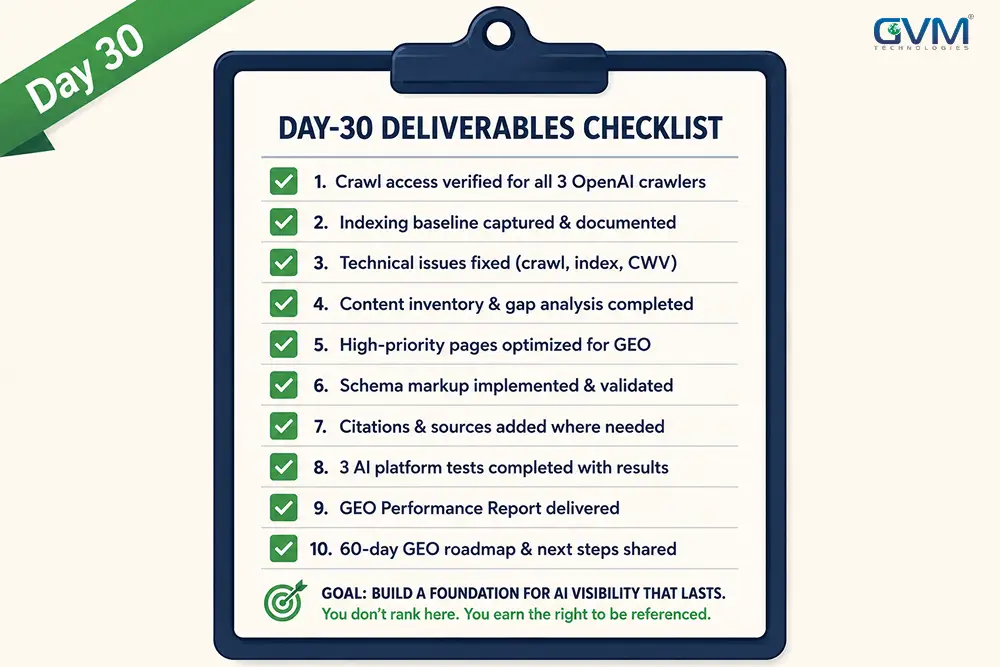
You still own your Search Console, Business Profile, and CMS access
A dated baseline exists across multiple named AI platforms
A crawlability audit covers all 3 OpenAI crawlers
Bing Webmaster Tools indexation was checked and submitted
Schema was audited or implemented
Entity consistency was checked across the site and listings
A dedicated AI-referral view was added to analytics
A rendering check ran specifically for AI-crawler visibility
At least 1 page was restructured around a direct, standalone answer
A written month-2 plan exists, tied to what month 1 found
Red Flags Versus Green Flags in Month 1
| Weak first 30 days | Real first 30 days |
|---|---|
| 100% content from day 1, no technical audit | Technical audit and baseline come first |
| No baseline, or 1 single prompt run | A repeatable, multi-platform baseline, dated |
| A citation chart with no baseline attached | A report stating plainly what didn’t move yet |
| Vague language: “optimized for AI visibility” | Specific items: which crawler, which schema, which page |
| A guaranteed citation for a fixed date | An honest explanation of why no one can guarantee that |
Most of month 1’s technical work (crawlability, structure, indexation) is what a competent SEO onboarding already covers. The AI-specific layer, a multi-platform baseline and the 3-crawler distinction, is what a relabeled SEO retainer usually skips.
How GVM Technologies Structures the First 30 Days
Our first 30 days on any GEO engagement are mostly technical, on purpose: crawlability, Bing indexation, schema, and entity consistency come before we write a new page.
Before we bill for ongoing work, we build a real, dated baseline for that specific client, and show it before work starts, not after.
We’re transparent that a guaranteed outcome in month 1 is something we won’t offer. Our published SEO, AEO, AIO, and GEO pricing reflects a real, scoped engagement.
Our case studies, including a real-estate engagement with Trem Group, show this same foundation-first structure. We’ve run engagements this way since 2012, across a Miami and Surat team.
FAQs
1. What should I actually see by day 30 with a GEO agency?
A dated baseline, a completed technical audit, at least 1 restructured page, and a written month-2 plan, not a dramatic ranking chart.
2. Why don’t I see movement in the first 30 days?
AI answers are non-deterministic, and a baseline has to exist before “movement” can be measured at all.
3. Is it normal for month 1 to be mostly technical, not content?
Yes. Content published before crawlability and schema are confirmed working inherits an unverified foundation.
4. What if my industry doesn’t get many AI search questions yet?
A real month 1 checks this honestly before a content plan gets built around chasing AI citations.
5. How is GEO onboarding different from a normal SEO agency’s first month?
The technical layer is broader (AI-specific crawler checks, Bing indexation) and measurement is a repeatable, multi-platform citation baseline, not just a rank tracker.
6. What’s the biggest red flag in a GEO agency’s first-30-days plan?
100% content with no technical audit or baseline. A close second: any guaranteed outcome for a fixed date.
7. Should I expect a full report by day 30, or just a baseline?
Both. A baseline plus a technical audit plus at least 1 shipped content change is a reasonable day-30 deliverable.
8. What happens after the first 30 days?
Month 2 shifts toward heavier content, off-site citation work, and the first repeat baseline run, so movement becomes a real trend.
Conclusion
A real first 30 days is quiet, technical, and mostly invisible. Access handed over cleanly, a dated baseline, a technical audit, and a written month-2 plan should exist by day 30.
A ranking chart with no baseline behind it shouldn’t.
Book a Free Strategy Call and we’ll walk through exactly what your own first 30 days should include, before you sign anything.
Quick answer: No agency can honestly guarantee a Google ranking or an AI citation.
Both are moving targets: Google’s ranking signals shift constantly, and AI Overviews, ChatGPT, and Perplexity rebuild each answer from scratch on every run.
A guarantee is either a misunderstanding of that mechanism, or a closing tactic dressed up as confidence.
Key Takeaways
- Google’s own SEO Starter Guide warns businesses to distrust any SEO who guarantees rankings, since no outside party controls the algorithm.
- AI citation guarantees fail for a related reason: retrieval-based answers are non-deterministic, so the same question can surface a different source on two separate runs.
- The mechanism behind a hallucinated AI citation and a “guaranteed” AI citation is the same one, and academic publishing is already living with the fallout.
- A “first page in 90 days or you don’t pay” pitch is a real, recurring market pattern. The guarantee itself is the red flag, not the outcome.
- A credible agency swaps the guarantee for a dated baseline, published pricing, and a plain explanation of the mechanism.
Why “Guaranteed” Means Something Different in 2026
Search split into two surfaces with different rules. A page can rank #1 on Google and still be invisible when the same person asks ChatGPT or AI Overviews the identical question.
What Changed Between a Guaranteed Ranking and a Guaranteed Citation
The classic pitch is decades old: pay a flat fee, get a #1 Google ranking for a keyword nobody searches.
The 2026 version swaps the target to an AI citation, a mention in AI Mode, or a self-scored “visibility number.” The mechanism behind the promise hasn’t gotten more honest. It just changed its acronym.
The Same Sales Tactic, New Acronym
We consistently see this pattern in GEO audits: an agency that couldn’t guarantee a Google ranking 5 years ago now guarantees an AI citation, using language too vague for either side to prove broken.
- A specific claim (“ranked #1 for your business name”) is checkable and hard to fake.
- A vague claim (“improved AI visibility”) is neither, on purpose.
Red-flag pattern: a guarantee that only becomes specific once you push back was built that way.
The Mechanism: Why No One Can Honestly Guarantee an AI Citation
This is the part most agency-vetting content skips, and it’s the real reason a guarantee fails.
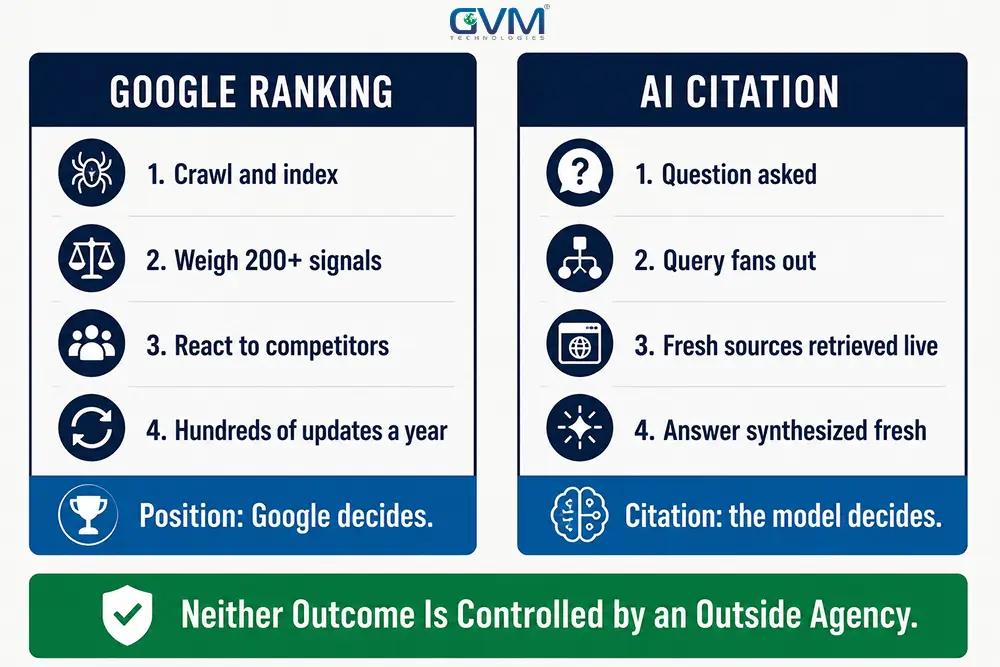
1. AI Answers Are Rebuilt for Every Question
Most AI engines don’t hold a fixed answer in memory. Each question triggers a fresh retrieval process:
- The question fans out into several related searches (a query fan-out).
- Those searches run against a live index.
- Fresh sources come back, sometimes different every run.
- The system generates an answer from whatever it retrieved that time.
Google’s own AI optimization guide confirms AI Overviews and AI Mode run on Google’s core Search systems, not a separate algorithm. An agency can influence the odds of retrieval. It can’t fix the outcome of a process that rebuilds itself every time.
2. Non-Determinism: One Prompt, Two Different Answers
Run the identical prompt against the same AI platform twice, and you can get two different cited sources. That’s not a glitch in one tool. It’s how retrieval-and-synthesis systems behave.
- The pool of retrieved sources can shift between runs.
- The weighting given to each source can shift too.
- The final answer is generated fresh each time, not pulled from a locked answer key.
A single prompt run is a snapshot, not a measurement. Reporting AI visibility as one fixed number from one run isn’t honest reporting.
3. The Shared Root Cause Behind Hallucinated Citations and Guaranteed Ones
Here’s the connection most vetting guides miss. The same behavior that makes an AI model invent a fake source (a hallucinated citation) is the reason no one can guarantee a real one gets picked.
Generative systems predict the most statistically plausible output for that specific run. Most of the time, that’s an accurate citation. Sometimes it’s one that was never real.
Both outcomes come from the same design, a probabilistic system, not a locked answer key. Promising a guaranteed citation means promising to control a process no agency operates.
Image 1 sits here: a side-by-side mechanism diagram (see the Image & Thumbnail Concepts section for the full description).
The Academic Citation Crisis Proves This Mechanism Is Already Breaking Trust
Most vetting content treats “AI citations are unreliable” as a marketing claim. It’s already a documented, career-affecting problem in academic publishing.
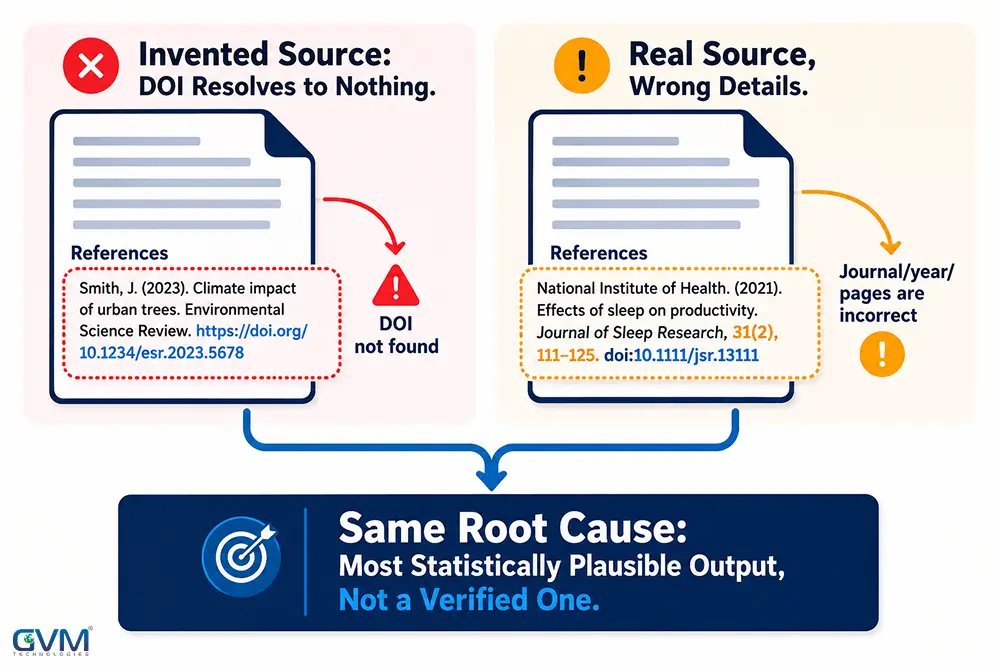
Two Failure Modes: Invented Citations vs. Misattributed Real Ones
Researchers leaning on AI for literature reviews hit two distinct problems, and conflating them hides how deep this runs.
| Failure mode | What happens | Why it’s dangerous |
|---|---|---|
| Fully invented citation | The model generates a plausible author, journal, and DOI for a paper that was never written | The DOI resolves to nothing, and the “author” barely works in that field |
| Misattributed real citation | A real paper gets cited, but the sample size, population, or conclusion is wrong | Harder to catch, since the source checks out at a glance |
We treat both as one failure, not two bugs. A system optimizing for plausible output doesn’t distinguish accurate from wrong.
What Journals and Reviewers Are Already Doing About It
Reviewers now treat a fabricated citation as disqualifying, not correctable. Manuscripts with invented references get rejected outright, and repeat offenders face submission bans.
A field built entirely on citation accuracy still can’t fully trust AI references without verification. A guaranteed-citation pitch promises more certainty than researchers grant the same technology.
Why Guaranteed Google Rankings Never Worked Either
The AI citation guarantee is new. The pattern underneath it is not.
Google’s Own Documentation Warns Against This Exact Promise
Google’s SEO Starter Guide tells site owners to be wary of any SEO provider claiming to guarantee a ranking, since no outside party controls Google’s ranking systems. That’s the platform itself telling buyers what to distrust.
What a Ranking Guarantee Usually Hides
A guaranteed #1 ranking works in exactly one scenario: the keyword gets searched by almost nobody.
| What the guarantee promises | What usually makes it “work” |
|---|---|
| “#1 ranking guaranteed” | A near-zero-search-volume keyword that was never the real target |
| “First page in 30 days” | Bought backlinks or link schemes carrying real penalty risk |
| “Guaranteed traffic increase” | Traffic from the wrong audience, with no tie to leads or revenue |
| “Money back if we don’t rank you” | A refund clause conditional on terms the agency controls |
We’ve watched this play out for years: bought links resold at a markup, alongside fabricated reviews, both sold under a “guaranteed results” pitch. The guarantee got satisfied on paper. The business inherited penalty risk instead of revenue.
The Guarantee Red-Flag Language Matrix
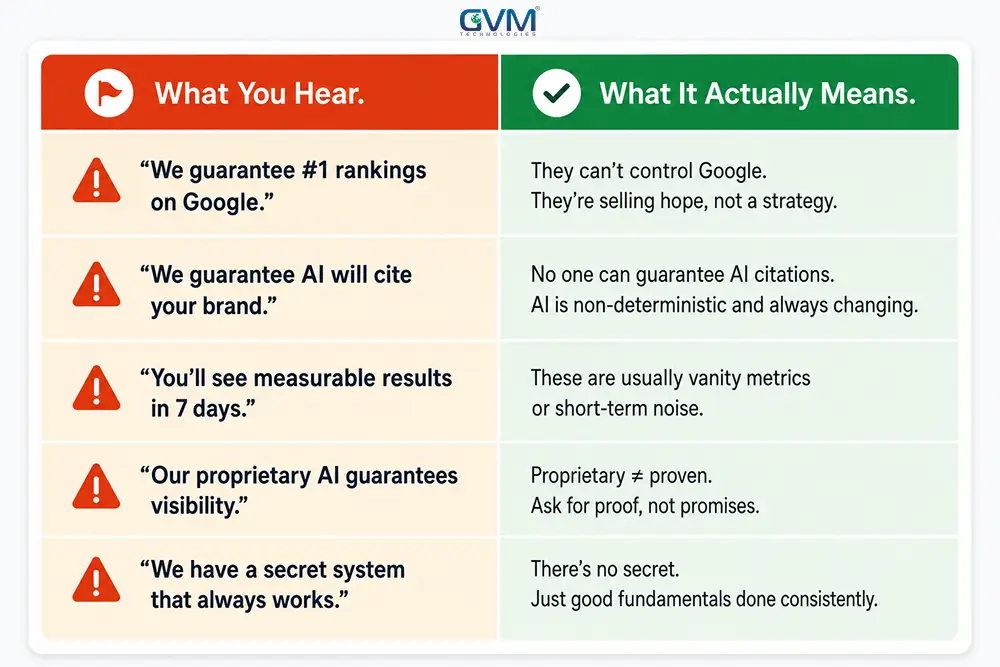
Score any pitch against this table before signing anything.
| Phrase you hear | What it actually means | What a credible agency says instead |
|---|---|---|
| “Guaranteed #1 ranking” | An unwinnable keyword, or black-hat tactics with penalty risk | A realistic ranking range based on current competition |
| “Guaranteed AI citation” | An unverifiable claim, since AI answers are non-deterministic by design | Citation trends tracked across platforms over time |
| “First page in 30 days or you don’t pay” | A deposit-plus-retainer structure, or a near-worthless keyword | Meaningful movement typically takes 4-9 months, explained plainly |
| “Guaranteed AI visibility score” | A self-scored metric with no independent way to verify it | The exact prompt set tested, open to the client’s own additions |
| “We’ll get you cited by ChatGPT” (no other platform named) | A single-platform claim sold as full AI-search coverage | ChatGPT, Perplexity, AI Overviews, and Gemini tracked separately |
| “Guaranteed ROI” | An outcome tied to your sales process, which the agency doesn’t control | Reporting tied to leads and revenue where tracking allows |
Phrases That Should End the Call Immediately
Any “guaranteed,” “promised,” or “locked-in” claim tied to a ranking, a citation count, or a fixed timeline is a hard stop, no exceptions.
Softer Guarantees That Are Still a Red Flag
- A “satisfaction guarantee” with no defined, measurable trigger.
- A deposit-plus-retainer structure where the deposit quietly covers the agency’s cost regardless of outcome.
- A guarantee that only applies to a keyword list the agency picked, with no client input.
The pattern to notice: every credible answer in the table above swaps a fixed promise for a real measurement method. That single swap is the clearest signal separating a real agency from one that’s just better at sales calls.
What a Credible SEO or GEO Agency Says Instead
Removing the guarantee doesn’t remove accountability. It replaces a promise with something you can check yourself.
1. A Real, Dated Baseline Before Any Work Starts
We build a dated baseline before billing a single hour: a fixed set of buyer questions, run across the AI platforms that matter, with cited sources recorded plainly. Without it, neither side can honestly tell later if anything moved.
2. The “What, Why, How” Transparency Test
A quick filter for any proposal: can the agency state what it’s doing, why, and how it’s expected to move this specific business, not a generic benefit?
- What: the named deliverable (a schema fix, a content rewrite, an entity-consistency pass).
- Why: the mechanism it affects (crawlability, retrieval odds, entity clarity).
- How: the honest, expected effect on this business’s real numbers.
3. Ownership and Contract Checks That Matter More Than a Promise
- You should own your Google Search Console property, ad accounts, and Google Business Profile from day one, with the agency granted access, never the reverse.
- Exit terms should be written down before you sign, not discovered the day you try to leave.
- Pricing should be visible before a sales call, not gated behind one. Our own pricing page publishes real weekly rates across 5 tiers for exactly this reason.
For the complete due-diligence process, our GEO and SEO agency vetting checklist covers all four evaluation layers with 18 questions and a 100-point scorecard.
If You’ve Already Signed a Contract With a Guarantee Clause
A guarantee clause on paper doesn’t mean the relationship is a loss. It means your next conversation needs to be sharper.
Questions to Ask at Your Next Check-In
- What, specifically, changed last month because of the work, not market movement?
- Which AI platforms are being tracked, by name, not “AI platforms” as a category?
- Who defines the prompt set or keyword list this account is measured against?
- Do we own our Search Console, ad accounts, and Google Business Profile outright?
- What are the exact, written costs to end this contract today?
When to Renegotiate vs. Walk Away
| Situation | Reasonable next step |
|---|---|
| The guarantee was vague from the start, and results are also vague | Renegotiate toward a measurable baseline before more spend |
| You don’t own your Search Console, ad accounts, or website platform | Prioritize regaining ownership immediately |
| The agency gets defensive when asked how citation tracking works | Treat that reaction as the real answer, start interviewing replacements |
| Real, itemized deliverables are being produced despite the guarantee | Ask for the guarantee clause to be replaced with a measurement plan |
A guaranteed outcome that never materialized is foreseeable, not a fluke. The fix is an agency willing to show its method, not a bigger promise.
How GVM Technologies Applies This Standard
Test this against GVM Technologies instead of taking it on faith.
What We Publish Instead of Promising
- We will never guarantee a ranking or an AI citation, in any form, because it reflects how these systems work, not a policy we’d reverse for the right client.
- SEO, AEO, AIO, and GEO are built by one team, published across 5 transparent tiers on our pricing page.
- 13+ years operating since 2012, ISO 27001:2022, 20000-1:2018, and 9001:2015 certified, a checkable record most guarantee-first agencies can’t show.
Real Case Studies You Can Verify Independently
Named client work, not anonymized results, sits on our case-study hub, including Alvix Insurance Group and GlobalRose. Compare us against a GEO agency in the US or a GEO service agency in India, then bring the full vetting checklist to your next call with us.
FAQs
1. Can any SEO or GEO agency legally guarantee a #1 ranking or an AI citation?
No agency controls Google’s ranking algorithm or an AI platform’s retrieval process. Google’s own SEO Starter Guide explicitly warns businesses to distrust any SEO who guarantees rankings.
2. What’s the difference between a “guaranteed ranking” scam and a legitimate performance-based contract?
A legitimate structure ties payment to real, verifiable outcomes you can check independently, like leads or a documented ranking range. A guarantee promises a fixed outcome regardless of competition or algorithm changes.
3. Why do ChatGPT and Google AI Overviews cite different sources for the same question on different days?
Both retrieve fresh sources for each question instead of consulting a fixed answer, and the pool retrieved can vary between runs. That non-determinism is structural, not a glitch in one platform.
4. Is a money-back guarantee the same red flag as a ranking guarantee?
It can be, if it’s conditional on terms the agency controls, like a trivially easy keyword list. A refund tied to a specific, client-approved deliverable is a more reasonable structure.
5. What should an agency say instead of guaranteeing results?
A credible agency explains the mechanism in plain terms, shows a dated baseline, and reports trends across repeated measurement rather than one fixed number.
6. I already signed a contract with a guarantee clause. What should I do now?
Ask for itemized deliverables and confirm you own your Search Console, ad accounts, and Google Business Profile. A vague answer on measurement method is your real answer.
Conclusion
A guarantee sounds like confidence. It’s the opposite: a promise that only makes sense if the seller misunderstands the mechanism, or is counting on the buyer not to ask twice.
The same mechanism that makes AI citations impossible to guarantee is already causing rejections and bans in academic publishing, a field with far more at stake in getting citations right.
The One-Sentence Test to Run on Your Next Call
Ask any agency, including us, to explain in one sentence why it won’t guarantee your results. A real answer names the mechanism. A defensive answer names the problem.
Book Your SEO + GEO Audit
Want a straight answer instead of a guarantee? Our team offers a SEO + GEO audit, built around a real baseline and our own published pricing, not a promise we’d have to walk back later.
Book a Free Strategy Call and ask us directly why we won’t guarantee your ranking or your AI citation. The answer is the actual test.
Most agency vetting checklists were built for a world where Google was the only surface that mattered. That world ended.
A business can rank on page one and still be invisible when someone asks ChatGPT or Google’s AI Overviews the same question. The old checklist misses the exact thing you’re now paying for. This guide replaces it with four layers, one scorecard, and 18 real questions built from what actually separates a capable SEO and GEO agency from one that’s simply good at sales calls.
Quick answer: Vet a GEO or SEO agency by testing four layers before you sign anything.
- Proof: named, dated case studies and current-client references, not screenshots.
- Process: a specific first-30-days plan and a named point of contact, not a philosophy.
- Measurement: who controls the prompt set you’re scored against, tracked across every AI platform, not just one.
- Contract: you own your Search Console and ad accounts, exit terms are written down, and no guarantee of rankings or citations appears anywhere.
Key Takeaways
- A guaranteed ranking or AI citation is a disqualifier, not a selling point. No agency controls Google’s algorithm or an AI platform’s retrieval process.
- The single most revealing question isn’t about tactics. It’s “who defines the prompt set we’re measured against?” Almost nobody asks it, and the answer tells you more than any case study.
- Real retainers span roughly $99 a month for basic on-page work to $20,000+ for full multi-market coverage. The gap is explainable. If it isn’t explained, that’s the actual red flag.
- A healthy account load is 8 to 12 clients per strategist. Above 20, your account is being managed by a spreadsheet, not a person.
- Client-side rendered content can be functionally invisible to an AI crawler even when it looks perfect to a human visitor, and almost no vetting guide checks for this.
Why Vetting Broke in 2026
Search split into two surfaces with two different sets of rules. Google’s own generative-AI optimization guide confirms this directly: AI Overviews and AI Mode extend core Search, built on the same ranking systems.
That single fact changes what a vetting conversation should cover.
Every agency now claims some version of GEO (Generative Engine Optimization). The word covers wildly different work depending on who’s saying it.
- One shop adds an FAQ section and calls it AI-ready.
- Another audits crawler access, entity consistency, and citation structure and calls it the same thing.
- Both put “GEO” on the invoice.
That labeling gap is exactly why the old backlink-and-keyword checklist stopped catching bad agencies.
You need a framework built for a market where the acronym on an invoice tells you almost nothing about the work underneath it. AI Overviews and chat-based answers already touch a large, growing share of everyday searches.

Layer One: Proof – What Real Evidence Actually Looks Like
Start here. This layer alone filters out roughly half the agencies you’ll talk to.
1. The Case Study Test: Name, Date, Outcome
“We grew organic traffic 340%” proves nothing on its own. Push for three specifics on any case study:
- Which client, named, not “a leading provider in the space.”
- What date range, so you can judge whether six months or two years produced the result.
- What business outcome changed, leads or revenue, not just a traffic chart.
A capable agency answers all three without hesitating. A weak one gets vague about the client’s identity or pivots to a softer metric.
The clearest signal is a citation trend across multiple AI platforms over months, not one lucky screenshot. Consistency across platforms and time is what counts.
2. Why the Agency’s Own Visibility Is the Fastest Filter
An agency selling local SEO should rank locally for its own core terms. One selling GEO should show, on the spot, where its own content gets cited by ChatGPT, Perplexity, or AI Overviews.
Not promised. Demonstrated, with a prompt you run yourself in the room.
If an agency can’t show this about itself, it’s asking you to trust a result it hasn’t achieved for its own business.
3. How to Actually Use a Reference Call
A testimonial page is marketing copy the agency wrote and the client approved. A reference call is different.
Ask for two or three current clients, ideally in a similar business type, and call them directly.
Ask what changed by month one versus month six, and whether anything got worse before it improved. A confident agency offers this without prompting.
Layer Two: Process – What Should Actually Happen After You Sign
Vague process is the failure point that costs the most, because it doesn’t show up until month three or four, well past any early goodwill.
1. The First-30-Days Specificity Test
“We’ll do keyword research, on-page work, and content strategy” describes every agency that has ever existed. Push harder and ask for specifics:
- Which pages get audited first
- What the exact technical fixes are
- What content publishes, and when
- What the day-30 report actually looks like
If the answer stays generic even after you push, that generic answer is the real answer.
2. Who Actually Touches Your Account
This is the industry’s most common bait-and-switch, and it deserves a direct question. Ask specifically who works your account, and how many other clients they carry at the same time.
A senior strategist often closes the deal, then a junior team member with a dozen other accounts inherits the work. That isn’t automatically disqualifying, junior staff can do excellent work under real supervision.
You just want to know it going in, not discover it in month four.
3. Team Load and Client Tenure: The Numbers That Matter
| Metric | Healthy range | Red flag |
|---|---|---|
| Accounts per strategist | 8 to 12 | 20 or more |
| Content output (mid-market) | 4 to 12 pieces monthly | Zero specificity, “as needed” |
| Client tenure (mid-market) | 18 to 36 months | Agency won’t disclose average tenure |
| Break-even timeline | 7 to 9 months | Promises ROI inside 30 to 60 days |
We consistently see one pattern in how a retainer gets spent: a meaningful share goes toward acquisition and account-management overhead before it touches your campaign. Agencies carry real costs, so this isn’t automatically wrong.
It’s exactly why “what will you specifically do this month, and who is doing it” is worth asking every month, not just once.
Layer Three: Measurement – The Layer Most Agencies Are Weakest On
This is where most vetting checklists stop short entirely.
1. Who Defines the Prompt Set You’re Measured Against?
Every GEO agency scores itself against a set of AI prompts it chose. If the agency alone picks the prompts, the agency alone controls the scoreboard.
Ask who builds the prompt list, whether it reflects what your real customers would ask, and whether you can contribute prompts yourself.
A confident agency welcomes this question. One protecting an engineered number gets defensive.
2. Vanity Metrics Versus Outcomes That Matter
| Vanity metric (sounds good, proves little) | Real metric (harder to fake) |
|---|---|
| “AI visibility score” with no way to verify it independently | Citation trend across named AI platforms, tracked over months |
| Total keywords “tracked” | Movement on the specific terms tied to real buying intent |
| Number of backlinks acquired | Referring domains with real relevance, tied to a documented method |
| Content pieces published | Which pieces actually rank, get cited, or generate a lead |
| Generic traffic increase | Traffic increase on pages that convert, plus effect on leads |
3. Cross-Platform Tracking Is No Longer Optional
ChatGPT, Perplexity, Google AI Overviews, and Gemini each cite sources through different mechanics. Tracking only the easiest platform and calling it full coverage shows you a partial picture on purpose.
Ask which specific platforms get tracked. Be skeptical of any answer that names only one.
Try this before you sign anything: ask the agency to run the exact same prompt against ChatGPT or Perplexity three times in a row, in front of you. If even one run cites a different source, that isn’t a glitch, it’s the retrieval mechanism working exactly as designed. Any agency that can’t explain why in the moment doesn’t fully understand what it’s selling you.
How Each AI Platform Actually Decides Who to Cite
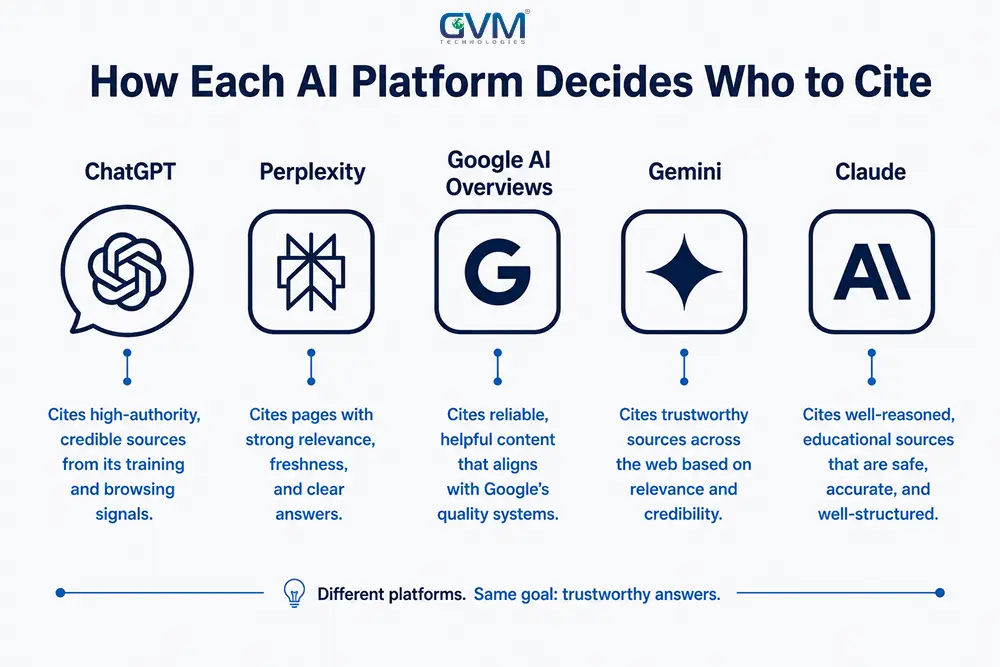
This is the part almost no vetting guide explains, and it’s exactly the technical detail that separates a real GEO specialist from a relabeled SEO shop.
| Platform | What it actually weighs | What this means for your vetting questions |
|---|---|---|
| ChatGPT (search mode) | Leans heavily on Bing’s index, plus community and reference sources like Reddit and Wikipedia | Ask whether the agency has ever verified your site’s indexation in Bing Webmaster Tools, not just Google Search Console |
| Perplexity | Prioritizes freshness and citation density, favors recently updated, source-dense pages | Ask how often content gets refreshed with new dates, data, or sources, not written once and left static |
| Google AI Overviews / AI Mode | Rooted in Google’s own core ranking and quality systems, extended from standard organic signals | Ask whether the agency’s AI-visibility work is separate from its SEO work or built on the same technical foundation |
| Gemini | Overlaps heavily with Google’s own index and ranking signals | Ask if the agency distinguishes Gemini reporting from AI Overviews reporting, or lumps them together |
| Claude | Weighs a distinct mix of sourcing signals from the other platforms | Ask if Claude is tracked at all, since most agencies skip it entirely |
Layer Four: Contract – Ownership, Exit Terms, and Real Pricing
This layer determines what happens the day you decide to leave. Review it before signing, not after.
1. Non-Negotiable: You Own Your Own Accounts
You should own these from day one, with the agency granted access, never the reverse:
- Google Search Console property
- Ad accounts (Google Ads, Meta, etc.)
- Google Business Profile
- Ideally, your CMS or website platform
If an agency insists on holding these under its own login, you lose visibility, and leaving later means starting from zero instead of a clean handoff.
This single check catches more bad agreements than anything else on this list.
2. CMS and Platform Lock-In
If an agency builds your site on a platform only it can export or maintain, leaving becomes expensive by design. Ask plainly what happens to your website if you cancel.
3. Exit Terms and Off-Boarding Fees
Some contracts include a termination clause or an “off-boarding fee” that only surfaces once you’re trying to leave. Always request the full contract, not a summary, and ask exactly what ending the relationship costs.
A fair agency explains this before you sign. One that buries it on page twelve is telling you something.
4. Real 2026 Pricing Benchmarks
| Scope | Monthly range | What it typically includes |
|---|---|---|
| Basic on-page and technical hygiene | $99 to $150 | On-page fixes, technical SEO, AI-crawler access checks |
| Growing small business, content-led | $150 to $300 | Full on-page work, content production, structured data |
| Mid-market, AI-citation focused | $300 to $500 | Complete SEO plus AEO/GEO coverage, multi-platform tracking |
| Competitive market, multi-platform | $1,500 to $5,000 | Aggressive content velocity, digital PR, dedicated strategist time |
| Enterprise or multi-market | $5,000 to $20,000+ | Custom scope across every discipline, dedicated team |
We publish our own current tiers on our pricing page for this exact reason. You shouldn’t need a sales call just to learn whether a service is in range.
Two pricing red flags worth remembering:
- Pricing well under $99 a month for genuine combined SEO and GEO work almost always means templated, automated execution with no real strategist attached.
- A flat quote with no scope breakdown makes it impossible to compare against a second proposal.
The Technical Checks Most Vetting Guides Skip
This section covers exactly what most agency-hiring guides leave out, because it requires real, mechanism-level knowledge, not marketing language.
1. Why Client-Side Rendering Can Hide Your Site From AI Crawlers
A page can render perfectly for a human visitor and stay functionally invisible to an AI crawler if the content only appears after JavaScript executes.
Ask whether the agency checks for this separately from a standard SEO crawl, and whether it recommends server-side rendering for GEO-priority pages.
2. The Three Different OpenAI Crawlers Most Agencies Confuse
A site can allow search-and-citation crawling while blocking training crawling entirely, but only if the agency treats these as three separate crawlers:
| Crawler | What it actually does |
|---|---|
| GPTBot | Trains OpenAI’s underlying models |
| OAI-SearchBot | Builds ChatGPT’s live search index |
| ChatGPT-User | Fetches a page live when someone clicks a citation |
Most generic GEO content treats “GPTBot” as the only crawler that matters. Ask an agency to name all three. If it can’t, its technical GEO knowledge is likely surface-level.
3. Why Bing Indexation Matters for ChatGPT Visibility
A meaningful share of what ChatGPT surfaces in search mode leans on Bing’s index underneath, not Google’s. Ask whether the agency verifies Bing Webmaster Tools indexation as a standard step, not an afterthought.
4. robots.txt Is a Request, Not a Lock
robots.txt is a voluntary, honor-system directive, not a lock. Well-behaved crawlers like GPTBot, ClaudeBot, and PerplexityBot respect it, but the file can’t force compliance from one that doesn’t.
An agency that calls robots.txt a hard security control is stating something inaccurate, and that inaccuracy tends to show up elsewhere in its work too.
SEO-Only, GEO-Only, or Combined: Which Agency Are You Even Vetting?
Figure this out before running any question above, because the right questions shift depending on the category.
| Type | Built for | Real risk |
|---|---|---|
| SEO-only agency | Google rankings, organic traffic, technical health | May bolt on a thin “AI visibility” line item without changing real methodology |
| GEO-only / “AI visibility” specialist | AI citations specifically | Often weak on the technical SEO foundation GEO actually depends on |
| Combined SEO + GEO, one team | Both, from one technical foundation | The only risk is verifying the “combined” claim is genuine, not two disconnected teams sharing a logo |
That last distinction matters most. A large share of what makes content GEO-ready is simply what already made it good SEO: real crawlability, clear structure, content an AI system can extract a clean answer from.
An agency treating GEO as a fully separate service, sold by a separate team, is usually the one relabeling an unchanged retainer.
We built our own service around exactly this gap. SEO and GEO, run by one team, from one technical foundation, from day one, rather than a generic SEO retainer with a GEO line item added later.
The 100-Point Vetting Scorecard
Score any agency out of 100 across the four layers during or right after your first call. This turns a subjective “good vibe” into a number you can actually compare across proposals.
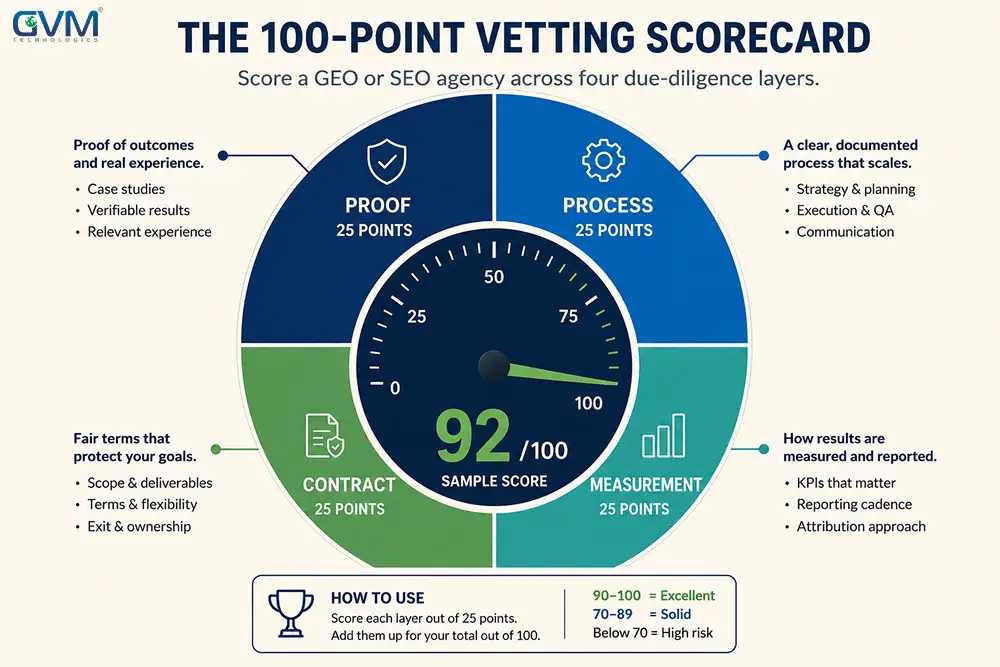
How to Score Each Layer
- Proof (0 to 25): Named case study with dates and numbers (10), current-client reference offered (10), agency demonstrates its own AI visibility (5).
- Process (0 to 25): Specific first-30-days plan in writing (10), named point of contact with disclosed account load (10), realistic timeline staged by month (5).
- Measurement (0 to 25): Explains who controls the prompt set (10), tracks 3+ AI platforms by name (10), ties results to leads or revenue (5).
- Contract (0 to 25): Full account ownership confirmed (10), written exit terms with no hidden fees (10), zero guarantee language anywhere (5).
What Your Total Score Means
- 90 to 100: Strong candidate. Move to a second reference check and a written proposal.
- 70 to 89: Workable, but get every soft answer in writing before signing.
- Below 70: Keep looking. A score this low means at least one layer is a real, unresolved gap.
The Script: 18 Questions and What a Real Answer Sounds Like
Use this as a working checklist on your next call. Copy it into your notes.
| # | Question | Strong answer | Red-flag answer |
|---|---|---|---|
| 1 | Show me a case study with a name, dates, and a business outcome | Names a real client, gives a date range, states leads or revenue impact | “We can’t share client names, but here’s a chart” |
| 2 | Can I talk to two or three current clients? | Arranges it within days, no hesitation | Only offers written testimonials |
| 3 | Where does your own content get cited by an AI platform right now? | Shows a real, current example on the spot | Deflects without showing anything |
| 4 | What specifically happens in the first 30 days? | Names specific audits, fixes, and dated deliverables | “We’ll audit and go from there” |
| 5 | Who works on my account, and how many others do they manage? | Names the person or role, gives a realistic count | Vague, “our team handles it collaboratively” |
| 6 | Will the person I’m talking to now be involved in the work? | Yes, with specifics, or introduces who will be | Silence or a topic change |
| 7 | Who defines the prompt set we’re measured against? | Explains the methodology, welcomes your input | “Our own proprietary system,” no further detail |
| 8 | Which AI platforms do you actually track? | Names specific platforms by name | Names only one, or says “AI platforms” generically |
| 9 | Does this connect to leads or revenue, not just visibility? | Describes a specific attribution method | “More visibility is always good,” full stop |
| 10 | Do you guarantee rankings or AI citations? | No, and explains clearly why that’s not possible | Yes, in any form |
| 11 | What link-building methods do you use? | Names legitimate methods, digital PR, outreach, expert citations | Vague, or mentions link packages and guaranteed monthly counts |
| 12 | Will I own my Search Console, ad accounts, and Business Profile? | Yes, fully, from day one | Accounts built under the agency’s own login |
| 13 | What happens to my site if I leave? | You keep full, working ownership | Site built on a platform only they can export |
| 14 | What are the exact costs and terms to end the contract? | A clear, written answer before you sign | Vague, or a fee that surfaces only when you try to leave |
| 15 | Can I see a real sample monthly report? | Shows a specific, readable example | “We’ll walk you through results on a call” |
| 16 | What would you deprioritize for my specific business? | A specific, reasoned answer for your situation | A generic answer that fits any client |
| 17 | What’s realistic by month three, six, and twelve? | Specific, honestly staged expectations | One early, aggressive promise, no staging |
| 18 | Is SEO and GEO run by one team, or two separate ones? | One accountable team, one strategy | Two disconnected teams, GEO framed as a bolt-on |
Real Patterns That Cost Businesses Real Money
These four repeat often enough to name directly, each with a quick way to check for it.
1. The Retainer That Buys Almost No Work
A business pays a real monthly retainer for months and gets a handful of short content pieces, with no real link-building activity behind vague reporting.
Get itemized, dated deliverables in writing before signing anything.
2. The Portfolio That Doesn’t Hold Up
An agency’s own site still has unfinished placeholder content indexed, or a business address that’s really a generic template default.
Search the exact text of their listed address, in quotes. If it turns up on ten unrelated sites, it’s a template, not a real office.
3. The Account You Never Actually Own
An agency builds your ad account under its own login, then quotes management fees with no real visibility into spend.
Layer Four above exists specifically to prevent this.
4. The Guarantee That Should End the Conversation
Any guaranteed ranking or guaranteed AI citation is, alone, enough reason to walk away.
Neither Google’s ranking system nor an AI platform’s retrieval process can be controlled by an outside agency. Full stop.
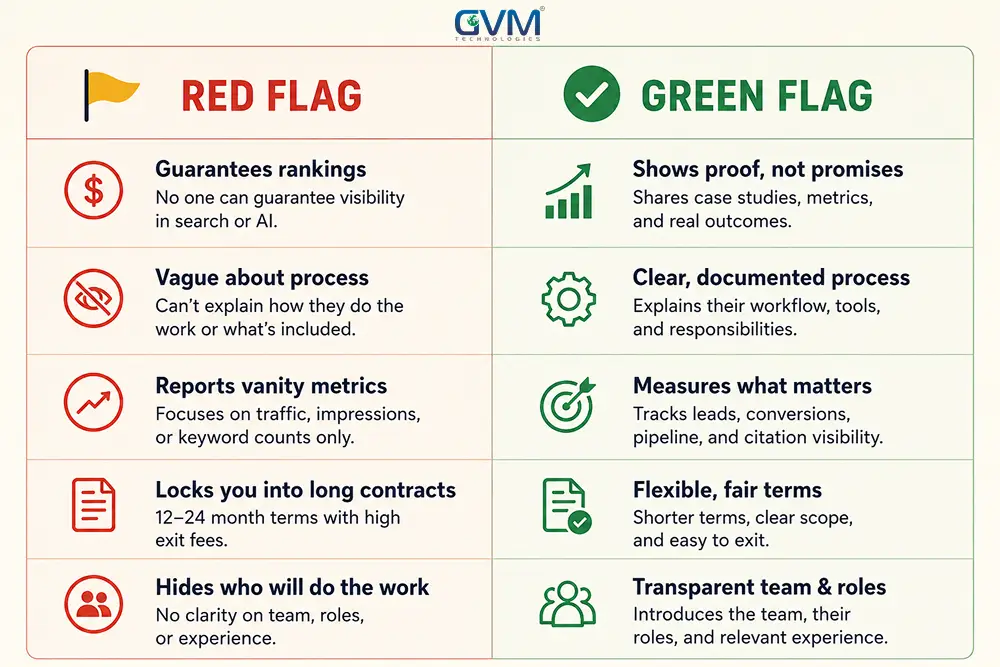
Applying This Framework to Us, So You Can Verify It Yourself
We’d rather you run this checklist against GVM Technologies than take our word for anything.
- Proof: Operating since 2012, 13+ years, ISO 27001:2022, ISO 20000-1:2018, and ISO 9001:2015 certified. Named case studies across insurance, real estate, and e-commerce sit on our case-study hub.
- Process: SEO and GEO are built by one team from one technical foundation from the start, viewable on our SEO service page and GEO service page.
- Measurement: We track visibility across multiple AI platforms, not one, and tie the work back to leads and revenue, because a citation that never becomes a customer isn’t the goal.
- Contract: Our tiers and terms are published on our pricing page, month-to-month at the lower tiers, with no guaranteed-outcome language anywhere.
See the same due-diligence thinking applied to specific markets in our breakdowns of choosing a GEO agency in the US and what a GEO service agency in India should look like.
Conclusion
Vetting an agency in 2026 means testing four things, not one: proof, process, measurement, and contract. Skip any layer and you’re gambling on a sales pitch instead of hiring based on evidence.
Run the 100-point scorecard on your next two or three calls. Score them the same way. The difference usually becomes obvious fast, often before the call even ends.
Prefer a direct walkthrough of your own situation? Our team offers a free SEO + GEO audit, no obligation attached.
Bring this checklist and run all 18 questions against us on the call.
Book a Free Strategy Call and get a straight answer to all 18 questions in one conversation.
FAQs
1. Is GEO just SEO with a new name?
No, though the confusion is understandable. GEO and SEO share a technical foundation, but GEO adds entity consistency, AI-extraction structure, and visibility inside platforms like ChatGPT and Perplexity that SEO alone doesn’t cover.
2. How much should I expect to pay for a real GEO or SEO agency?
Basic on-page work starts around $99 to $150 a month. Mid-market combined SEO and GEO work typically runs $300 to $500. Competitive or multi-market coverage runs $1,500 to $20,000 or more.
3. How long until I see real results?
Expect technical fixes and early content within 30 to 60 days. Meaningful movement on competitive terms typically takes 4 to 9 months. Anyone promising page-one rankings in a few weeks is guessing.
4. Why can’t an agency guarantee AI citations?
AI platforms retrieve from multiple sources and generate a synthesized answer at the moment a question is asked. The same question can return a different cited source on a different day, on the same platform.
5. What’s the single most important question to ask?
Who defines the prompt set you’re measured against. If the agency alone controls the metrics, it alone controls whether the engagement looks successful.
6. Should I hire a local agency or is remote fine?
Location matters far less than transparency. A remote agency upfront about its structure, with real proof across all four layers, is safer than a “local” agency that’s vague on all four.
7. Is very low pricing always a red flag?
Usually. Pricing well under $99 a month for genuine combined SEO and GEO work almost always signals templated or automated execution with no real strategist involved.
8. What if I’ve already been burned by a bad agency?
Get a fresh technical and content audit first, so you know your real starting point. Then run this exact framework on the next agency, and insist on owning your own accounts from day one.
9. Do I need separate agencies for SEO and GEO?
One accountable team handling both is generally stronger, since GEO builds directly on SEO fundamentals. Two separate vendors can end up giving contradictory recommendations without either side realizing it.
Quick Answer: A capable GEO agency in the US does three things most agencies skip: it fixes Bing indexation and crawlability before writing a single new page, it builds content around standalone answers instead of long introductions, and it shows you a real citation baseline before it asks for a signed retainer.
Key takeaways before you read further:
- Real GEO retainers in the US run roughly $1,000 to $20,000+ a month, and the gap between tiers is explainable, not arbitrary.
- A guaranteed AI ranking is not a strong sales pitch. It is a technical impossibility dressed up as one.
- Google AI Overviews, ChatGPT, Perplexity, and Gemini each reward different signals. One playbook does not cover all four.
- Being US-based is not automatically safer than working with a globally-distributed team. What matters is the same accountable process on both ends.
- If you want a real baseline conversation instead of a sales pitch, book a free strategy call with GVM Technologies and run every question in this guide past them directly.
Everything below explains why each of these is true, with the mechanics, real 2026 USD pricing, and the exact questions that separate a serious partner from a rebrand.
What “GEO” Actually Means for a Business Evaluating Agencies in the US
Generative Engine Optimization is the work of getting a business quoted, summarized, or recommended inside an AI-generated answer. That is a different job from ranking in a list of blue links.
When someone asks ChatGPT, Perplexity, or Google’s AI Overviews a question, the system does not just retrieve a page. It pulls from several sources and synthesizes one answer.
GEO is the work of becoming one of those sources, consistently, across more than one platform. That means three things change about how content gets built:
- The goal shifts from “rank in a list” to “get quoted inside an answer.”
- Success is measured per platform, not with one combined number.
- A single passage, not the whole page, is what actually gets judged.
1. The Working Definition, Explained Without the Buzzwords
Most guides define GEO in one sentence, then move straight into a ranked list of vendors. That alone will not tell you whether your own content can actually be lifted into an answer.
An AI system deciding whether to cite a page is not scoring it the way Google scores a ranking. It is asking one narrower question: can this specific passage answer this specific question cleanly, right now, without extra context?
Trick: open any page you are unsure about and read only the first two sentences out loud. If those two sentences alone do not answer a real question, an AI system will likely skip the page too.
2. How GEO, AEO, SEO, and SXO Actually Relate to Each Other
These four terms get thrown around as separate services. They are four lenses on the same underlying content.
| Discipline | What it optimizes for | Where it shows up | How you know it’s working |
|---|---|---|---|
| SEO | Ranking position in classic search | Google, Bing organic results | Position, organic sessions |
| AEO | Being the direct, standalone answer | Featured snippets, voice assistants, AI answer boxes | Snippet wins, extraction rate |
| GEO | Being cited or recommended inside a generated response | ChatGPT, Perplexity, Gemini, Google AI Overviews and AI Mode | Citation frequency across platforms |
| SXO | The actual experience once someone lands on the page | Every surface at once | Time on page, scroll depth, conversion |
A page built well enough to win AEO and GEO at the same time is not a coincidence. It is the same discipline: clear, self-contained, verifiably accurate answers, structured so both a human and a machine can use them fast.
3. Why Your Site Can Rank on Google and Still Be Invisible in ChatGPT
This is the most common confusion we see from businesses evaluating agencies. A page can sit on page one of Google and never once get cited by an AI system for the same question.
Google’s own documentation is direct about the relationship here. Google’s generative-AI optimization guide states that its AI features are rooted in the same core Search ranking and quality systems, not a separate algorithm running in parallel.
“Rooted in the same systems” does not mean “identical outcome.” An AI system still has to decide it can lift a specific passage cleanly.
Three signs a page is ranking but not getting cited:
- It opens with a scene-setting intro instead of a direct answer.
- No single paragraph could be lifted out and still make sense alone.
- Numbers, dates, or specifics only appear deep in the page, not near the top.
Note: a widely observed pattern in this category is that a large share of the pages an AI system cites for a given question are not sitting anywhere near the top of Google’s own results for that same query. Rankings and citations are related, not identical.
What Google AI Overviews, ChatGPT, Perplexity, and Gemini Each Actually Reward
This is the section most agencies skip. It is also the fastest way to tell whether one does real GEO work or just talks about it, because each platform behaves differently.
1. Google AI Overviews and AI Mode: Traditional Signals Plus Extractable Answers
Google’s own AI features lean heavily on the same ranking and quality signals as classic Search, then layer extraction on top. A page needs both real traditional SEO strength and a clean, liftable answer.
Google now has a dedicated way to check this directly. Search Console added generative-AI performance reporting in June 2026.
Tip: this gives site owners first-party visibility into AI Overviews and AI Mode appearances, instead of relying only on third-party estimates. Check it before paying for any separate AI-visibility tool.
2. ChatGPT Search: Bing’s Index and Live-Fetch Citations
ChatGPT’s search behavior leans substantially on Bing’s index underneath, alongside its own crawler discovering pages directly. A site never submitted to Bing Webmaster Tools is starting from behind, regardless of how well it ranks on Google.
This is one of the most overlooked, easiest wins in this category, because most agencies never look at Bing at all.
3. Perplexity: Freshness and Citation Density First
Perplexity behaves closer to a citations-first engine. It rewards content with clear dates, frequent legitimate updates, and a real density of checkable facts over long narrative sections.
Trick: if a page’s “last updated” date has not moved in over 90 days, treat it as stale for GEO purposes specifically, even if nothing on the page is factually wrong. Perplexity notices staleness more than Google typically does.
4. Gemini and Copilot: The Two Platforms Most Agencies Ignore
Gemini draws heavily on Google’s own knowledge graph and indexed web content. The traditional-SEO-plus-extraction approach above applies here too, with more weight on entity clarity.
Copilot leans on Bing’s index in a similar way to ChatGPT search. Most GEO pitches in the US only ever mention ChatGPT by name.
A fast recap of what each platform actually rewards:
- Google AI Overviews / AI Mode: strong traditional SEO plus a clean, extractable answer.
- ChatGPT: Bing indexation, training-data presence, and live-fetch-friendly pages.
- Perplexity: freshness, clear dates, and citation density.
- Gemini / Copilot: knowledge-graph and entity clarity, layered on the same Bing/Google foundations above.
If an agency cannot describe what changes for Gemini or Copilot, its “multi-platform” claim is not multi-platform.
The Technical Foundation Every Real GEO Program Gets Right First
Content strategy gets all the attention in agency pitches. The technical layer decides whether any of that content is even reachable by the systems you are trying to get cited in, which is why this is the first checklist run on every real GEO engagement.
1. The Three AI Crawlers Most Agencies Mix Up
Businesses usually think of “the AI crawler” as one thing. There are three distinct types, and confusing them leads to real, checkable mistakes.
- Training crawlers (like GPTBot) gather data to train future models. Blocking these does not affect today’s live search visibility.
- Search crawlers (like OAI-SearchBot) build the live index a chat assistant actually searches against right now.
- Live-fetch agents (like ChatGPT-User) grab a page in real time only when a user clicks through a citation.
A site can allow search and live-fetch crawling while blocking training crawling. Most generic GEO content in the US treats “GPTBot” as the only crawler that matters, which is technically wrong.
2. The Overlooked Reason ChatGPT Can’t Find Your Site: Bing Indexation
As covered above, a meaningful share of what ChatGPT surfaces leans on Bing underneath. Submitting a sitemap to Bing Webmaster Tools, verifying indexation, and fixing Bing-specific crawl errors is a five-minute check most agencies never run.
Quick note: run a
site:bing.comsearch for your own domain right now. If almost nothing comes back, that gap alone could be costing you ChatGPT citations today.
3. The 25-30 KB Rule: Why Your Homepage Intro Is Costing You Citations
AI crawlers typically extract only a limited slice of any page they land on, commonly in the rough range of the first 25-30 KB of content. Everything after that window contributes far less to what gets cited.
The real, specific answer has to sit inside the opening section. A page that spends three paragraphs on scene-setting before answering anything is functionally invisible to that window.
Tip: count roughly 400-500 words from the top of a page. Whatever answer is not stated by that point is, for GEO purposes, effectively not on the page at all.
4. Server-Side Rendering vs. JavaScript: A Real, Checkable Risk
AI crawlers handle client-side-rendered, JavaScript-heavy pages inconsistently. Content that only appears after the page finishes rendering in a browser can be effectively invisible to an AI system, even though it looks fine to a human visitor.
Warning: if your site was built on a modern JavaScript framework without server-side rendering, check this before anything else on this list. It can silently undo every other GEO effort on the page.
5. FAQPage vs. QAPage vs. Article Schema, Used Correctly
Structured data helps both search engines and AI systems understand what a page is, but the details matter more than most agencies present them.
Google deprecated FAQ rich results in classic Google Search between May and August 2026. FAQPage schema no longer wins a rich snippet, but it remains one of the more reliably extractable formats for an AI system generating an answer.
Schema.org’s own documentation draws a firm line between two schema types that get confused constantly:
- FAQPage: for content the site itself wrote and authored.
- QAPage: for user-submitted, forum-style Q&A only.
Using the wrong one is a real, checkable technical error, and it shows up more often than it should.
The AI Citation Readiness Checklist, drawn from the five points above:
- Crawlability confirmed for GPTBot, ClaudeBot, PerplexityBot, and Google-Extended.
- Site verified and indexed in Bing Webmaster Tools, not just Google Search Console.
- Every priority page states its real answer inside the first 300-400 words.
- Priority pages confirmed to render correctly without JavaScript execution.
- FAQPage and Article schema implemented, with FAQPage used only for site-authored Q&A.
What Actually Gets a Business Cited, Beyond Its Own Website
Technical foundation gets a page reachable. What happens next decides whether it actually gets used.
1. Standalone, Front-Loaded Answers Beat Long Introductions
Every section that could realistically get lifted into an AI answer needs to make complete sense on its own, without needing the paragraph before it for context.
A quick way to test this: copy any single paragraph from a page and read it cold. If it still reads as a complete, useful answer, it is GEO-ready. If it references “as mentioned above” or assumes earlier context, it is not.
This single content habit has more measurable effect on citation likelihood than almost anything else on this list.
2. Entity Consistency: Why the Same Business Gets Described Five Different Ways Online
A business’s own website, its Google Business Profile, its LinkedIn page, and its directory listings often describe it slightly differently. That inconsistency makes it harder for an AI system to build one confident picture of who a business is.
Expert tip: pull up your business name in five different places online right now, including your own homepage. If the one-line description is not near-identical in all five, that is a real, fixable GEO gap, not a cosmetic one.
3. Why Reddit, LinkedIn, and Review Sites Get Cited More Than Most Company Websites
This is why an off-site strategy matters as much as on-site work. Large open discussion platforms and professional networks get cited by AI systems for buying-decision questions more often than most brands’ own websites.
That is not a reason to abandon on-site content. It is a reason to treat these as real GEO surfaces, not side reputation management:
- Open discussion and community platforms.
- Professional networking platforms.
- Third-party review and comparison sites.
- Genuine, unpaid customer discussion anywhere online.
Note: new content on an already-trusted third-party platform can get pulled into an AI answer within roughly a day of publishing. That is far faster than anything in traditional SEO ever moved, and it is one of the reasons off-site work shows up as its own line item in real case studies rather than an afterthought.
4. The One Bad Review That Can Undo Months of Content Work
Even a small number of specific, credible negative mentions can meaningfully suppress how often an AI system recommends a business. That effect can outweigh a much larger volume of generic positive content elsewhere.
Red flag to watch for internally: if nobody on your team is monitoring what AI systems say about your business by name, you have no way of knowing if this is already happening. Reputation monitoring is GEO work now, not a separate function.
Real GEO and SEO Agency Pricing in the US for 2026
Almost every agency ranking for this exact query eventually shows a number somewhere. The problem is that the numbers rarely explain what changes between one tier and the next.
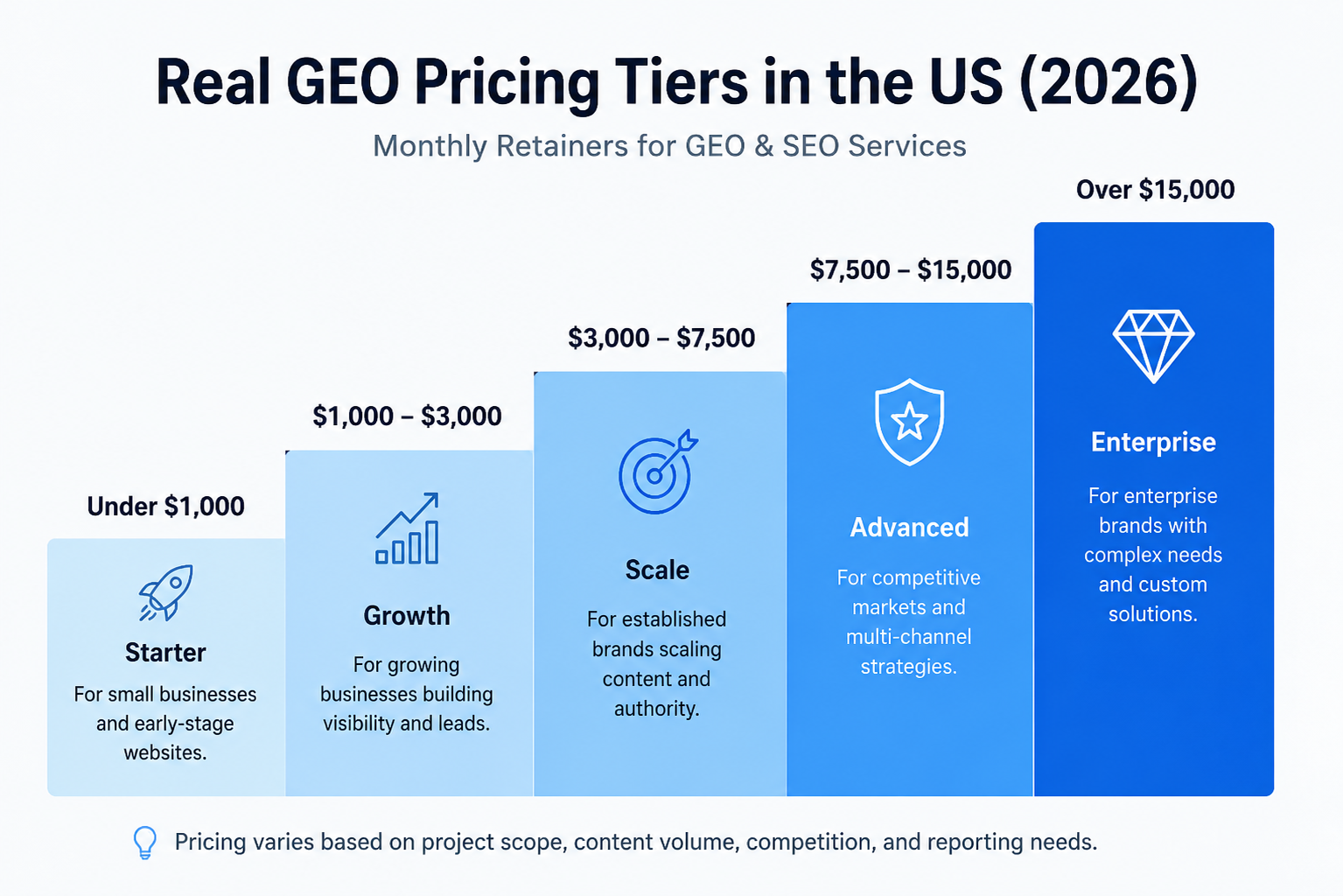
1. The Five Real Pricing Tiers US Businesses Actually See
| Tier | Monthly range (USD) | What it realistically covers |
|---|---|---|
| Caution zone | Under $1,000 | A single audit or a light self-serve tool subscription. Rarely covers real technical work, content, and repeated measurement together. |
| Small / local business | $1,000 – $2,500 | Basic AI-visibility auditing, initial schema and crawlability fixes, monthly reporting, usually single-platform focus. |
| Credible dedicated GEO | $2,500 – $5,000 | Genuine multi-platform citation tracking, entity work, content built specifically around AI extraction, combined with real SEO. |
| Full mid-market program | $5,000 – $15,000 | Coverage across Google AI Overviews/AI Mode, ChatGPT, Perplexity, and Gemini, ongoing measurement tooling, and content at real production volume. |
| Enterprise | $15,000+ | Large content libraries, dedicated measurement infrastructure, and full on-site plus off-site coverage across every major platform. |
A quick, illustrative scenario: picture an Austin-based B2B SaaS founder comparing three quotes. One is $650 a month with a “guaranteed AI ranking” attached.
The second is $4,200 a month, comes with a real baseline citation audit, and names the specific person running the account. The third is $18,000 a month bundled with a full content team the founder does not yet need.
The middle quote is usually the right instinct. Not the cheapest, not the most padded with services nobody asked for, and the only one that led with evidence instead of a promise.
2. Three Pricing Red Flags That Show Up in Almost Every Bad Contract
Three patterns account for most of the bad contracts we see in this category:
- A guaranteed outcome. No provider can honestly guarantee a specific ranking or AI citation, because the systems involved are non-deterministic by design. The same prompt run twice on the same platform can return two different cited sources.
- No baseline before the sale. A credible provider can show a real, dated benchmark across a defined set of buyer questions and multiple platforms, recorded before any work started.
- A low retainer with everything charged separately. A cheap-looking base fee that turns into a much larger invoice once every audit, every content piece, and every report gets billed as an add-on.
Trick: ask directly, “what did my AI visibility look like before you started?” If nobody can answer that with real dates and real data, the “measurement” being sold is likely a single, unreliable prompt run. A free audit is a reasonable way to see what a real baseline looks like before committing to anything.
3. On-Site Work vs. Off-Site Work: Where Most Budgets Get Misallocated
Most GEO budgets in the US go almost entirely toward on-site work: new pages, schema, technical fixes. That work matters, but it is only half the job.
Off-site work covers everything that happens outside the business’s own domain: third-party mentions, review-platform consistency, and genuine community discussion. Several major citation sources for AI-generated answers sit entirely off-site.
Note: if an agency’s entire pitch is about what it will change on your website, ask what it plans to do off your website too. A GEO program with zero off-site component is missing a real, large share of what actually gets cited.
The 10-Point Framework for Vetting a GEO Agency Before You Sign
The same handful of questions come up across almost every real buyer discussion about hiring a GEO agency in the US, regardless of industry. Use all ten before signing anything.
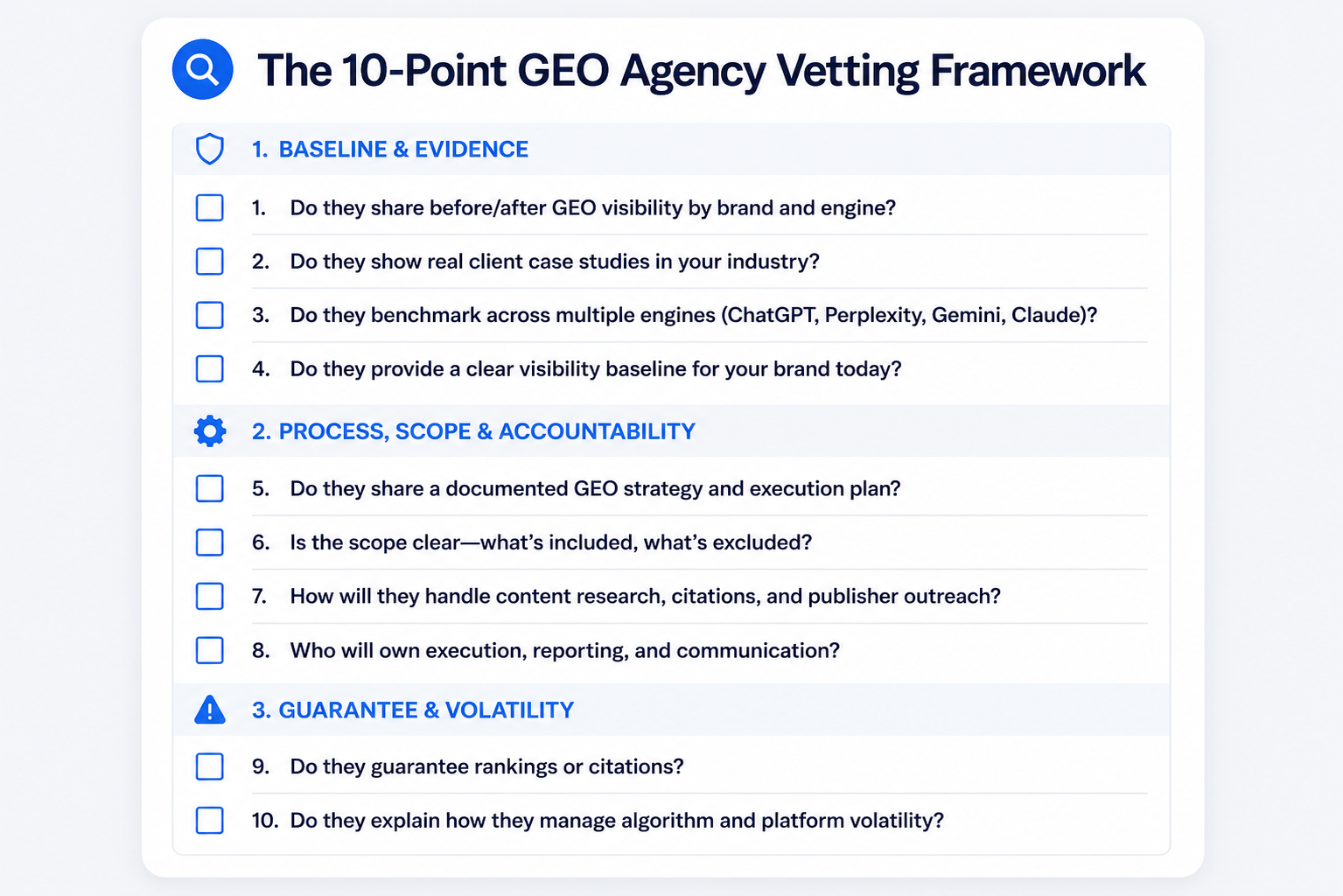
Tip: print or copy this list before your next sales call. Watching how confidently, not just how quickly, someone answers each question tells you more than the pitch deck will.
1. Baseline and Evidence Questions
- Can you show me a real, dated baseline across multiple AI platforms, from before any work started?
- Can you show verified citations you have already earned, not just a screenshot that could be staged?
- Does your own website or content get cited by AI systems? If your methodology works, it should show up somewhere in your own results.
2. Process, Scope, and Accountability Questions
- What specifically changes in your process for AI-citation work, versus standard SEO? A vague answer names nothing; a real answer names entity audits, Bing indexation, and multi-platform tracking.
- What happens in the first 30 days that is not content production? Real technical work comes before new articles, not after.
- Who is the actual person doing the hands-on work, by name, not just who ran the sales call?
- What percentage of the retainer goes toward on-site work versus off-site work, and how is that split decided?
3. Guarantee, Contract, and Volatility Questions
- Is anything guaranteed? If the answer is yes, that is one of the fastest disqualifiers on this list.
- What do you do when a major AI model updates overnight and a client’s visibility drops as a result? A real agency has a specific playbook for this; a rebranded SEO shop has never thought about it.
- Are audits, reports, and content pieces included in the quoted retainer, or billed separately as add-ons?
Should You Hire a US-Based Agency or a Globally-Distributed Team
1. Why “US-Based Only” Isn’t Automatically Safer
Many buyers assume a US-based-only agency is inherently more reliable than a team working across countries. That assumption does not hold up once you look at what actually predicts good work.
A same-country address does not guarantee a real baseline, a named point of contact, or an honest answer about guarantees. Those things depend on the agency’s process, not its mailing address.
Quick contrast:
- What does not predict quality: a US-only office location by itself.
- What does predict quality: a documented process, a named account lead, and evidence shown before the sale.
2. The Real Advantage of a Global Delivery Model, Explained Honestly
A team working across US and international time zones, under one accountable process, is moving work across a longer stretch of the day than a single-timezone shop can offer.
Note: this is a real operational advantage when it is explained honestly, with real offices and real named contacts on every end, and a liability only when a distributed structure is hidden rather than disclosed.
The right question is not “where is this agency based.” It is “can this agency show me the same evidence and the same accountability regardless of where the work physically happens.”
Common GEO Myths That Are Quietly Wasting Marketing Budgets
1. “GEO Is Just SEO With a New Name” Is Half True and Half Dangerous
For a real share of the market, this objection is fair. A large amount of what makes content GEO-ready is simply what already made it good SEO: clarity, structure, real expertise, and a site an AI crawler can reach.
What should differ is the technical and measurement layer built on top:
- Schema built for machine extraction.
- Entity consistency across every place a business appears online.
- Citation tracking across more than one AI platform.
If an agency cannot describe that layer, it is likely selling a rebrand.
2. “More Brand Mentions Always Help” Is Not Backed by What We See
Chasing raw mention volume is a weaker strategy than it sounds. A handful of specific, credible, third-party mentions that say something concrete about a business consistently outperform a large volume of generic ones.
3. “AI Rankings Can Be Guaranteed” Breaks on One Simple Mechanism
AI-generated answers are measurably non-deterministic. The same prompt, run twice against the same platform, can return two different answers with two different sources cited.
Myth vs. reality, in one line each:
- Myth: “We can guarantee you rank first in ChatGPT.” Reality: nobody controls what a probabilistic model outputs, including the model’s own maker.
- Myth: “More content always means more citations.” Reality: one specific, checkable fact beats ten vague paragraphs.
- Myth: “GEO and SEO need separate teams.” Reality: the strongest pages win both at once, because the underlying discipline is the same.
Any agency offering a guaranteed ranking or guaranteed citation is either misunderstanding how these systems work, or comfortable overpromising to close a deal. Neither is a good sign.
Where GVM Technologies Fits, and How to Verify It Yourself
1. Verified Facts, Not a Superlative Claim
GVM Technologies runs SEO and GEO from one accountable team and one technical foundation, rather than treating GEO as a line item added onto an existing SEO retainer later. A few specific, checkable facts, not a superlative claim:
- Operating since 2012, with ISO certification across 27001:2022, 20000-1:2018, and 9001:2015.
- A real US office in Miami, Florida, and a second office in Surat, India, with the same team and the same published contact details on both.
- robots.txt already correctly configured to allow GPTBot, ClaudeBot, PerplexityBot, and Google-Extended, a baseline check most agencies in this category still skip.
- Real, named client work across distinct US verticals, including a commercial trucking insurance case study, a real estate marketing case study, an ecommerce growth case study, and a full case-study portfolio.
- SEO and GEO delivered by one team, not two separate vendors working around each other.
2. What the First 30 Days Actually Look Like
The first 30 days on a real GEO engagement should be mostly technical, per the checklist earlier in this guide:
- Bing indexation and crawlability fixes.
- Schema implementation, checked against the FAQPage/QAPage distinction covered above.
- Entity consistency across every place the business appears online.
- All of this before a single new article gets written.
That is exactly how this brand’s own engagements start, and it is a fair, specific thing to ask any agency to match.
Note: the honest way to use this section is not as a verdict. Run GVM through the ten-point framework above, exactly like any other name on your shortlist.
Choosing the Right GEO Agency in the US: Quick Recap and Next Step
A capable GEO agency gets four things right, all covered in this guide:
- It gets the technical foundation right first, not last.
- It writes content built around standalone answers, not long introductions.
- It splits real budget between on-site and off-site work, not just one.
- It shows you real evidence before asking for a signature.
Real pricing in the US runs from roughly $1,000 a month at the small-business entry tier to $15,000 and beyond for full enterprise coverage. Anything priced dramatically below that range, or priced with a guarantee attached, is unlikely to cover the real work involved.
The fastest way to apply everything in this guide is to run it against a real conversation, not another blog post.
Get a free SEO + GEO audit from GVM Technologies and bring the ten-point vetting framework with you. Ask every question on it directly. If the answers are specific, evidence-based, and honest about what is still uncertain in this category, that is what a real GEO partner sounds like.
FAQs
1. My website already ranks well on Google. Do I actually need a GEO agency too?
Ranking well on Google does not guarantee AI systems cite you for the same question. A page can sit on page one and still get zero mentions in ChatGPT or AI Overviews if it never states a clean, standalone answer. If your customers are starting to research on AI tools before they search Google, this gap is worth closing now rather than later.
2. I already pay an SEO agency every month. Why would I need a separate GEO retainer?
You may not, if that agency can name the specific technical work involved instead of adding “AI SEO” to an existing invoice. Ask them directly what changes about their process, per the framework earlier in this guide. If the answer is vague, that is your answer.
3. How do I check whether my business already shows up in ChatGPT or AI Overviews, before paying anyone?
Ask ChatGPT and Perplexity the exact question a real customer would type, including your city or category, and see what comes back. Check Google Search Console’s AI performance report if you have one connected. Also run a site:bing.com search for your own domain, since a weak Bing presence quietly limits ChatGPT visibility too.
4. Can my in-house marketing team just do this instead of hiring an agency?
For a small number of high-intent pages, yes, especially the technical checklist covered earlier in this guide. Full multi-platform coverage with ongoing measurement usually needs dedicated time most in-house teams do not have, which is where an agency or a defined audit-first engagement becomes worth the cost.
5. Why do GEO agency quotes in the US vary so wildly, from under $1,000 to over $15,000 a month?
The gap almost always reflects what is included, not just markup. A sub-$1,000 quote is usually a single audit or a light content add-on. A $5,000-$15,000 quote typically covers real multi-platform tracking, entity work, and content production together, which costs more to run properly.
6. How long before I see results, and what should the first month actually look like?
There is no fixed timeline because AI citation behavior is platform-dependent and non-deterministic. A realistic first month is mostly technical: Bing indexation, crawlability fixes, and schema, not a stack of new blog posts. Citation-frequency trends usually become clearer over the following two to three months.
7. Is a guaranteed AI-visibility promise ever real, or always a red flag?
Always a red flag. AI-generated answers are measurably non-deterministic, meaning the same prompt run twice on the same platform can return two different results. Treat any guaranteed-ranking or guaranteed-citation offer as a reason to walk away, not a reason to sign.
8. What happens if I sign a long-term contract and the agency’s approach stops working?
Ask this before signing, not after: what are the exit terms, and how often does reporting happen. A credible agency should be comfortable answering both questions plainly, since a locked-in, low-visibility contract is one of the most common regrets buyers report in this category.
9. Which AI platforms should a US business actually worry about?
Google AI Overviews and AI Mode carry the most volume for most US search categories right now, followed closely by ChatGPT and a fast-growing share on Perplexity. A credible agency should explain its approach to all three by name, not lean on “ChatGPT” as a stand-in for the whole category.