Entity clarity is how reliably search and AI systems can identify your business, place it in the right category, and confirm which facts about it are true. It underpins generative engine optimization.
Quick answer: entity clarity decides whether an AI names the right business with the right facts. It cannot force a citation, but a blurred name gets skipped or mixed up with another company.
Key Takeaways
- Entity clarity means 1 name, 1 category, and the same core facts on every page and profile that describes you.
- Google’s guide to AI features in Search never uses the word “entity”, so this is a practical aim, not a documented ranking factor.
- Google does say Organization markup helps it tell similar organizations apart in results.
- In our test, ChatGPT named the right parent company but listed SEO and GEO as 1 of 8 services and never named this site.
- The usual cause is drift: our own homepage showed 2 site names, 2 founding years across GVM pages, and 3 Organization entries with no shared ID.
- Fix owned pages first, then profiles, then earn independent coverage. Bought mentions and llms.txt do not produce AI citations.
What Is Entity Clarity, and Is It Just Entity SEO?
Entity clarity is the state you want: 1 identity that machines can match to the right facts. Entity SEO is the work that gets you there.
| Term | Plain meaning | Example |
|---|---|---|
| Entity | A distinct thing a system tracks | A company, author, product, or city |
| Entity clarity | How cleanly that thing is identified | Same name and category everywhere |
| Entity SEO | The work that improves it | Schema, profile cleanup, consistent copy |
| Disambiguation | Telling it apart from lookalikes | Your firm versus a same name firm |
| Knowledge graph | A database of entities and links | Wikidata or Google’s own graph |
People often assume “entity” means a Wikipedia page. It does not. Any business with a name, a category, and a website already has an entity, clear or blurred.
2 meanings get mixed up in search results:
- Brand entity: you, your business, and your authors. This guide covers it.
- Topic entity: the concepts a page discusses, such as schema or Wikidata. That is a content planning job, not an identity job.
You will also see this work filed under AEO, GEO, and LLMO. The labels differ, but GEO, AEO, and SEO all sit on the same identity layer.
Why Entity Clarity Matters for Getting Cited by AI
An AI answer can only name or link you if the system first matches your name to the right pages and facts. When that match is shaky, the answer names a competitor, hedges, or leaves you out.
The 3 Levels of Entity Clarity
Every AI answer about a business rests on 3 questions. Each fails in a different way.
| Level | Question the system faces | What breaks it |
|---|---|---|
| Resolve | Which thing does this name mean? | A same name rival or a renamed brand |
| Describe | What category and offer does it have? | Vague copy and 8 services with no lead |
| Corroborate | Do independent sources agree? | Old listings and stale profiles |
Rule of thumb: fix Resolve first, Describe second, and Corroborate third. Outreach before the first 2 only spreads a blurred name wider.
The same 3 questions come up on every AI surface, from ChatGPT to Claude to Google’s AI Overviews, though each retrieves differently. A name can resolve and still fail at Describe, which is where our test below broke.
Our reading: embedding based retrieval matches meaning, so 2 same name firms with similar copy can sit close together. Place and category words pull them apart.
What Google Confirms and What It Does Not
| Level | Claim | Proof |
|---|---|---|
| Confirmed | Organization markup helps Google disambiguate organizations | Google documentation |
| Confirmed | Google AI features need no extra markup beyond normal SEO | Google documentation |
| Confirmed | Inauthentic mentions help less than they appear to | Google documentation |
| Confirmed | llms.txt neither helps nor harms Google Search | Google documentation |
| Reported | Brands that resolve cleanly earn more AI citations | Small tests, cause unproven |
| Unknown | How much entity clarity is enough | No public causal test found |
Google’s guide to AI features in Search does not use the word entity, so entity clarity is an industry term, not a named Google factor. Organization structured data is the 1 place Google names disambiguation.
Caution: treat reported correlations carefully. A test on 1 new brand over a few weeks cannot separate a clear identity from the reputation that usually comes with it.
In our AI ranking algorithm test, Gemini listed entity clarity as a ranking factor. Google’s guide makes no such claim.
Our Entity Clarity Test: 1 Company, 2 Founding Years, 3 Organization Entries
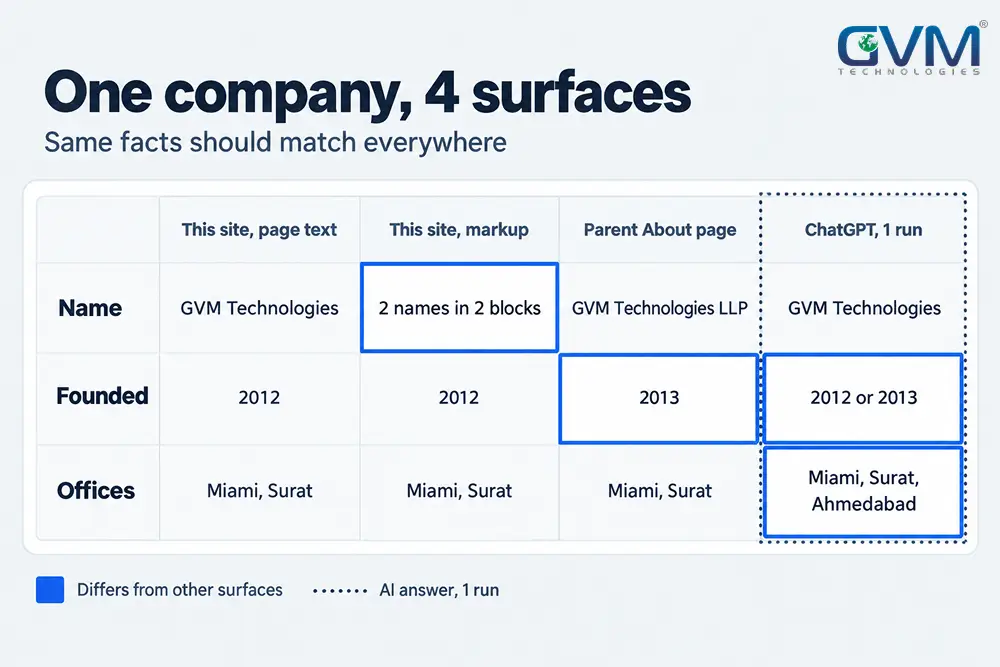
We checked GVM Technologies the way a buyer or an AI would, on 2026-10-07. The parent company resolved, but the category blurred and our own markup disagreed with itself.
What ChatGPT Said About GVM Technologies
We asked signed out ChatGPT “What is GVM Technologies and what does it do?” once. The answer cited 3 sources: the company’s own site, LinkedIn, and a university page.
| Check | Result |
|---|---|
| Right entity named | Yes, the parent company |
| Right category | Partly: SEO and GEO was 1 of 8 services |
| Right facts | Partly: gave 2012 or 2013, and added an Ahmedabad office |
| This microsite named | No |
What Our Own Markup Showed
The disagreement sat on our side. We compared the homepage text, its JSON-LD (the code block that labels facts for machines), and the parent company’s About page.
| Item | What we found |
|---|---|
| Names for 1 business | A plain name in 1 block, a longer site name in another |
| Page title | A third wording, with no company name |
| Founding year | 2012 on the homepage, 2013 on the About page |
| Organization entries | 3, with no shared @id |
| sameAs profiles | Listed in 1 entry, missing from the others |
Our reading: the answer hedged on the founding year because the sources disagreed. That is a guess, not a proven cause.
What This Test Cannot Prove
- It is 1 prompt, 1 run, and 1 platform. Answers change between runs.
- Every other platform went untested, from Perplexity and Claude to Copilot, Gemini, and Google AI Mode.
- The Ahmedabad office appears nowhere on the company’s contact page, and we do not know which source produced it.
A dated citation baseline repeats a prompt across weeks, which 1 run cannot do.
Where Entity Clarity Breaks: Symptoms, Causes, and First Fixes
Match what you see in the answer to a cause. Each symptom has a different first fix, and most start with a page you control.
| Symptom in the AI answer | Likely cause | First fix |
|---|---|---|
| A different company is named | Same name rival | Add place and category beside the name |
| Right company, old facts | Stale markup or listing | Rebuild markup from 1 source of truth |
| Right company, wrong category | Vague or mixed copy | Open every page with 1 category sentence |
| Facts conflict between answers | Drift between profiles | Run the drift check in step 2 below |
| Not named at all | No independent pages | Earn coverage and check crawler access |
| Parent named, sub brand missing | No shared ID or links | Point the sub brand at the parent @id |
Audits often turn up JSON-LD that nobody updated after the page text changed. Hours, prices, and founding years then disagree on the same URL.
Crawler access still comes first, because a clean identity on a blocked page reaches no buyer.
How to Build Entity Clarity in 6 Steps
These 6 steps are entity SEO at small business scale. Define 1 identity, fix the pages you own, add markup, align profiles, earn coverage, then recheck.
The loop: Define → Align → Mark up → Profile → Earn → Recheck, then repeat every quarter.
1. Write 1 Entity Statement
- Template: “[Name] is a [category] that [does what] for [whom] in [where].”
- Example: “GVM Technologies is an SEO and GEO agency with offices in Miami and Surat.”
- Keep it under 25 words, and reuse it as sentence 1 of your homepage, About page, and profiles.
2. Make Your Own Pages Agree
- List name, category, founding year, address, and phone in a spreadsheet, 1 column per surface.
- Surfaces to include: homepage, About, Contact, footer, JSON-LD, and author pages.
- Pick the correct value for each row, then change every other surface the same day.
3. Add Organization Markup With 1 Stable ID
Google lists name, url, logo, sameAs, address, description, alternateName, legalName, and foundingDate as recommended Organization properties. Give the organization 1 stable @id and refer to it from every other node.
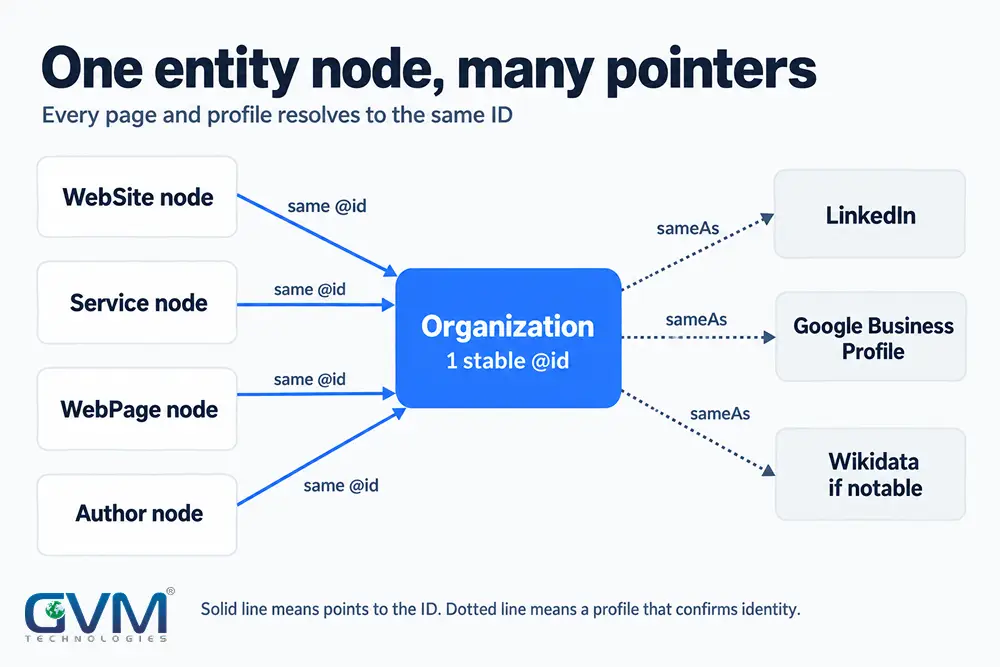
- The sameAs property points to a page that “unambiguously indicates the item’s identity.”
- Use the most specific subtype that fits, such as a LocalBusiness subtype for a shop with an address.
- A sub brand site points its WebSite and Service nodes at the parent’s @id.
4. Align Profiles and Listings
- Copy your entity statement and key facts to LinkedIn, Google Business Profile, and the directories in your category.
- Correct stale listings directly. Old profiles keep repeating the old name.
- Add a Wikidata item only if you meet Wikidata’s notability rules, which need a sitelink, serious public references, or a structural need.
5. Earn Independent Coverage
- Give reviewers and partners 4 facts to repeat: your name, category, location, and founding year.
- Skip bought placements. Google calls inauthentic mentions unhelpful, and a promised citation count is a warning sign.
- A name alone rarely earns a link, as our 3 run mentions test showed.
- Saying your name more often adds no fact, which is why repeating keywords for AI search fails.
6. Recheck With a Prompt Log
- Run 5 prompts 3 times each: what is [name], who is it for, where is it based, who founded it, and is it the same as [lookalike].
- Score each answer on 4 checks: right entity, right category, right facts, own site named.
- Repeat monthly, and report facts next to counts, using a GEO report that goes past citation tallies.
Entity Clarity by Situation: Local Business, Freelancer, Startup, Agency
Entity SEO looks different for a shop than for a freelancer. Your entity is whatever the AI must name, and the first fix differs for each.
| You are | Your entity is | First step |
|---|---|---|
| Local business | 1 business at 1 address | Match name, address, phone on site and profile |
| Freelancer or blogger | You as an author | Build 1 author page with Person markup |
| Startup | A new brand, few mentions | Publish the statement, then earn coverage |
| Parent with sub brands | 1 parent, several sites | Give the parent 1 @id and link each site |
| Agency | Your clients, not you | Audit each client’s drift before writing |
A new brand gains little from markup alone, because markup only repeats what the page says. SEO still underpins GEO, so crawlable, indexed pages come first.
Entity Clarity Pitfalls, Tools, Cost, and Timing
Most entity clarity pitfalls come from touching the markup before the page. The table pairs each pitfall with a better first move.
| Pitfall | Why it backfires | Better first move |
|---|---|---|
| Adding schema to a blurred brand | Markup repeats the page | Fix page copy first |
| Renaming without updating profiles | Old listings keep the old name | Update all profiles that week |
| Counting on llms.txt | Google says it changes nothing | Spend the hour on drift |
| Buying mentions | Google calls them unhelpful | Earn coverage instead |
- Tools: a spreadsheet, the Schema Markup Validator, and your prompt log.
- Cost: the core fixes take hours, not licences. Paid tracking tools are extra, and typical retainer ranges sit in what a retainer typically costs.
- Timing: no platform gives a schedule. We plan to retest monthly for 3 months and treat results as a pattern, not a promise.
FAQs
1. Is entity clarity the same as entity SEO?
No. Entity clarity is the condition of being clearly identified. Entity SEO is the set of tasks, such as markup and profile cleanup, that improves it.
2. Do I need a Wikipedia page or Wikidata entry?
No. Wikidata needs public references or a sitelink, so many small businesses do not qualify. Build consistent owned pages and independent coverage first.
3. Does schema alone fix entity clarity?
No. Google says AI features in Search need no extra markup. Markup repeats what the page says, so fix the copy first.
4. Why does ChatGPT describe my business wrongly?
The sources it retrieved usually disagree or are stale. Compare your site, markup, and profiles 1 fact at a time, then fix the mismatched source.
5. Does entity clarity help classic rankings too?
Possibly in part, but no source we found proves a ranking lift. Consistent names and clear page purpose help users and crawlers either way.
6. Can a brand new business get cited at all?
Yes, if its pages are crawlable and state checkable facts. Progress is slower, because few independent pages describe it yet.
Conclusion
Entity clarity is the work of making 1 identity easy to match to the right facts. It does not guarantee AI citations, but a blurred identity weakens every other GEO effort.
- Today: write your entity statement and run 5 prompts 3 times each.
- This week: list 5 facts across 6 surfaces and fix the odd ones.
- This month: add Organization markup with 1 @id and align profiles.
- Every quarter: rerun the prompt log and refresh stale facts.
Retrieval systems will keep shifting, yet a consistent identity stays easy to match. When hiring help, ask an AI SEO specialist these questions and use a checklist for judging agencies on drift.
Stop Letting AI Guess Who You Are
You search your own name in ChatGPT and get the wrong category, the wrong year, or a competitor. A buyer who reads that answer may shortlist someone else.
GVM Technologies runs 4 identity checks inside its free SEO + GEO audit:
- Identity: your name, category, and key facts across site, markup, and profiles
- Markup: Organization, Person, and sub brand nodes sharing 1 stable ID
- Answers: what AI platforms say about you across repeated runs
- Sources: which independent pages describe you, and where they disagree
With 13+ years of SEO behind it, GVM Technologies now delivers generative engine optimization services from that same foundation, plus ISO certified processes and case studies from 3 industries, covering trucking insurance, real estate, and floral e-commerce.
AI brand mentions are the times an AI answer names your business in its text. A citation is different: a link to a page the answer used. Generative engine optimization tracks them apart.
Quick answer: no. AI brand mentions alone do not earn citations. In our 3-run test, 7 makers were named and only 1 had its own site linked.
Key Takeaways
- AI brand mentions and AI citations come from different steps, so 1 does not cause the other.
- In our test, 6 of 7 named makers never had their own site linked, and 2 were named only to be ruled out.
- A citation attaches to a page an engine can retrieve and quote, not to a name.
- A mention helps when it sits on an independent, specific, retrievable page, and the link then goes to that page.
- Google and Bing reports cannot count AI brand mentions, so keep your own prompt log.
- Google says seeking inauthentic mentions is not as helpful as it might seem, so earn coverage instead of buying it.
What Are AI Brand Mentions, and How Do They Differ From AI Citations?
An AI brand mention is your name appearing in an answer’s text. An AI citation is a link to a page the answer used as evidence, and the 2 can happen independently.
| Term | What you see | Where it comes from | What it earns |
|---|---|---|---|
| Mention | Your name in the answer text | Model memory or a retrieved passage | Awareness and a shortlist spot |
| Citation | A link to a page | A retrieved page that backs a sentence | A click path and source credit |
| Recommendation | Your name offered as a pick | A mention plus a favorable judgment | A buying consideration |
Many website owners struggle because trackers fold AI brand mentions, citations, and recommendations into 1 score. A name can even appear only to rule you out, as our test below shows.
The difference between GEO, AEO, and SEO explains why each outcome needs its own measure.
Do AI Brand Mentions Alone Get You Cited? What the Evidence Shows
We found no public evidence that adding AI brand mentions causes citations. What exists is official guidance, how retrieval works, and correlations that cannot separate cause from reputation.
We asked ChatGPT this question on 2026-10-06, signed out with search on. It said no, not by themselves. Perplexity needed a sign-up and Google AI Mode errored, so only ChatGPT was tested.
The 4 Proof Levels Behind AI Brand Mentions
| Level | Claim | Proof |
|---|---|---|
| Confirmed | A page must be indexed and snippet eligible to be linked | Google documentation |
| Confirmed | Seeking inauthentic mentions is not as helpful as it seems | Google documentation |
| Follows from retrieval | A link goes to the page retrieved, wherever your name sits | Mechanism, not published |
| Reported correlation | Brands named on many independent pages get named more | Correlation, cause unproven |
| Unknown | How many mentions it takes to earn a citation | No public test found |
Google’s own guide says seeking inauthentic mentions across the web “isn’t as helpful as it might seem.”
Its AI features can still show what blogs, videos, and forums say about products. They also rest on core ranking systems, which is why SEO still underpins GEO.
Why Public Numbers on AI Brand Mentions Disagree
Public counts of the mention and citation gap disagree because “a brand appears” has no standard definition. Trackers count it 3 different ways:
- Domain linked: the brand counts even if its name never appears in the text.
- Name in text: the brand counts even if no page of its own is linked.
- Product name: the brand counts only if the tracker knows its products.
Any single percentage is true only under its own matching rule, so build your own log.
Our 3-Run Test of AI Brand Mentions: 7 Named, 1 Linked
We ran 1 buyer question 3 times in signed out ChatGPT with search on. The 3 answers named 7 makers, and only 1 had its own site linked.
The prompt, run on 2026-10-06, was “What are the best luxury alternatives to a jet ski under 5 meters?” The answers priced in rupees, so the session read as India based.
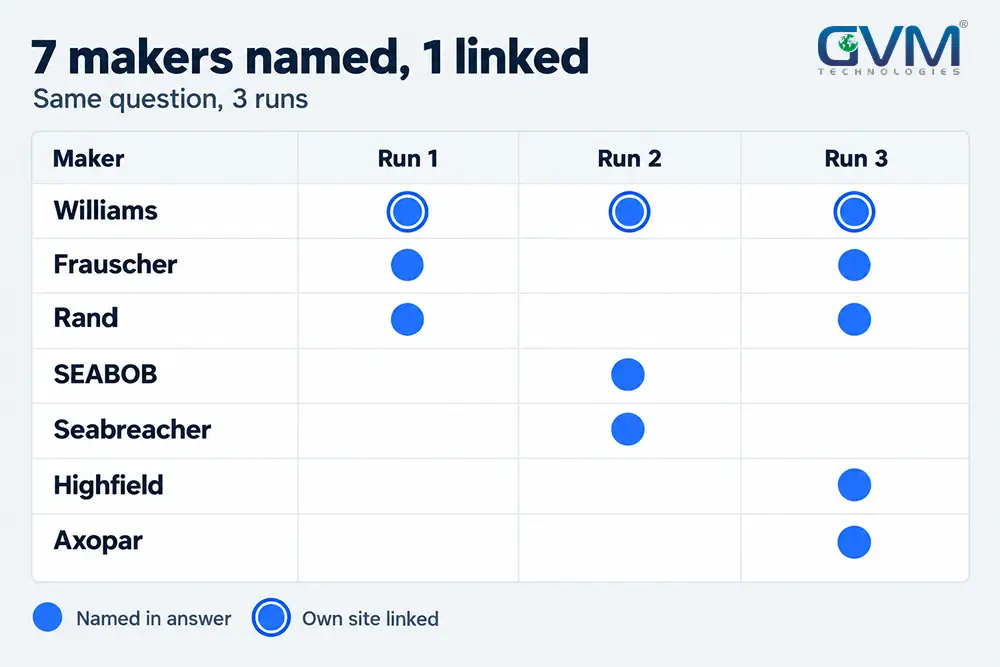
| Maker | Runs named (of 3) | Own site linked |
|---|---|---|
| Williams | 3 | Yes, in all 3 runs |
| Frauscher | 2 | No |
| Rand | 2 | No, named as over the size limit |
| SEABOB | 1 | No |
| Seabreacher | 1 | No |
| Highfield | 1 | No |
| Axopar | 1 | No, named as over the size limit |
What the 3 Runs Show
- Only 1 maker appeared in all 3 runs, and the shortlist changed each time.
- 6 of 7 makers were named without their own site being linked.
- 2 makers were named only to be ruled out, so AI brand mentions are not recommendations.
- Links went to the maker’s own pages, a distributor page, and boating media pages.
- A screenshot shared with us listed makers that none of our 3 runs named.
What the Test Does Not Show
Our reading is that the linked maker’s pages held the figures the answers kept quoting: length, power, speed, and seats. No platform documents that rule.
This is a probe, not a benchmark: 3 runs of 1 prompt on 1 platform. A dated AI-citation baseline repeats it across weeks.
Why AI Brand Mentions Rarely Turn Into Your Own Citation
A mention attaches to a name, while a citation attaches to a page the engine retrieved and could quote. That is why a name can travel without your link.
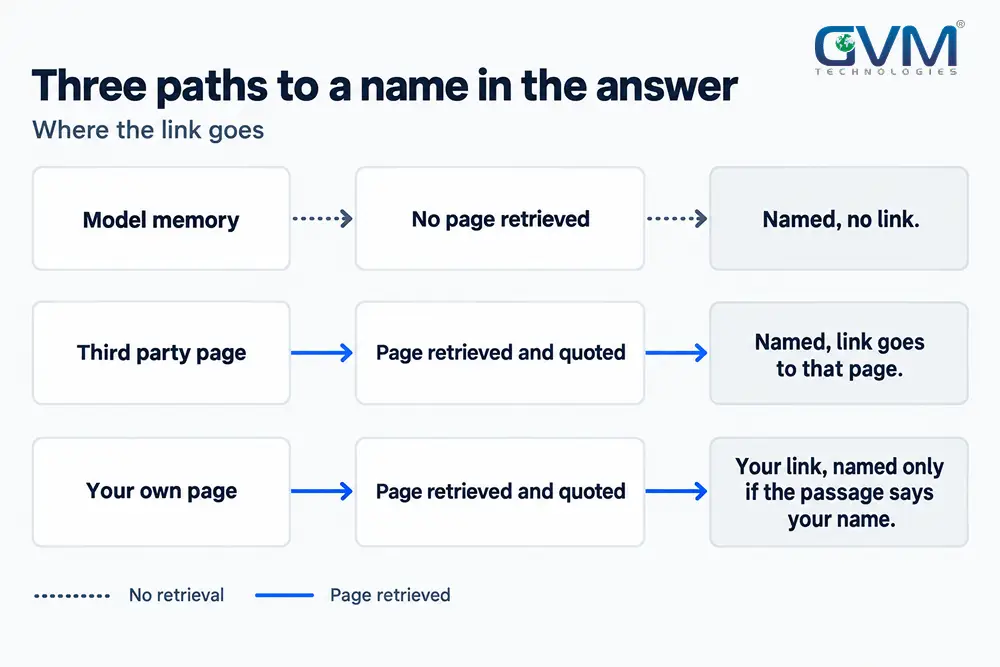
- It came from memory. An engine answering without a search can name a brand it learned in training. With no page retrieved, there is nothing to link.
- It sits on someone else’s page. A roundup or review backs the sentence, so the link goes to that publisher. The retrieval and selection layers of AI search decide which page wins.
- Your page cannot qualify. Google requires a page to be indexed and eligible for a snippet as a supporting link. Sites opted out of OAI-SearchBot are not shown in ChatGPT search answers.
- Your page backs no specific sentence. Engines link pages that support a claim, and repeating your name adds no fact. Add the fact, and the name has something to attach to.
Rule of thumb: an AI brand mention is something said about you. A citation is something an engine found on a page.
When AI Brand Mentions Help: The 3-Part Test
A mention can lead to a link when it passes 3 tests: independent, specific, and retrievable. Failing any 1 leaves you named without a link.
| Test | Pass looks like | Fail looks like |
|---|---|---|
| Independent | An editor or reviewer wrote it | You or a rival wrote it |
| Specific | It states a checkable fact about you | It says “a leading provider” |
| Retrievable | Indexed, crawlable, snippet allowed | Blocked, noindexed, behind a login |
Independent has degrees. Our test linked a distributor page, which sells the product it describes, so check who benefits before you chase a placement.
- Google’s spam policies count attempts to manipulate generative AI responses as spam.
- The same policy prohibits buying links for ranking.
- Paying for planted AI brand mentions has no documented return.
At GVM Technologies, we start with the pages that already answer your buyer questions, then check whether you appear on them. That beats outreach to pages no engine retrieves.
Anyone selling a fixed number of mentions as a result is selling a guaranteed citation, which is a red flag.
Diagnose Your AI Brand Mentions Gap With the 4-Outcome Grid
File each answer into 1 of 4 outcomes: named and linked, named only, linked only, or absent. Each outcome points to a different first fix.
| Outcome | What it means | First fix |
|---|---|---|
| Named and linked | Your name and your page both surfaced | Protect the page and log it weekly |
| Named only | The name came from memory or a third party page | Make your page quotable and crawlable |
| Linked only | Your page supplied a fact, but your name stayed out | Put the name beside the fact |
| Absent | Neither surfaced | Check crawler access, then earn independent coverage |
A common mistake we see in audits is treating “named only” as a win. The name may come from memory, so nothing you published moved it.
“Linked only” is the quiet leak: your page informs the answer while a competitor’s name gets the buyer.
GVM Technologies files every audited prompt into this grid before recommending any outreach. Run each question 3 times, and check crawler access first, because AI optimization starts with access.
How to Track AI Brand Mentions and Citations Separately
Track AI brand mentions and AI citations as 2 separate fields: your name in the text, and your page linked. Repeat each prompt 3 times, because answers change between runs.
1. Why Official Reports Cannot Count AI Brand Mentions
- Bing’s AI Performance report shows total citations, cited pages, and grounding queries.
- Search Console’s generative AI reports count impressions when a link to your page appears.
- Neither counts a name written in the answer text.
So mention counts come only from your own log. Reporting beyond citation counts shows how to present both.
2. The Prompt Log in 6 Columns
- Prompt: the exact wording, with and without your brand name.
- Platform and date: engine, signed in or out, location.
- Run: 1, 2, or 3.
- Named: pick, excluded, or listed.
- Linked: your domain, a third party, or none.
- Sources: every domain the answer cited.
Count prompts that name your brand separately. A name inside the question all but guarantees a mention, so those numbers flatter you.
3. Mistakes, Tools, Cost, and Timeline
| Mistake | Why it misleads | Do this instead |
|---|---|---|
| Counting every name as a win | Excluded names inflate the count | Tag each mention pick or excluded |
| Judging from 1 run | Our 3 runs gave 3 different shortlists | Keep the pattern across runs |
| Tracking only the company name | Engines often name the product | Log products and misspellings |
| Buying mentions | Google lists AI manipulation as spam | Earn independent coverage |
- Tools: a spreadsheet works. Paid trackers are optional; see what SEO and GEO work costs.
- Timeline: OpenAI says robots.txt changes take about 24 hours to apply. Earned coverage takes months, and no platform publishes a timeline.
- After a mention: buyers often search your name next, so analytics files the visit under branded search. Ask new leads how they found you, and add an AI option.
GVM Technologies treats the first 30 days as access and measurement work before outreach. See the first 30 days of GEO work.
FAQs
1. Do AI brand mentions help get cited at all?
They can, when they sit on independent, specific, retrievable pages. No public test shows mentions cause citations, and the link goes to the page that carries the mention.
2. Is a citation worth more than a mention?
They do different jobs. A citation gives a click path, while AI brand mentions put you on the shortlist. A citation without your name can send the buyer to a competitor.
3. Do unlinked mentions beat backlinks for AI?
No public test isolates one from the other. Google says its AI features rely on core ranking systems, so treat links and mentions as 2 inputs, not rivals.
4. Should I pay for mentions or sponsored placements?
Not to manipulate answers, because Google counts that as spam. Ask any seller the 7 questions to put to an AI SEO specialist first.
5. Why does ChatGPT name my competitor but link my page?
That is the linked only outcome. Your page supplied a fact, but the passage never named you. Put your name beside the fact, and keep naming consistent across pages.
6. Does schema or llms.txt turn a mention into a citation?
No. Google says structured data is not required for its generative AI features, and Google Search does not use llms.txt. Access and quotable facts matter more.
Conclusion
AI brand mentions and AI citations are 2 separate events, and a name alone does not earn a link. Earn independent, specific mentions on pages engines can retrieve, and make your own pages worth quoting.
- Today: run 5 buyer questions 3 times each and file every answer in the 4-outcome grid.
- This week: confirm key pages are indexed, crawlable, and snippet eligible in Google and Bing.
- This month: list the independent pages engines cite for your questions, and check whether you appear on them.
- Every quarter: rerun the log, compare outcomes, and drop any outreach that moved nothing.
Engines will keep changing what they retrieve, but a page that states a checkable fact stays easy to quote. Before hiring help, vet any GEO or SEO agency on how it measures both.
Stop Guessing Whether AI Is Naming You, Linking You, or Neither
You are named in some answers and invisible in others, and nobody can say whether your pages, your coverage, or your access is the cause. Each month of guessing hands that answer to a competitor.
In your free SEO + GEO audit, GVM Technologies checks:
- Outcomes: your buyer questions filed as named, linked, both, or absent
- Access: crawler access and Google and Bing indexing for key pages
- Sources: which independent pages engines cite instead of yours
- Passages: which sections of your pages can be quoted on their own
GVM Technologies has built SEO and generative engine optimization services together since 2012, with ISO-certified processes and named client results in insurance, real estate, and e-commerce.
An AI search ranking algorithm would be a published formula that orders sources for an AI-written answer, the way PageRank orders links.
Quick answer: partly. Every AI search engine has its own answer-selection layer, but only some own an index, and none has published an AI search ranking algorithm. That is why GEO builds on SEO instead of replacing it.
Key Takeaways
- “Own” means 3 different things: own index, own retrieval ranking, and own answer selection. Most claims blur them.
- Google’s AI features rely on its core ranking systems, not a separate AI search ranking algorithm. Other AI search engines mix their own crawlers with outside sources.
- Query fan-out is a rewrite step, not an AI search ranking algorithm. It explains most “AI ranks differently” complaints.
- Ranking and citation are separate wins in every AI search engine. A page can win the first and lose the second.
- Nobody outside the labs knows how selection weighs passages, so treat any claimed AI search ranking algorithm formula as marketing.
What Is an AI Search Ranking Algorithm?
An AI search ranking algorithm would be a documented system that scores and orders sources for an AI answer. No AI search engine has published one.
What exists is a pipeline called retrieval-augmented generation (RAG): the AI rewrites your question, fetches current pages, then writes from them.
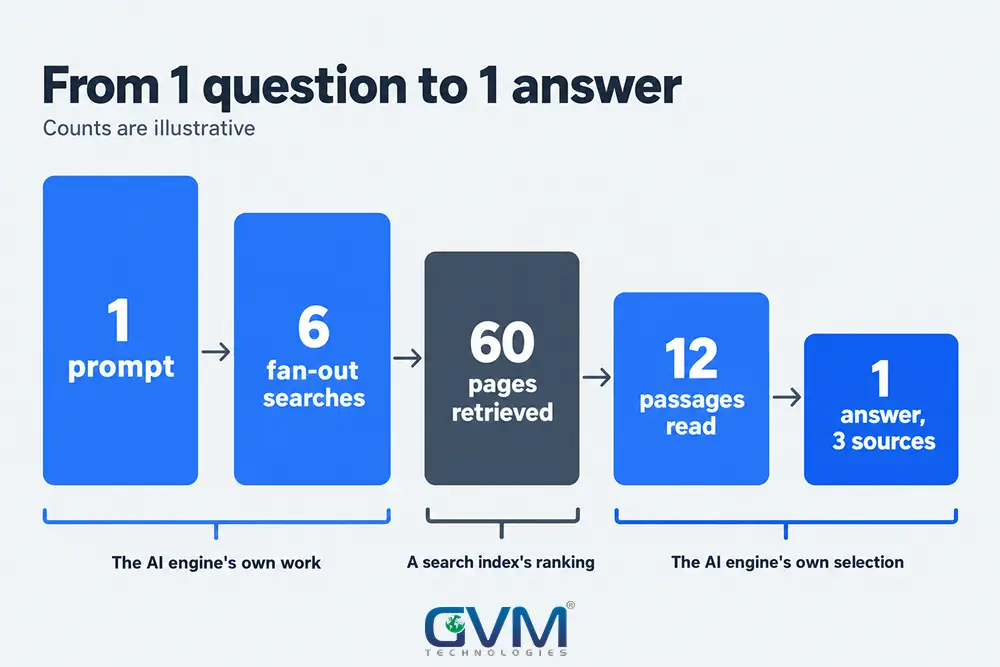
Most claims go wrong because “own” is not 1 thing. It is 3:
- Index: the engine crawls and stores the web itself.
- Retrieval ranking: the engine scores pages for each search.
- Selection layer: the model picks which passages and sources to quote.
Many website owners test 1 prompt, see a brand list unlike Google’s page 1, and decide the AI runs new ranking math. The cause is usually query fan-out.
The labels add noise. AI Optimization (AIO), GEO, AEO, and LLMO mostly name 1 goal.
Who Owns Each Layer of the AI Search Ranking Algorithm
Every AI search engine owns the selection layer. Ownership of the index and the retrieval ranking varies by platform, and no vendor publishes a full AI search ranking algorithm.
Vendors confirm less than marketers claim, so the table marks confidence as of 2026-10-01.
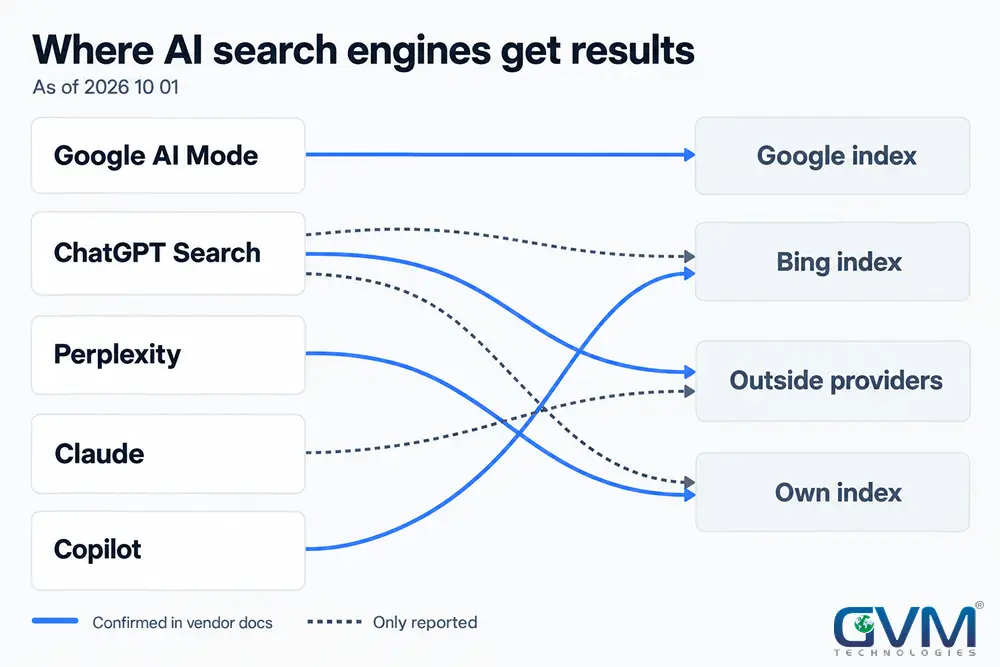
| Platform | Index | Retrieval ranking | Selection | Confidence |
|---|---|---|---|---|
| Google AI Overviews, AI Mode | Google’s | Core ranking systems | Gemini | Confirmed in Google’s docs |
| ChatGPT Search | Own index reported | Outside providers, partners | OpenAI model | Partly confirmed |
| Perplexity | Own crawler and API | Own ranked results | Perplexity model | Mostly confirmed |
| Claude | Not disclosed | Outside vendor reported | Claude | Crawlers confirmed |
| Microsoft Copilot | Bing’s | Bing ranking | GPT models | Documented in 2023 |
1. What vendors confirm about AI search ranking algorithms
- Google: AI features rely on core Search ranking systems, such as neural matching, passage ranking, RankBrain, and PageRank.
- Google, eligibility: a page must be indexed and snippet-eligible. No extra markup is required.
- OpenAI: OAI-SearchBot surfaces sites in ChatGPT search. GPTBot is a separate training crawler.
- Perplexity: PerplexityBot surfaces and links sites, and its Search API returns ranked web results.
- Anthropic: Claude-SearchBot improves search result quality. Blocking it may reduce visibility.
2. What is only reported about the AI search ranking algorithm
- ChatGPT results overlap heavily with Bing.
- ChatGPT runs a first-party retrieval index beside several outside providers. OpenAI has not confirmed this.
- Some AI products buy results from vendors that scrape Google, so a Google ranking can arrive second-hand.
- Claude’s search backend is Brave.
- Fresh pages on trusted sites can enter AI answers within days, because engines retrieve live results.
Treat each as a hypothesis. Checking Bing still costs nothing with Bing Webmaster Tools.
Whatever the backend, the work splits across the 3 targets of SEO, AEO, and GEO.
3. What AI search engines say about their ranking algorithm
We asked 4 AI search engines this exact question on 2026-10-01, signed out, from the US. All 4 answered yes.
- Google AI Mode listed 5 stages, including cross-encoder re-ranking and an authority filter. Google’s public documentation names neither.
- ChatGPT split the answer into retrieval ranking and answer selection, the 2 layers above.
- Perplexity answered yes in 2 sentences.
- Gemini listed schema markup as a ranking factor. Google says AI features need no special schema.
- Google AI Overviews did not appear for the question.
All 4 said yes because “own” is ambiguous. ChatGPT’s answer sits closest to vendor documentation.
4. What nobody outside the labs knows about the AI search ranking algorithm
- How selection weighs authority against freshness and clarity.
- How many fan-out searches each engine runs.
- Which passages the model drops, and why.
With 3 unknowns that large, a guaranteed AI citation is a red flag.
Query Fan-Out Is Not an AI Search Ranking Algorithm
Query fan-out is an AI search engine rewriting your question into several related searches before retrieval. Google describes AI Mode as issuing a multitude of queries at once.
It is a rewrite step, so it cannot be an AI search ranking algorithm. A model writes them when you ask, so they change between runs.
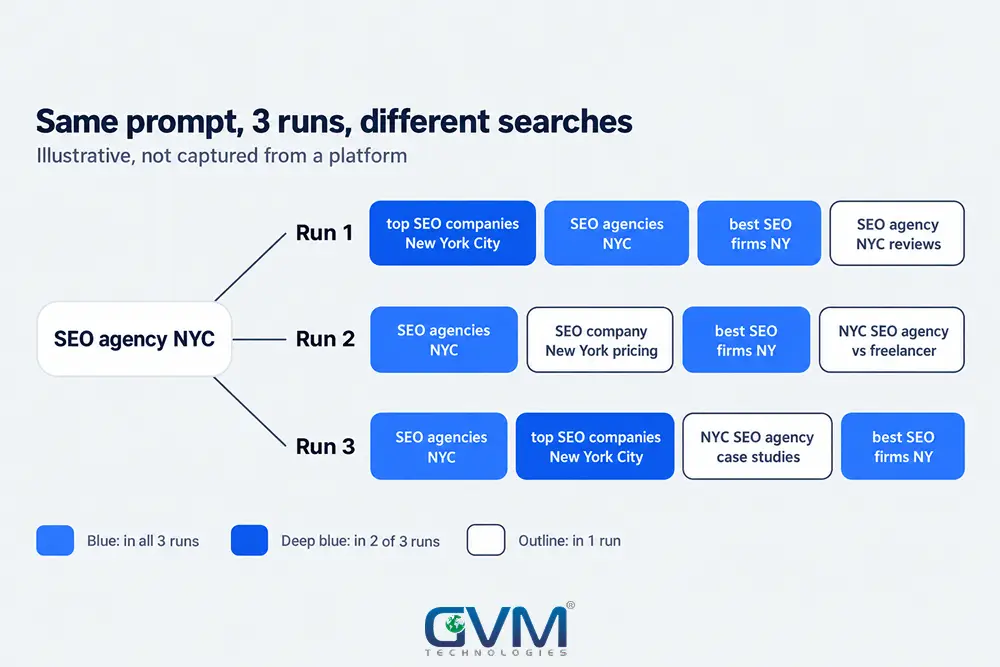
The 5 query fan-out rewrite patterns
These examples are illustrative, not captured from a platform.
| Pattern | Typed prompt | Fan-out search | Your page needs |
|---|---|---|---|
| Synonym swap | SEO agency NYC | top SEO companies New York City | Your wording variants |
| Added modifier | skincare for teen skin | best skin care 2026 | A fresh, dated answer |
| Constraint split | accountant for freelancers | accountant cost for freelancers | A section per constraint |
| Added comparison | CRM for 5 people | CRM vs spreadsheet small team | A comparison block |
| Trust check | hire a roofer | roofer reviews | Third-party reviews |
The query fan-out keyword-list trap
Sub-queries vary between runs, so a page per sub-query chases a moving target.
Group them into subtopics and cover each on 1 strong page. In our experience, 1 strong page per subtopic outlasts 6 thin variants.
Why keywords matter again in query fan-out
Prompts are conversational, but the fan-out searches are usually shorter and more literal.
Write natural answers, then put the literal phrases buyers search into your headings and first sentences.
Why a #1 Ranking Can Still Miss the AI Citation
A page can rank first for your typed query and still miss the AI answer, because the engine runs query fan-out and searches its rewrites.
The page must also be fetchable and quotable. Ranking enters you in the pool for 1 search, not all of them.
1. The 2-search test
Run each fan-out search in Google and Bing, then read the result:
- Ranks in neither: a retrieval problem. Fix coverage and authority.
- Ranks in both, never cited: a selection problem. Fix extraction and corroboration.
- Ranks in 1 only: an indexing gap. Fix the other index.
Log each result in a real AI-citation baseline so you can compare runs.
2. A worked example
Prompt: “Which accountant should a new freelancer in Austin hire for taxes?”
| Fan-out search (illustrative) | Who tends to win |
|---|---|
| freelance tax accountant Austin | Local firm pages |
| best CPA for self-employed Texas | Directories, roundups |
| accountant cost for freelancers | Pricing explainers |
| Austin accountant reviews | Review platforms |
A firm ranking #3 for the first line can be absent from the other 3. The answer tends to name sources that appear across several searches.
3. Citations can come from beyond page 1
Google says AI features identify more supporting pages, for a wider and more diverse set of links. A page ranking 14th for the typed query can win 1 sub-query and get cited.
GVM Technologies often sees the reverse gap: a page that ranks for the headline phrase and ignores the follow-up questions. A baseline across repeated runs shows which case you are in.
4. The symptom-to-layer map
| Symptom | Likely layer | First fix |
|---|---|---|
| Absent, ranking page 3 or lower | Retrieval | Cover the missing subtopics |
| Ranking top 5, never cited | Selection | Open sections with the answer |
| Cited with wrong facts | Source pages | Correct the pages retrieval returns |
| Cited on 1 AI product only | Index gap | Check Bing and crawler access |
| Cited once, gone next run | Non-determinism | Track the pattern, add corroboration |
If you see wrong facts, GVM Technologies starts with the source pages, not the AI answer.
AI Search Ranking Algorithm Myths, Checked
Both loud camps are partly wrong. “The AI search ranking algorithm has secret criteria” has no public evidence.
“AI is only Google with a chat window” ignores the selection layer and the AI search engines that run their own crawlers. The table scores 5 common claims.
| Claim | Verdict | Why |
|---|---|---|
| A secret AI search ranking algorithm replaced classic ranking | Unproven | No vendor has published one |
| AI search is just Google or Bing | Too strong | Selection is new; some run own crawlers |
| Rank #1 and you will be cited | Unreliable | Engines search rewrites, then select |
| Schema, llms.txt, or chunking gets you cited | Not required | Google says AI features need none |
| Fan-out is a fixed keyword list | Misleading | The searches change between runs |
“Unproven” is the honest label, because selection logic stays closed. That is also why people ask whether GEO is just rebranded SEO.
How to Optimize for the AI Search Ranking Algorithm
Optimize each layer of an AI search engine on its own: make pages reachable, win the fan-out searches, then make passages easy to select.
Start with access, because a blocked crawler beats every content fix. No separate budget or tool is needed to begin.
Rule of thumb: rank decides whether you are retrieved. Clarity decides whether you are quoted. Corroboration decides whether you are believed.
1. Fix access so the AI search ranking algorithm can reach you
- Index key pages in Google and Bing, and verify both.
- Allow OAI-SearchBot, Claude-SearchBot, and PerplexityBot in robots.txt.
- Check your CDN and security plugins. Some block AI crawlers by default.
- Remove nosnippet and tiny max-snippet limits from pages you want quoted.
- Keep key answers in the HTML, not behind JavaScript.
This layer is dull, checkable, and often broken. At GVM Technologies it is the first thing we test.
2. Run a query fan-out audit in 5 steps
- List 10 prompts your buyers type.
- Run each 3 times on 1 platform and note the searches shown.
- Group repeated query fan-out searches into subtopics, including buyer constraints like budget.
- Search each subtopic in Google and Bing, and record who ranks.
- Expand 1 existing page per gap. Build a new page only when none fits.
3. Audit what AI answers say about you
Grounded answers repeat what retrieval returns, including outdated or wrong pages about you.
- Run 10 prompts that name your brand.
- List every claim about pricing, services, and location.
- Trace each wrong claim to its source page, then fix or replace it.
- Keep brand and product names identical everywhere, because engines often name the product, not the company.
4. Measure the pattern, not 1 run
Run the same prompts weekly and track how often you appear, as GEO reporting beyond citation counts explains.
Google also reports AI-feature visibility in Search Console’s generative AI performance reports.
Mistakes, Timelines, and Costs
Most wasted effort comes from chasing an AI search ranking algorithm formula, judging from 1 run, and buying a tool before checking access.
Expect crawler fixes within days and authority gains over months. The first checks cost hours, not budget.
| Mistake | Why it fails | Do this instead |
|---|---|---|
| 1 page per query fan-out search | Searches change between runs | 1 strong page per subtopic |
| Blocking GPTBot to hide from search | OAI-SearchBot is separate | Set each crawler on purpose |
| Buying a visibility tool first | A score hides access gaps | Audit first, then pick tools |
- Access fixes: OpenAI says robots.txt changes take about 24 hours to reflect.
- Ranking gains: these follow normal SEO timelines, so expect weeks to months.
- Cost: Search Console and Bing Webmaster Tools are free. Paid tools are optional.
If a vendor sells you only a rank report, you are blind to 2 of the 3 layers. See the first 30 days of GEO work and SEO and GEO pricing for what a real engagement includes.
Before signing anyone, vet a GEO or SEO agency. GVM Technologies treats all 3 layers as 1 job, so SEO and GEO advice stays consistent.
FAQs
1. Do AI search engines have their own ranking algorithm?
Partly. Each has its own selection layer, but no public AI search ranking algorithm exists. Google’s AI features rely on core Search ranking systems, and other engines pair their own crawlers with outside or first-party sources.
2. Does ChatGPT use Google or Bing?
OpenAI has described outside search providers plus its own crawler. Earlier tests found heavy Bing overlap, and recent analysis reports a first-party index. The mix is shifting, so verify both indexes.
3. Is query fan-out the same as keyword research?
No. Keyword research starts from phrases people type, while query fan-out starts from searches the AI writes. Use it to find missing subtopics, not to build a page per query.
4. Can I influence an AI search ranking algorithm?
You cannot change the weights, but you can improve every input: be indexed, rank for fan-out searches, and write standalone answers.
No one can guarantee a citation, and hiring an AI SEO specialist should not change that.
5. Does an AI search ranking algorithm need schema or an llms.txt file?
Google says its AI features need no special schema, AI text files, or chunking, and ties them to helpful, people-first content. Keep schema for rich results, and treat llms.txt as optional.
Conclusion
No public AI search ranking algorithm exists, but AI search engines are not just Google with a chat box. They add a query rewrite before retrieval and a passage pick after it, and both stay closed.
The fix is a sequence, not a trick. Work through it in order:
- Today: confirm key pages are indexed in Google and Bing.
- This week: test robots.txt, your CDN, and nosnippet limits against the 4 search crawlers.
- This month: run the fan-out audit and the brand-fact audit.
- Every quarter: recheck the platform table, because vendors keep changing sources.
The sites that get cited are rarely the ones that guessed a formula. They are the ones that fixed the 3 layers while everyone else debated it.
Stop Guessing Which Layer Is Failing
You rank on Google, yet AI answers name someone else, and nobody can explain how the AI search ranking algorithm treats your site. Each month of guessing hands that answer to a competitor.
In your free SEO + GEO audit, GVM Technologies checks:
- Retrieval: indexing and crawler access across Google and Bing
- Fan-out: the buyer searches your pages miss
- Selection: whether your answers are built to be quoted
- Source pages: what AI answers say about your brand today
GVM Technologies has built SEO and generative engine optimization together since 2012, with ISO-certified processes and named client results in insurance, real estate, and e-commerce.
You leave with a clear answer on which layer to fix first.
Quick Answer: AI optimization (AIO) is the technical work that lets AI systems access, read, and correctly understand your site: crawler access, structured data, and a site architecture built for machine readers, not only human visitors.
Nothing else works until that layer holds, not content, not citations, not entity work. GEO depends on the same foundation, which is exactly why the 2 terms blur together.
You will also see “AIO” used more narrowly, for ranking specifically inside Google’s AI Overview box. Both meanings are real, and this guide covers the technical layer underneath both.
Key Takeaways
- AI optimization (AIO) means the technical work that lets AI systems access, read, and understand your site, not a content strategy or a citation-tracking dashboard.
- 3 layers decide AI optimization readiness: crawl access, rendering, and structure. A 4th, entity consistency, is where it hands off to GEO.
- AI systems retrieve by semantic match to the question, not by link count, so a clean, well-structured page can out-cite a heavily-linked one.
- Skipping a technical audit and going straight to content is the single most common gap we find in AI-optimization work.
- Passing the technical layer makes a page eligible for citation. It does not guarantee one, off-site signals still decide who wins.
- A guaranteed AI citation is a red flag, not a selling point, since no one controls a non-deterministic system.
What AI Optimization (AIO) Actually Means
GVM prices its own AI optimization work the way most practitioners now use the term: making a site legible to every AI system, not gaming one platform’s summary box.
The wider market has not settled on this yet, and mixing up the 2 meanings wastes budget.
The 2 meanings, side by side
| Meaning | What it targets | Who tends to use it this way |
|---|---|---|
| AI Overview Optimization | Ranking inside Google’s AI-generated summary box specifically | Vendors selling one Google-only feature |
| AI Optimization (this guide’s definition) | Crawl access, rendering, and structure, across every AI system | Practitioners, and how GVM prices its own AIO service |
This guide uses the second, broader definition throughout. If a provider pitches “AIO services,” ask which one they mean before signing anything.
AIO, AEO, and GEO in one pass
- AIO asks whether an AI system can reach, parse, and trust the page at all.
- AEO asks whether the page gets chosen as the short, direct answer.
- GEO asks whether the brand gets cited inside a longer, generated response.
The 3 overlap heavily in practice. The full GEO vs. AEO vs. SEO breakdown covers that comparison end to end. This piece stays on the layer underneath all 3.
Why the Technical Layer Comes First
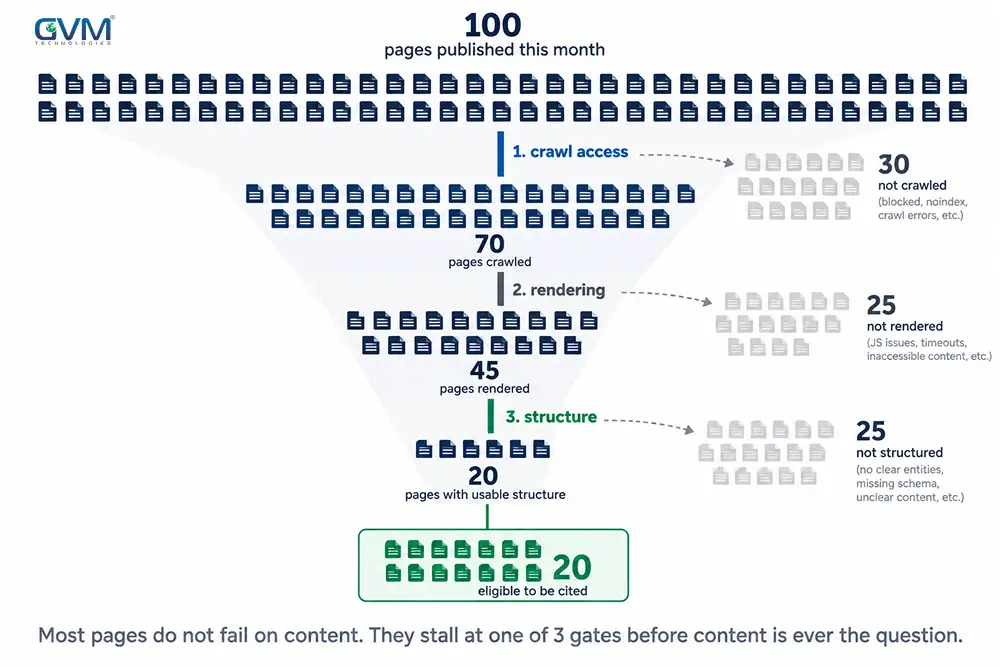
An AI system cannot cite a page it cannot fetch and read cleanly. That single fact is why AI optimization starts with 3 checkable layers, not a content brief.
| Layer | What it checks | What fails if it does not hold |
|---|---|---|
| 1. Crawl access | Can an AI crawler reach the page at all | The page is invisible, regardless of content quality |
| 2. Render and index | Does content actually load in the raw HTML | JavaScript-only content often reads as blank |
| 3. Structure and schema | Can a clean, standalone passage be lifted | Strong answers get buried and never quoted |
1. Crawl access
Robots.txt has to explicitly allow GPTBot, ClaudeBot, PerplexityBot, and Google-Extended. It is an honor-system request, not a lock, compliant crawlers respect it, but nothing technically forces a non-compliant one to.
- OpenAI alone runs 3 separate crawlers with different jobs: GPTBot trains on content, OAI-SearchBot builds ChatGPT’s live search index, and ChatGPT-User fetches a page live when someone clicks a citation.
- A site can allow search crawling while blocking training. Most AI optimization content treats “GPTBot” as the only one that matters and misses this entirely.
2. Render and index
AI systems generally read the raw HTML a page returns, not what a browser shows once JavaScript finishes running. Content that only appears after a script executes can be invisible to a crawler even though it looks complete to a visitor.
- Server-side rendering or static generation is the direct fix for any page meant to be an AI optimization priority.
- Bing indexation matters here too. A real share of what ChatGPT surfaces in search mode leans on Bing’s index, on top of its own crawler.
3. Structure and schema
AI systems pull short passages, not full pages. A passage earns reuse when its direct answer sits in the first sentence of a section and the section reads correctly on its own.
FAQPage schema still helps, but not for the reason most people assume. Google retired FAQ rich results in classic Search in May 2026, so a marked-up FAQ block no longer wins extra space on the results page.
It still gives an AI system a clean structure to parse. Treat it as an extraction aid, not a ranking tactic, and never swap it for QAPage, the schema meant for user-submitted questions.
Why Structure Beats Backlinks for AI Retrieval
Search engines and AI systems score content differently. That gap is why a lower-authority page can out-cite a bigger competitor.
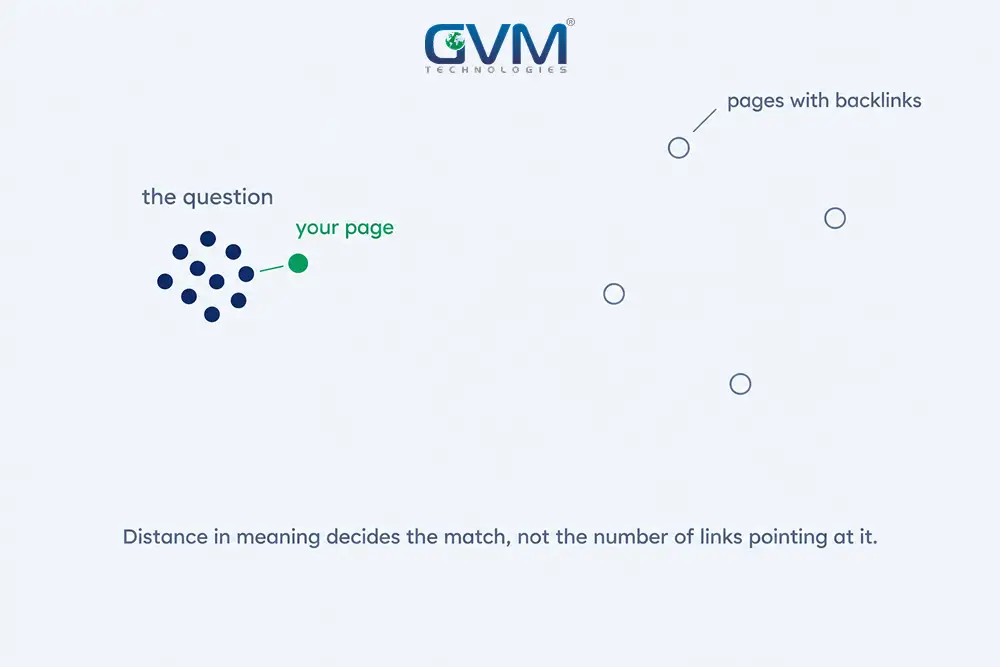
Google’s ranking systems weigh backlinks and domain history heavily. AI retrieval weighs something else first: how closely your text matches the meaning of the question.
Retrieval systems convert the question and your content into numerical representations of meaning, then measure how close those sit to each other.
A clear, self-contained answer can match closely with zero backlinks. A page buried in scene-setting prose can match poorly even with a strong link profile.
| Signal | What decides a Google ranking | What decides an AI citation |
|---|---|---|
| Primary weight | Backlinks and domain authority | Semantic match to the question |
| Secondary weight | Engagement, historical trust | Passage clarity, corroboration |
| What it rewards | A well-linked page | A well-structured, standalone answer |
This is why a smaller site with tightly written answers regularly out-cites a bigger, better-linked competitor whose content was never written to be lifted out of context.
What Breaks When You Skip the Technical Layer
This is the most common pattern in an AI optimization audit that starts from zero. A site publishes strong content, adds an FAQ block, and starts tracking mentions across ChatGPT and Perplexity, then nothing moves.
- The content is rarely the actual problem.
- The crawler could not reach half the site’s key pages, or
- The pages it reached were still rendering client-side, invisible to anything that was not a browser running JavaScript.
We ran a full crawl-and-render audit before writing a single page for a commercial trucking insurance client. The technical gaps were larger than the content gaps, so crawl access came first.
The client case studies cover work built the same way, across insurance, real estate, and e-commerce.
The Technical-First AI Optimization Checklist
Work through this order before spending on content, schema wording, or a citation-tracking tool.
- Confirm robots.txt explicitly allows GPTBot, ClaudeBot, PerplexityBot, and Google-Extended.
- Load your top pages with JavaScript disabled and confirm real content still appears.
- Verify indexing in Bing Webmaster Tools, not only Google Search Console.
- Check Core Web Vitals against Google’s thresholds: LCP under 2.5 seconds, INP under 200 milliseconds, CLS under 0.1, at the 75th percentile.
- Confirm each section opens with a direct answer in its first sentence.
- Use FAQPage schema only for questions your own site wrote, never for user-submitted content.
- Match your business name, description, and facts across your site, listings, and reviews.
- Skip
llms.txtas a fix on its own. Current evidence shows no measurable citation effect from the file alone. - Re-run this checklist after any migration or redesign, since rendering can silently break during a rebuild.
Necessary, Not Sufficient: Where AIO Hands Off to GEO
Passing all 3 technical layers makes a page eligible to be cited. It does not make citation automatic.
Before repeating a claim about a business, an AI system checks whether the rest of the web agrees. That entity-consistency check is where GVM’s own service breakdown shifts from AI optimization work into GEO work.
- Your name, description, and core facts should read identically across your site, listings, and reviews.
- Recency outweighs volume. We have seen a business with hundreds of older reviews passed over for a competitor with a smaller, more recent set.
- A brand-new site can be technically flawless and still get skipped for an established competitor, simply because it has no off-site footprint yet to check against.
That gap closes with entity and off-site work, not more technical fixes on a site that already passes the audit.
How to Tell If an “AIO” Offer Skips the Technical Work
The market for “AI optimization” services is crowded, and quality varies widely.
A pitch that opens with a promised visibility score, before ever mentioning robots.txt, rendering, or Bing indexation, has usually skipped the layer that decides whether the rest of the work can succeed.
- What did you check first? A real audit names robots.txt, rendering, and indexation by name, not just “AI visibility.”
- What changes if my site is client-side-rendered? A provider who has not asked this has not actually audited a modern site.
- How will you prove the fix worked? A before-and-after crawl test beats a proprietary score you cannot verify yourself.
A guaranteed AI citation or ranking is a red flag, not a skill signal, since nobody controls what a non-deterministic system cites on a given run.
See our full agency due-diligence guide, or these 7 questions for hiring an AI SEO specialist, before you sign anything.
See exactly which layer is holding you back. GVM breaks its own AI optimization work into the same 3 checks this guide covers, priced line by line on our SEO, AEO, AIO, and GEO pricing page.
Book a free SEO and GEO audit for a straight read on your site before spending on anything else.
How Long the Technical Layer Takes to Fix
Robots.txt corrections and Bing submission can take effect within days. Rendering fixes depend on the build: a configuration change on an already-capable platform can ship in a week, a full move to server-side rendering takes several weeks.
Content and off-site entity work compounds over 2 to 4 months. Fixing the technical layer first is the fastest way to learn whether an AI system can see your site at all, before a much larger content budget gets spent chasing it.
FAQs
1. What does AIO stand for?
AIO stands for AI Optimization, the technical work that lets AI systems access, read, and understand a site. Some providers use it more narrowly, for ranking inside Google’s AI Overview box specifically, so confirm which meaning is meant before hiring for it.
2. Is AIO the same as AI Overview Optimization?
Not exactly. AI Overview Optimization targets one Google feature. AI optimization, as used here, covers crawl access, rendering, and structure across every AI system, including ChatGPT, Perplexity, and Google’s AI Overviews and AI Mode.
3. Is AIO the same as GEO or AEO?
They overlap but target different things. AIO is the readiness layer underneath both: can an AI system reach, parse, and trust the site at all. AEO targets being the short, direct answer. GEO targets being cited inside a longer response.
4. Why does technical SEO come before AIO content work?
An AI system cannot cite a page it cannot fetch and render cleanly. Crawl access and indexing gate everything built on top of them, including content, schema wording, and off-site mentions.
5. What technical fixes matter most for AI optimization?
In order: confirm robots.txt allows the major AI crawlers, verify content renders in raw HTML rather than only after JavaScript runs, confirm Bing indexation alongside Google’s, and keep business facts consistent everywhere they appear.
6. Do I need to rebuild my website for AIO?
Usually not. Most sites need targeted fixes: a robots.txt correction, a rendering fix for key pages, and consistency cleanup across listings. A full rebuild only applies when the whole site is client-side-rendered with no server-side fallback.
7. Can an agency guarantee my AI optimization results?
No. AI-generated answers are non-deterministic, meaning the same prompt can cite a different source on a different run of the same platform. A provider can fix the technical layer, but nobody controls what gets cited on a given run.
Conclusion
AI optimization is not one tactic, and it is not whatever a given provider decides to sell under that name. It comes down to 3 checkable layers, crawl access, rendering, and structure, plus the entity work that hands off to GEO once those 3 hold.
Skip that order and content work becomes a bet on a foundation nobody checked. Fix it first, and everything built afterward, content, schema, entity work, finally has a system that can actually see it.
GVM Technologies checks all 3 layers before recommending a single new page, priced the same way on its own SEO, AEO, AIO, and GEO pricing page.
One accountable team since 2012, ISO-certified, with named client work in insurance, real estate, and e-commerce. Get a free audit and see exactly where your own technical layer stands.