Ask 10 marketers whether, “is GEO just rebranded SEO” and you get 10 different answers.
Quick answer: partly yes, partly no. Most of what makes content work for GEO (Generative Engine Optimization, getting your brand cited inside AI answers) is the same work that already made it rank in SEO (Search Engine Optimization).
One layer is genuinely new. A large share of agencies now selling GEO have just relabeled an SEO retainer, which is why it helps to know the difference before you vet a GEO or SEO agency.
This is the version with the parts most service providers leave out.
Key Takeaways
- The overlap is high. If your technical SEO, content, and authority work are strong, you are most of the way to GEO already.
- The new work is a layer, not a replacement: passage-level structure, entity consistency across the web, AI-crawler and Bing checks, and measurement built for answers that change on every run.
- “GEO” on an invoice tells you almost nothing. The same word covers “we added an FAQ block” and “we track citation share across 5 platforms weekly.”
- No agency controls what an AI cites, so a guaranteed AI citation is a red flag, not a feature.
- GEO, AEO, AIO, and LLMO mostly name the same goal. The terminology is unsettled, and honest practitioners say so.
The Honest Answer: Mostly Evolved SEO, Plus One New Layer
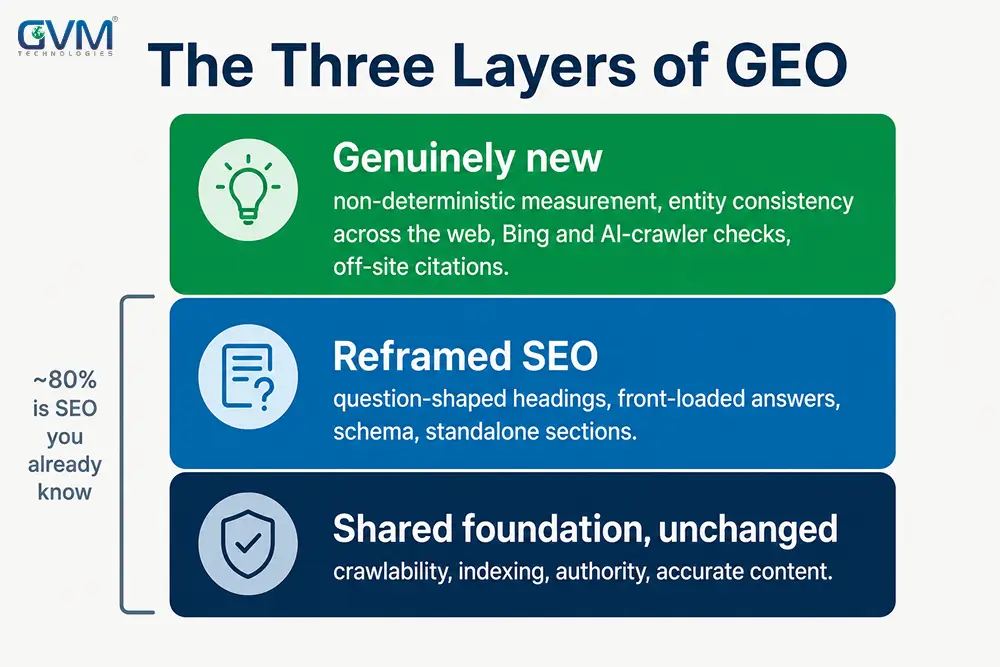
It helps to split GEO into 3 layers.
1. The shared foundation did not change
A page an AI cannot crawl, index, or trust will not be cited. Crawlability, site speed, real topical authority, accurate content, and genuine expertise carry over from SEO almost completely. This is the bulk of the work.
Google says the same thing in its generative-AI optimization guide: AI Overviews and AI Mode run on the same core ranking and quality systems as regular Search, and standard SEO still applies.
2. The structural work is reframed, not reinvented
You still write headings, structure sections, and add schema. You now do it so a single passage can be lifted cleanly into an answer, not only so a page ranks. Same skills, moved target.
3. One layer really is new
AI answers are assembled fresh from many sources at the moment of the question. That brings in problems SEO never had: results that differ on repeated runs, a citation pool wider than your own site, and separate AI crawlers you allow or block on their own.
| Layer | What it covers | Is it new? |
|---|---|---|
| Foundation | Crawlability, indexing, authority, accurate content | No, identical to SEO |
| Structure | Question-shaped headings, front-loaded answers, schema, standalone sections | No, reframed SEO |
| AI-specific | Non-deterministic measurement, entity consistency across the web, Bing and AI-crawler checks, off-site citation work | Yes, this part is real |
Why the “Just a Rebrand” Accusation Sticks
The skepticism is fair, because a lot of what gets sold as GEO is an unchanged retainer with a new line on the invoice.
1. The incentive to relabel is obvious
Adding “GEO” or “AI SEO” to a service page costs nothing and looks current. Changing the actual method costs time and new skill. Many shops skipped the second part.
2. The overlap makes it easy to hide
Because the foundation and structure layers really are shared SEO work, a shop can point at its normal work and call it GEO without lying outright. The tell is the missing AI-specific layer, not the presence of the shared one.
3. A relabeled audit looks like a 2022 SEO audit
If the deliverable is a keyword gap analysis, a few title-tag fixes, and an FAQ block, with no prompt testing, no named platforms, and no dated baseline, the label is doing the selling. Asking for a real AI-citation baseline before you sign exposes this in one conversation.
Note: A relabel is not always dishonest. Plenty of capable teams added schema and the word “AI” in good faith. The problem is paying a premium for work you already had.
What GEO Changes: Same Skills, New Target
1. SEO ranks a page, GEO gets a passage picked
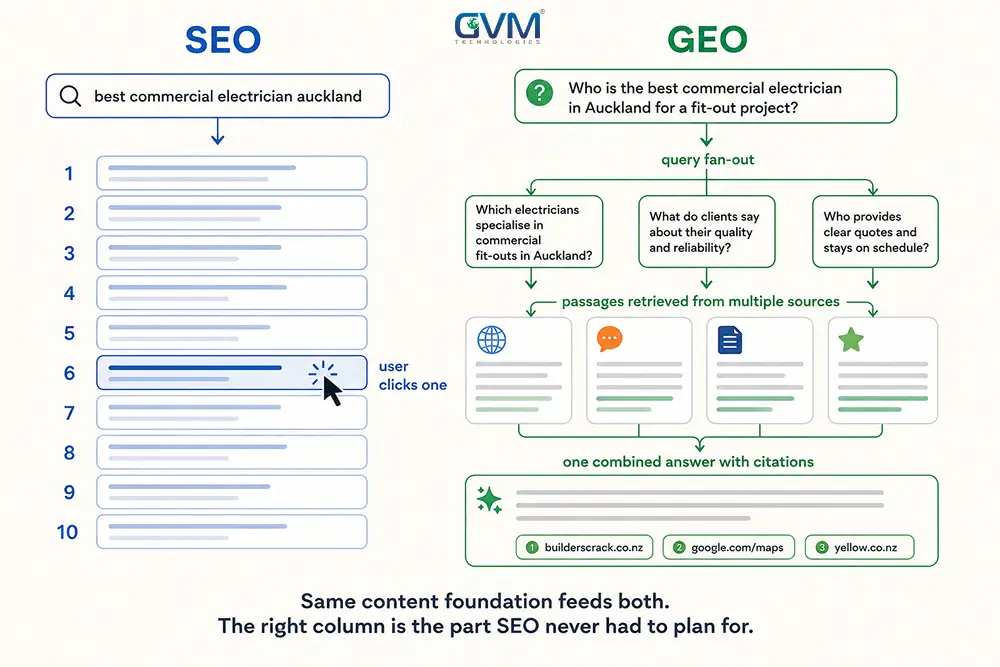
Search returns a page and hopes for a click. An AI answer pulls a sentence or a short block from your page, mixes it with blocks from other sources, and often sends no click at all. The unit of optimization shrinks from the page to the passage.
2. Keywords become questions and entities
SEO maps a page to a phrase. GEO maps it to the full question someone types into a chat box and the named things that question involves. One AI question often fans out into several hidden sub-searches, so covering the related questions on one clear page helps.
3. Measurement becomes sampling, not ranking
Run the same prompt twice and you can get two answers citing two different sources. That is non-determinism, and it is how these systems generate text. Credible measurement runs a prompt set many times and reports the pattern, which is why GEO reporting has to go past a single score. Google now offers a first-party view for this inside Search Console’s AI performance reports.
| Question | SEO answer | GEO answer |
|---|---|---|
| What wins? | A page, in a fixed position | A passage, chosen fresh each run |
| Is it stable? | Mostly, day to day | No, it varies on repeated runs |
| Where does the win happen? | Mostly your own site | Often third-party sites you do not own |
| Which index matters? | Google, mainly | Google and Bing, plus direct AI crawlers |
What Actually Moves AI Citations
This is the part few articles cover, because it comes from doing the work, not describing it.
1. Original data and first-hand experience
LLMs already answer “what is X” well, so another generic explainer earns little. A page with your own numbers, a real test, or a lived account gets cited because nothing else on the web says it. We have watched original data move a brand’s citation rate with no change in its Google ranking at all.
2. A direct answer, stated first
The engines lift the sentence that answers the prompt. Put it at the top of the section, not three paragraphs in.
3. Say what you are not, and what you do not do
If a page never states its limits, an AI will happily invent features a product does not have. Writing the boundaries plainly is the difference between an accurate citation and a misrepresentation.
4. Off-site mentions and consistent entity data
AI systems build a picture of a brand from its site plus reviews, directories, publications, and community threads. Even a couple of clear third-party mentions can outweigh a polished homepage. Keep the brand name, description, and key facts identical everywhere they appear.
| Moves the needle | Does little or hurts |
|---|---|
| Original data, first-hand experience | Another generic “what is X” post |
| Direct answer at the top of the section | Long build-up before the point |
| Specific, checkable statistics and named quotes | Keyword stuffing (still a negative signal) |
| Consistent entity data across the web | Rare synonym swaps to “sound authoritative” |
Clean robots.txt and real crawlability |
llms.txt as a standalone tactic |
GEO, AEO, AIO, LLMO: One Goal, Too Many Acronyms
The terms overlap heavily and the market has not settled them. Anyone defining them with total confidence is guessing.
1. The working definitions most practitioners use
- GEO: be found, understood, and cited by AI systems that generate answers.
- AEO (Answer Engine Optimization): the narrower “be the direct answer” slice, including snippets and voice results.
- AIO / LLMO: the same idea again, framed around AI or the models themselves.
- Search Everywhere Optimization: the umbrella some teams now use for all of it.
2. How we treat them
We do not argue labels on client calls. We treat AEO as the “be the direct answer” half of the wider GEO goal, and the rest is one job: be the clearest, most trustworthy source when a question is asked. If a pitch leans hard on policing the GEO-versus-AEO boundary, that is usually packaging.
The Rebrand Test: 5 Questions for Any Agency
Run these on a pitch, or on your own team. Specific answers mean real work. Vague answers mean a relabel.
| # | Ask this | Real-practice answer | Relabel answer |
|---|---|---|---|
| 1 | What do you do differently for GEO than standard SEO? | Names concrete items: entity audits, Bing checks, multi-platform citation tracking | “It is all connected,” no specifics |
| 2 | Which AI platforms do you track, and how often? | Names 4 or more, explains repeated sampling | Names one, or “AI platforms” generally |
| 3 | Why can the same prompt give a different answer twice? | Explains non-determinism in one sentence | Cannot, or calls it a glitch |
| 4 | What happens in the first 30 days beyond content? | Technical first: crawl access, schema, entity cleanup, Bing | “We start producing content in week one” |
| 5 | Do you guarantee an AI citation or a ranking? | No, and explains why it is not controllable | Yes, in any form |
If an agency fails question 5, stop there. No one controls what a probabilistic system cites on a given run, so a guarantee means they either do not understand the mechanism or will overpromise to close. Our full breakdown of what your first 30 days should cover expands on question 4.
1. Apply the same test to price
Real, dedicated GEO work carries a real cost, because repeated multi-platform measurement and entity work take time. A combined SEO and GEO quote priced far below a normal full-service SEO retainer is usually a single audit dressed as an ongoing program. Our tiers are on the SEO and GEO pricing page so you can compare without a sales call.
2. Apply it to your own team
If SEO and GEO come from 2 disconnected teams, their advice quietly conflicts: one wants a page split, the other wants it merged; one strips schema, the other adds it. One accountable team on both, from the same technical foundation, is how GVM Technologies runs it, and it is the cleanest way to avoid that.
Ready to run this test on us? GVM Technologies has built SEO and GEO together since 2012, with ISO-certified process and named client work in insurance, real estate, and e-commerce. Get a free SEO + GEO audit and a straight answer to all 5 questions. See the client case studies first if you want proof before a call.
FAQs
1. Is GEO just SEO with a new name?
No, though the confusion is fair. The foundation and the structural work are reframed SEO, and that is most of the job. One layer is new: passage extraction, entity consistency across the web, AI-crawler and Bing checks, and measurement built for answers that change on repeated runs.
2. Is SEO dead now that GEO exists?
No. AI answer engines still lean on traditional search retrieval underneath, and Google frames the bar for both as helpful, reliable, people-first content. A page that cannot rank is far less likely to be retrieved and cited, so SEO is the foundation GEO stands on.
3. Do I need a separate GEO agency and a separate SEO agency?
Usually not. Two disconnected vendors often give contradictory advice without noticing. One team handling both from the same foundation is stronger, since GEO builds directly on SEO fundamentals.
4. What is the real difference between GEO, AEO, and SEO?
SEO targets a ranked position in a list of links. AEO targets being the short, direct answer. GEO targets being cited inside a longer AI-generated response across platforms. AEO and GEO overlap so much that many people use the terms interchangeably.
5. Can you do GEO without doing SEO first?
Not effectively. If a page cannot be crawled, indexed, or trusted, it will not be pulled into an AI answer. The technical and authority work SEO covers is a prerequisite, not an optional partner.
6. How do I know if an agency is really doing GEO or relabeling SEO?
Ask what they do differently from standard SEO, which platforms they track and how often, and what the first 30 days include beyond content. Specific answers mean real work. If they guarantee a ranking or a citation, walk away.
7. Can AI citations even be measured?
Not as a single fixed number. The honest approach samples the same prompts repeatedly and reports the trend and its stability, plus first-party data from Search Console’s AI performance view. Anyone quoting one exact “AI visibility score” from one run is not measuring it carefully.
Conclusion
GEO is not a rebrand and it is not a revolution. It is SEO that took AI retrieval seriously: same foundation, reframed structure, one real new layer for measurement, entities, and AI crawling.
The part that deserves your skepticism is the market, not the discipline. When “GEO” on an invoice can mean anything, the questions you ask matter more than the label.
Run the Rebrand Test on whoever you are considering, including us.
If you want a clear read on where your site stands across Google and AI answers, GVM Technologies offers a free SEO + GEO audit with no obligation, from one team that has built both together since 2012.