Every SEO freelancer and agency now offers “AI SEO” or “GEO.” Very few changed how they work to earn the label.
Before you hire an AI SEO specialist, use 7 questions that expose the gap between the title and the skill.
A real practitioner explains how AI answer engines retrieve and cite content, shows their own citations on the call, and refuses to promise a ranking.
Hiring a firm instead of a person? Run our agency due-diligence checklist alongside this.
Quick answer: Ask the candidate to explain how ChatGPT or Perplexity chooses what to cite, and to show where their own work is cited today. Then ask what they would fix before writing any content, and how they measure a system that changes its answer every run. Specific answers point to a real specialist. Buzzwords and guarantees point to a relabel.
Key Takeaways
- “GEO specialist” and “AI SEO expert” are unregulated titles roughly 2 years old. The 7 questions test the skill the title is supposed to stand for.
- The sharpest single question is “explain how an AI engine picks a citation.” A real answer describes retrieval and query fan-out, not a separate secret algorithm.
- A guarantee of rankings, citations, or a deadline is a dealbreaker on its own. No one controls a probabilistic retrieval system.
- Ask whether your brand gets cited as the correct company. AI systems routinely merge similarly named businesses and credit the wrong one.
- AI search traffic is still small for most sites, often 1 to 3 percent of sessions, but it tends to convert 2 to 3 times better because visitors arrive already sold.
Why “AI SEO” and “GEO” on a Resume Tells You Almost Nothing
The label is new, unregulated, and attached to work that ranges from a genuine technical discipline to an FAQ block and a new invoice line.
1. The title is about 2 years old and certifies nothing
There is no recognized GEO certification, licensing body, or shared standard as of 2026. Anyone can print “Generative Engine Optimization specialist” on a profile tomorrow.
That is not a reason to skip hiring help. It is the reason to test for understanding instead of trusting the words.
2. Most “GEO” offers are a relabeled SEO retainer
A large share of specialists now selling GEO were selling the same audits 18 months ago. The methodology did not change. The deck did.
Google is blunt about the overlap. Its own guide to generative AI states that optimizing for AI search “is optimizing for the search experience, and thus still SEO.”
3. What a real specialist actually adds on top of SEO
Around 85 percent of the work is ordinary technical SEO done well: crawlable pages, clean structure, real expertise, thin pages removed.
The genuine 15% that is different:
- Writing self-contained answers that still make sense when an AI system lifts them out of the page.
- Keeping your brand described identically across your site, schema, Wikidata, and third-party listings.
- Earning mentions on pages you do not own, since unlinked brand mentions move AI citations more than backlinks do.
Our honest take on whether GEO is just rebranded SEO goes deeper on that split.
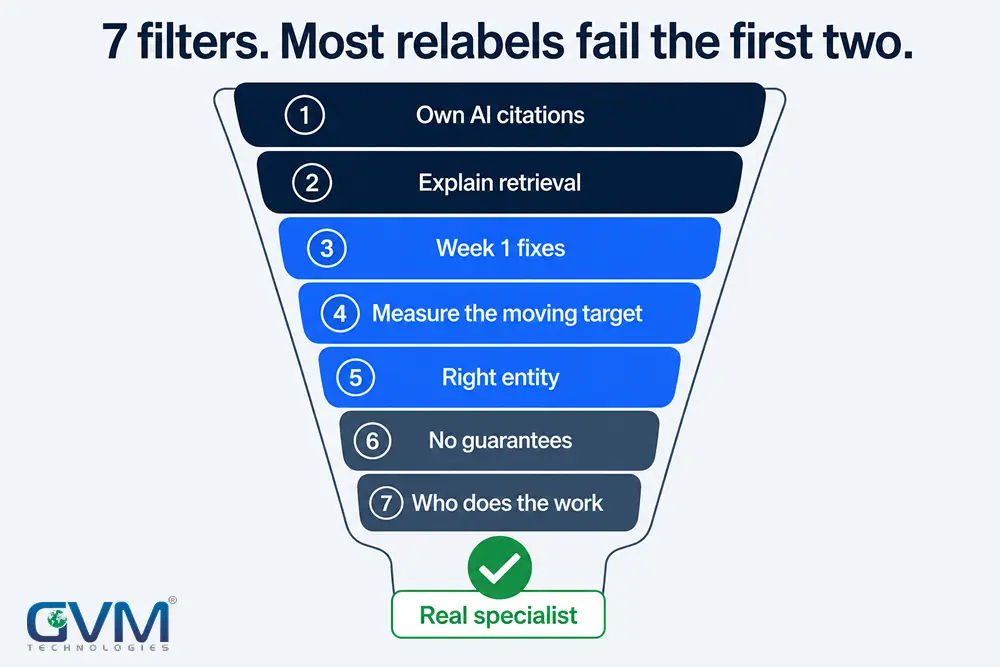
The 7 Questions That Separate a Real Specialist From a Relabel
Ask these in order. Each one tests a different thing, and the early ones are the hardest to fake.
1. Make them prove their own AI visibility first
Ask: “Show me where your own content or your own name gets cited by ChatGPT, Perplexity, or Google’s AI Overviews right now.”
Someone selling AI visibility should have earned some for themselves. This takes 2 minutes and is very hard to fake live.
| Strong answer | Weak answer |
|---|---|
| Runs a prompt in the room, points to the cited page, explains what made it citable | Shows a traffic chart, or deflects with “client work is confidential” and no redacted alternative |
2. Make them explain how AI engines choose citations
Ask: “Walk me through how ChatGPT or Perplexity decides what to cite for a question.”
The right answer describes retrieval. The engine splits your question into several searches, pulls pages from a search index, then writes a single answer and cites what it used.
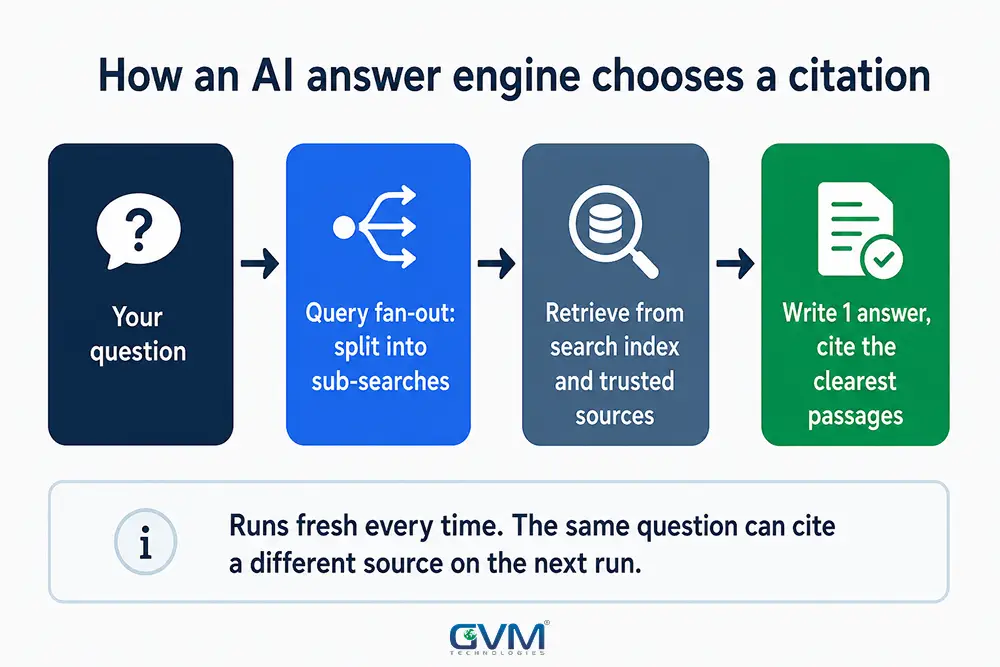
A strong candidate also mentions:
- Query fan-out: a single question becomes several background sub-searches before the model writes anything.
- Bing dependency: ChatGPT search leans on Bing’s index, so a site missing from Bing Webmaster Tools starts behind.
- Non-determinism: the same prompt can cite different sources on different runs.
A candidate who says “AI has its own ranking algorithm” or “you just need an llms.txt file” does not understand the mechanism.
3. Ask what they fix before publishing a single page
Ask: “What would you check and fix in the first week that has nothing to do with writing content?”
Real early work is technical and invisible. A pitch that is all content volume from day 1 is skipping the foundation.
The checklist a competent specialist reaches for:
- Crawler access in
robots.txtfor GPTBot, OAI-SearchBot, ClaudeBot, and PerplexityBot. - Bing indexation, because most sites have never been submitted there.
- Rendering, since client-side content can be invisible to AI crawlers that skip JavaScript.
- Schema and entity cleanup, so the business is described one way everywhere.
Our breakdown of a real first 30 days shows the full sequence.
4. Pin down how they measure a moving target
Ask: “If the answer changes every run, how do you measure whether my visibility improved?”
The honest method is repeated sampling. You run a fixed set of about 30 buyer questions across several platforms each month, then track whether your brand appears and what gets cited beside it.
| Credible measurement | Vanity metric |
|---|---|
| A dated baseline, a fixed prompt set, share of voice against named competitors, a line to leads | A single “AI visibility score” with no method you can check |
Two first-party signals belong in the answer:
- Search Console’s generative AI report, for visibility inside AI Overviews and AI Mode.
- An AI-assistant channel group in analytics, since default reporting buries that traffic inside “Direct.”
A credible plan also sets a dated baseline before work starts and reports past a single score.
5. Check whether you are cited as the right company
Ask: “How do you make sure an AI system cites my brand, and cites it as my company, not a similarly named one?”
This is the question almost no one asks, and the failure is common. A page can rank first and still get credited to the wrong entity because the model cannot tell two similarly named businesses apart.
A strong answer covers entity clarity work:
- The same business name, description, and category across the site, schema, and every third-party profile.
- A clean knowledge graph and Wikidata entry where relevant.
- Monitoring the actual answers, not just rankings, to catch a misattributed citation early.
6. Treat any guarantee as a dealbreaker
Ask: “Do you guarantee a ranking, an AI citation, or a date by which I will see results?”
The only safe answer is no, with a reason. No agency or individual controls Google’s ranking systems or an AI platform’s retrieval process.
| Strong answer | Weak answer |
|---|---|
| “No. I commit to specific work and honest staged expectations, not an outcome a probabilistic system decides at query time.” | Any version of yes, including “we’ve never missed,” or a deposit-plus-guarantee pricing structure |
We explain the full mechanism in why a guaranteed AI citation is a red flag.
7. Find out who actually does the work
Ask: “Who runs my account day to day, and what would you deprioritize for my specific site?”
A senior often sells the deal and a junior with a dozen accounts inherits it. That can be fine, but you want to know going in.
The trade-off half matters most. An answer that would fit any client means they have not studied your site; a specialist who names something specific they would skip for you, with a reason, has.
Specialist, Freelancer, or Agency: Which One Fits
Match the hire to the job. The failure mode is different for each.
| Option | Best for | Main risk |
|---|---|---|
| Freelance specialist | A defined audit, a fix list, part-time upkeep on a small site | A single person, limited hours, no backup |
| Agency | Technical, content, and digital PR running at once | Overhead cost, and the senior who sold it is not the one doing it |
| In-house hire | AI search as a core channel that needs someone in every planning call | A strong specialist is not always a strong manager |
| One team for SEO and GEO | Both search surfaces from a single technical foundation | Confirming the “combined” claim is real, not 2 disconnected teams |
If a long contract is on the table, read audit first or long contract before you sign.
Red Flags and Green Flags in a Hiring Conversation
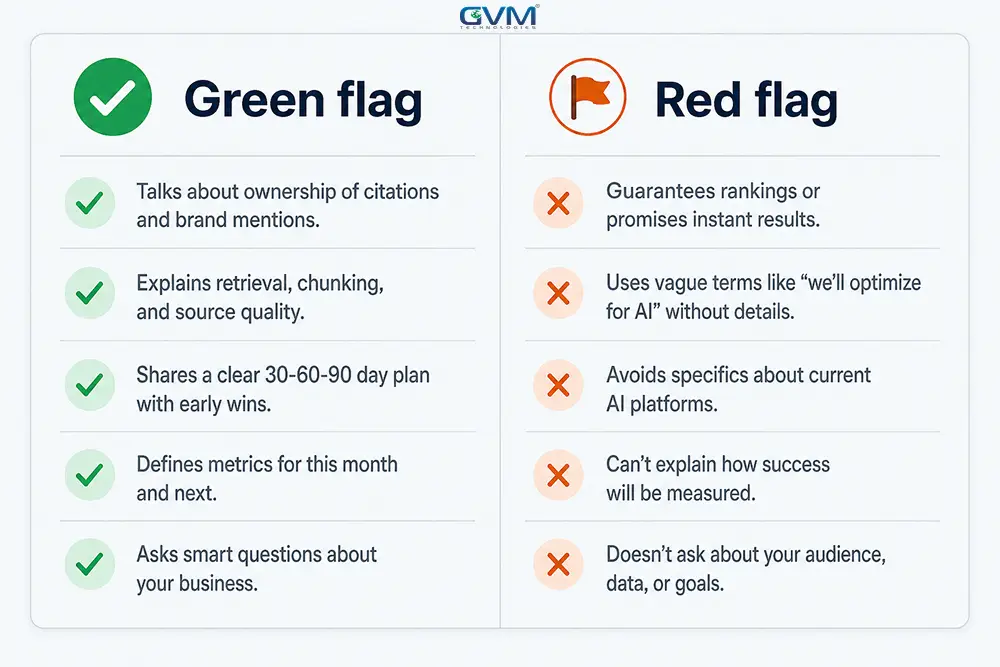
| Green flag | Red flag |
|---|---|
| Shows their own AI citations without being asked | “I can’t share any examples,” with no redacted version |
| Explains query fan-out and retrieval in plain words | Calls AI search a separate secret algorithm |
| Week 1 plan is mostly technical | Week 1 plan is “publish 4 posts a week” |
| Samples a fixed prompt set monthly and reports the pattern | Reports one fixed score with no method |
| Checks whether you are cited as the correct entity | Never mentions entity or brand consistency |
| Refuses to guarantee an outcome and says why | Guarantees a ranking, a citation, or a date |
What an AI SEO or GEO Specialist Costs in 2026
As general market context, an experienced freelance GEO specialist runs about 150 to 300 dollars an hour, and agency programs commonly start near 3,500 dollars a month.
Dedicated AI-search work below roughly 1,500 dollars a month is usually a template with no strategist attached.
Why the floor exists
Building a real baseline means running a genuine prompt set across several AI platforms, repeatedly. A rock-bottom one-off audit price buys a single unreliable prompt run.
Tracking tools are a separate cost, often several hundred dollars a month on their own. Ask whether that sits inside the fee or on top of it.
Why cheap GEO add-ons backfire
A cheap add-on, a few extra posts and a vague dashboard, is the pattern that leaves owners burned and unsure what they paid for.
GVM Technologies builds the AI-search layer into the core engagement instead of selling it as an upsell later, and our view on real GEO pricing in the US shows why that matters.
Where GVM Technologies Fits
Run these 7 questions on us before you take anything on faith.
- Proof: operating since 2012, ISO 27001, 20000-1, and 9001 certified, with named client results across insurance, real estate, and e-commerce on our case-study hub.
- Mechanism: we explain retrieval, query fan-out, and non-determinism so you can check our reasoning, not just trust it.
- Foundation: our own
robots.txtalready allows GPTBot, ClaudeBot, PerplexityBot, and Google-Extended. - One team: SEO and generative engine optimization are built together, so the two sets of recommendations never contradict each other.
For teams weighing an India-based partner, our view on how that model should work explains why we publish both office addresses.
Conclusion
Hiring an AI SEO or GEO specialist is not about the words on the profile. It is about whether they can explain how AI answer engines retrieve and cite content, show they have earned some of that visibility, and tell you plainly what they cannot promise.
Run the 7 questions on your next 2 or 3 candidates. The person who explains the mechanism, shows a real example, checks your entity, and refuses to guarantee an outcome is almost always the right hire.
Get a straight answer to all 7 questions in one call
Bring this list to GVM Technologies. We will run your own prompt set with you, live, and show where your site stands in AI answers today before you commit to anything.
Book a free SEO and GEO strategy call
FAQs
1. What does an AI SEO or GEO specialist actually do?
They optimize a site so AI answer engines like ChatGPT, Perplexity, and Google’s AI Overviews can find, understand, and cite it. The work sits on top of technical SEO and adds self-contained answers, entity consistency, crawler access, and cross-platform measurement.
2. Do I need a GEO specialist or a GEO agency?
Hire an individual for a defined project or part-time upkeep on a small site. Hire an agency when technical work, content, and digital PR all need to run at once. The 7 questions apply to both.
3. How much should I pay to hire an AI SEO specialist?
As market context, roughly 150 to 300 dollars an hour for an experienced freelancer, or agency programs from about 3,500 dollars a month. Much cheaper for real multi-platform work usually means templated execution.
4. Can one person handle both SEO and GEO?
Yes, and the best specialists treat them as one job since most of the work overlaps. Be cautious of anyone who cannot also audit crawlability, indexation, and site structure, because GEO is built on that foundation.
5. Are GEO certifications worth anything?
Not yet. There is no established, respected GEO certification in 2026. Ask the person to explain a mechanism and show a real citation instead of trusting a badge.
6. How long until an AI SEO specialist shows results?
Readability and structured-data fixes can show impact within 2 to 4 months. Competitive movement takes longer and depends on authority. Anyone promising citations in weeks is guessing.