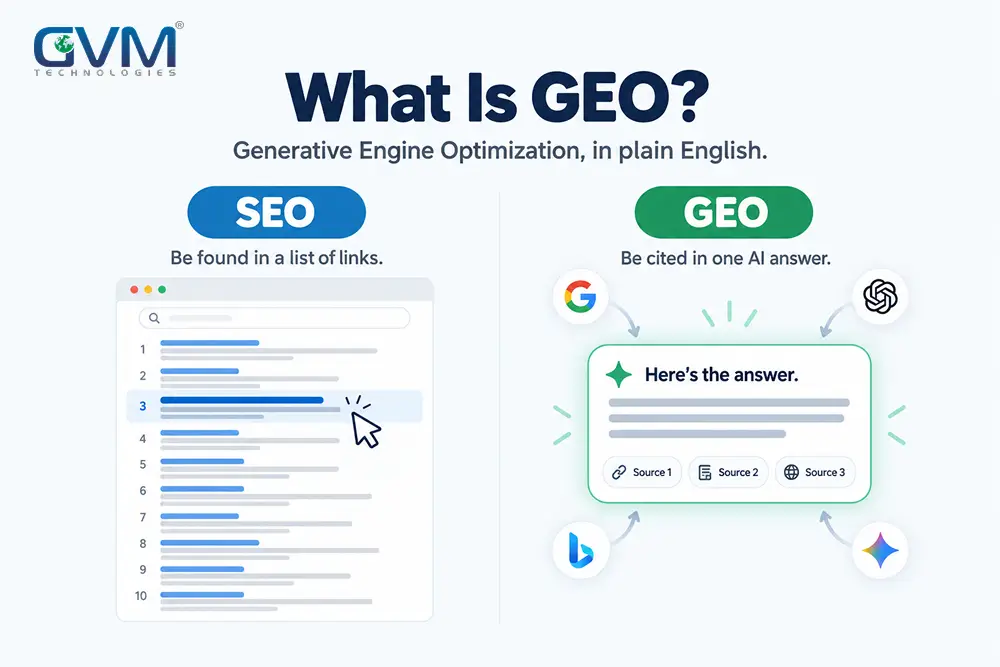
Generative engine optimization is what SEO becomes when search hands back a written answer instead of a list of links. Your brand is either inside that answer or it is not.
Generative engine optimization (GEO) is the work of getting your brand found, understood, and cited inside the answers that AI tools like ChatGPT, Perplexity, Google AI Overviews, and Gemini generate.
It runs on the same foundation as good SEO, plus one new layer for how AI systems reuse content.
Because so much of it is ordinary SEO, it is fair to ask whether GEO is just SEO with a new name.
Key Takeaways
- Generative engine optimization is a sub-discipline of SEO, not a replacement. Strong fundamentals get you most of the way there.
- AI engines mostly retrieve live sources and synthesize an answer. They do not simply know it, so the open web still decides what gets said.
- 3 things decide a citation: an AI can reach your page, it can lift a clean answer from it, and the rest of the web agrees on who you are.
- The same question can return different sources on different runs, which changes how generative engine optimization is measured.
- No one controls what an AI cites on a given run, so a guaranteed AI citation is a red flag.
- The pages that get cited are the clear ones, not the longest ones.
What Generative Engine Optimization Means
Generative engine optimization is optimizing your content and wider online presence so answer-writing AI systems can find it, understand it, and quote it.
“Generative” points to the AI that writes a fresh reply instead of returning a page of links.
The behavior driving it is plain. More people type a full question into an AI tool and read the answer instead of clicking 10 blue links.
If you are absent from that answer, you are absent from that buyer.
Generative engine optimization vs AEO vs SEO
You will see these terms used loosely. Here is the working split most practitioners use day to day.
| Term | What it targets | Plain version |
|---|---|---|
| SEO (Search Engine Optimization) | A ranked spot in a list of links | Be on the results page |
| AEO (Answer Engine Optimization) | Being the short, direct answer | Be the snippet or the voice reply |
| GEO (Generative Engine Optimization) | Being cited inside a longer AI answer | Be a source the answer is built from |
AEO and GEO overlap so much that we treat AEO as the “be the direct answer” half of the wider GEO goal.
AIO and LLMO are the same idea again under different letters.
What generative engine optimization is not
- Not a separate ranking algorithm you can game.
- Not a file you upload. Google’s own guidance says you do not need special files or content chopped into fragments.
- Not a guarantee, and not a reason to stop doing SEO.
Say this plainly: GEO is young. Some of it is settled, some is still being worked out. Anyone describing it with total certainty is selling something.
How AI Engines Choose What to Cite
Most AI answer engines do not store the answer to your question. They retrieve current web content, then synthesize a reply from what they pulled.
That one fact explains most of generative engine optimization.
1. The sequence behind an answer
- Fan-out. Your one question is split into several related searches behind the scenes.
- Retrieval. Those searches run against a web index and pull back pages, often the same pages that rank in normal search.
- Synthesis. Short passages from several pages are stitched into one answer.
- Citation. A few of those sources get named, usually 2 to 7.
2. A question, traced end to end
Someone asks an assistant, “who are the best commercial trucking insurance brokers for a small fleet?”
The system fans that into a few related searches, then pulls a sentence from a broker FAQ, a row from a directory table, and a line from a forum thread. It writes one paragraph naming 3 brokers and linking 2.
The broker it cited did not win a ranking. It had one page that answered that exact question in a form easy to lift.
We have run SEO and GEO together for a commercial trucking insurance client, and the pattern held: the pages earning citations were the clear ones, not the longest. The client case studies cover that work.
3. Why the same question gives different answers
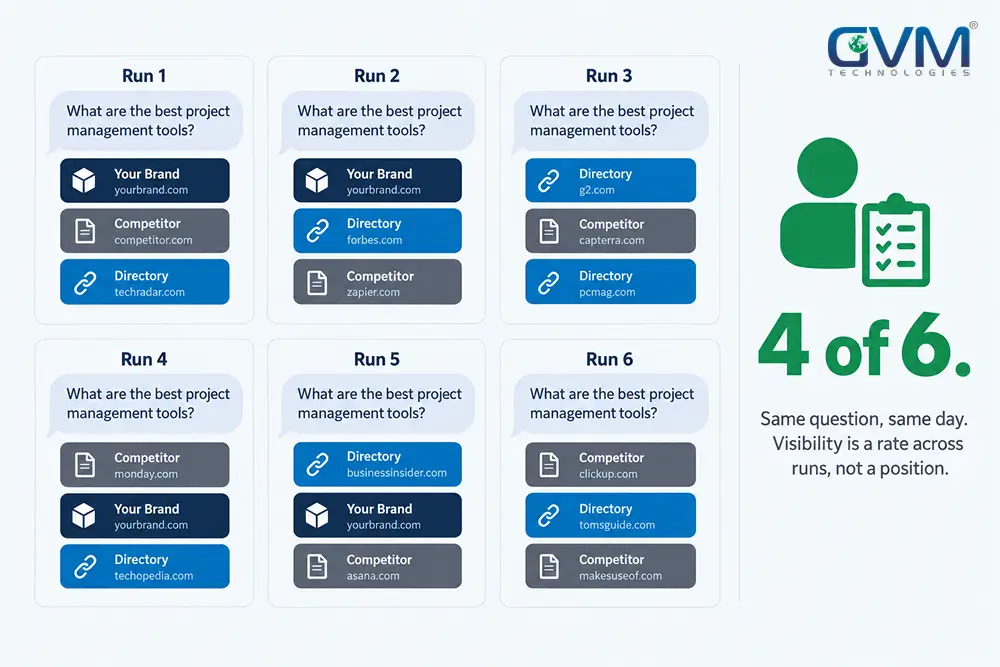
Run the same prompt twice and you can get 2 answers citing 2 different sources. That is non-determinism, and it is how these systems generate text.
It has a direct effect on reporting. One prompt run is a snapshot, not a measurement, which is why honest GEO reporting looks past a single score at the pattern across many runs.
4. Each platform reads a different web
Generative engine optimization is not one playbook. Each surface pulls from a different set of sources.
| Surface | Leans on | Practical effect |
|---|---|---|
| ChatGPT Search | An external search index plus its own crawler | Being invisible to that index is a real disadvantage |
| Perplexity | Discussion and community content, heavily | Forum and review presence matters more here |
| Google AI Overviews | Core Search ranking and quality systems | Traditional SEO carries over almost directly |
| Google AI Mode | A partly separate source set | Winning Overviews does not mean winning AI Mode |
The 3 Checks Every AI Runs Before Citing You
You can predict most generative engine optimization outcomes by asking 3 questions about a page. We use this as the spine of every audit.
| Check | The question | Fully checkable? |
|---|---|---|
| Access | Can the AI crawler reach and read this page? | Yes |
| Extraction | Can a clean, standalone answer be lifted from it? | Mostly |
| Corroboration | Does the rest of the web agree on who you are? | Partly, and slower to fix |
1. Access
An AI cannot cite a page it cannot read. Four things have to be true:
- Your robots.txt allows GPTBot, ClaudeBot, and PerplexityBot.
- Your content is in the HTML, not loaded only after JavaScript runs.
- Pages load fast.
- Your site is in Bing’s index, not only Google’s.
This layer is dull and fully checkable. The most common gap we find in audits: a site never confirmed in Bing’s index at all.
2. Extraction
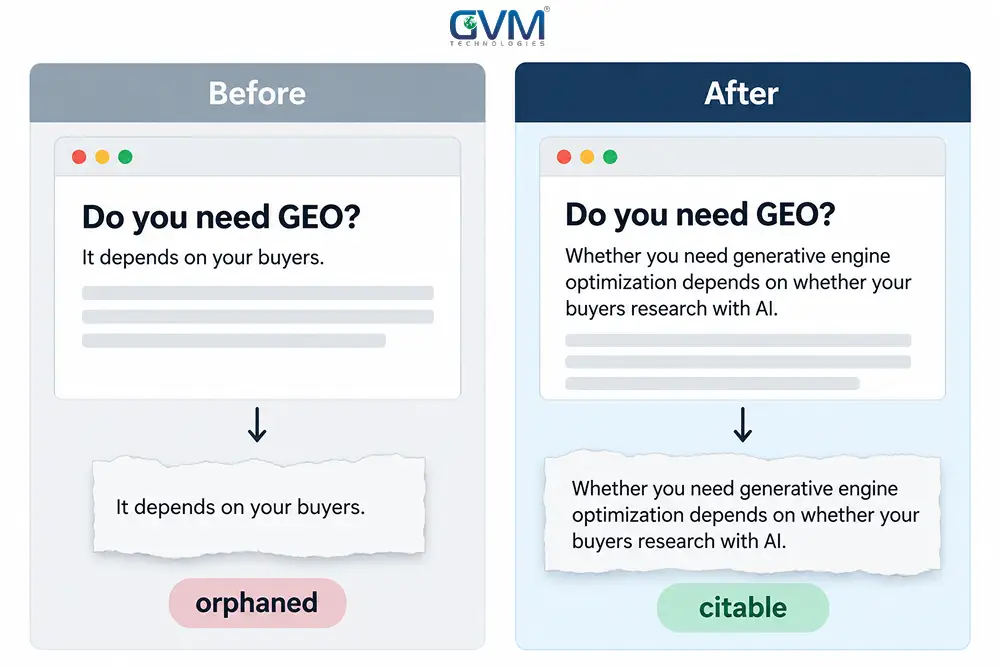
An AI pulls short passages, not whole pages. A page earns citations when the answer sits in the first sentence or two of a section and each section stands on its own.
When an AI lifts a passage, it drops the heading above it. A line like “it depends on your team size” then means nothing.
Write it as “whether you need generative engine optimization depends on your team size” and it survives the trip.
One page that answers a single narrow question well beats a 3,000-word guide that covers 10 questions loosely.
3. Corroboration
Before an AI repeats a claim about your business, it checks for agreement across sources. Your name, description, and key facts should match across your site, listings, and reviews.
Two details that move this more than people expect:
- Recency over volume. We have seen a business with 300 old reviews get skipped while a competitor with 40 recent ones got named.
- Off your own site. A company’s website is rarely the top-cited source about it. Directories, reviews, and third-party mentions often carry more weight.
What Generative Engine Optimization Changes, and What It Leaves Alone
Split generative engine optimization into 3 layers and it stops feeling mysterious. Two are ordinary SEO. One is new.
| Layer | What it covers | New? |
|---|---|---|
| Foundation | Crawlability, indexing, topical authority, accurate content | No, identical to SEO |
| Structure | Answer-first sections, question-shaped headings, schema, standalone passages | No, reframed SEO |
| AI-specific | Non-deterministic measurement, entity consistency across the web, Bing and AI-crawler checks, off-site citation work | Yes, this part is real |
The two layers that are just SEO
The foundation does not change. A page an AI cannot crawl, index, or trust will not be cited. The structural work is the same skills aimed at a new target: a passage lifted cleanly, not only a page ranked.
Google frames it the same way in its guide to optimizing for generative AI: AI Overviews and AI Mode run on the same core systems as regular Search.
The one layer that is new
AI answers are assembled fresh at the moment of the question. That brings problems SEO never had: results that shift between runs, a citation pool wider than your site, and separate AI crawlers to allow or block.
This new layer is also where a relabeled retainer gets exposed, which is the focus of our guide to spotting a real GEO specialist.
How to Tell If Generative Engine Optimization Matters for You Now
The fastest way to know is to run the searches your customers would run and see whether you show up. It takes about 5 minutes and needs no tools.
The 5-minute self-check
- Open ChatGPT, Perplexity, and Google with AI Overviews on.
- Ask each the question a customer would type, like “best [your service] company in [your city].”
- Note whether you appear, whether a competitor appears, and which sources each answer cites.
- Search your product category, not just your company name. Engines often name the product, not the company behind it, so a name-only check undercounts you.
- Repeat the 3 prompts the next day, save both sets with the date, and compare. That is your baseline.
If you never appear and competitors do, generative engine optimization has a clear job. If the answers cite directories you are not listed on, you have found task one.
Who it pays off for fastest
- B2B services and software, where buyers shortlist with AI before a call.
- Local service businesses in categories people ask AI to compare.
- Any brand in a “best X for Y” type of market.
It pays off slower for impulse purchases and for brands people already search by name.
3. Myths worth dropping
| Myth | What is actually true |
|---|---|
| AI search runs a fully separate ranking system | Most engines fan a question into real searches, then synthesize |
| An llms.txt file lifts your citations | Current evidence shows no measurable effect; a clean robots.txt does the work |
| “No fragmented content” from Google means structure does not matter | Each section still needs to stand alone. That is not the same as chopping a page into fragments |
| Keyword stuffing works again because the reader is an AI | Still a negative quality signal, in answers as much as in search |
| More mentions anywhere will get you cited | A few specific, credible, third-party mentions beat a pile of generic ones |
How to Start With Generative Engine Optimization This Month
You do not need a big project. You need to fix the foundation and set up honest measurement.
- Confirm your robots.txt does not block GPTBot, ClaudeBot, PerplexityBot, or Google-Extended.
- Check that your site is submitted to and indexed by Bing, not only Google.
- Rewrite your top 3 pages so each section opens with a direct answer and headings match real questions.
- Make your business name, description, and key facts identical across your site, your Google Business Profile, and your main listings.
- Add an “AI assistants” channel group in analytics so referrals from ChatGPT and Perplexity stop hiding inside “Direct.”
- Run the 5-minute self-check monthly and keep the dated results.
Where an agency earns its fee
If a vague retainer has burned you before, the worry is fair: much of the “GEO” on the market is an unchanged SEO plan with a new invoice line.
If the audit you are quoted looks like a 2022 SEO audit, you are buying a label.
An outside team earns its fee when the technical layer runs past an afternoon, entity cleanup spans dozens of listings, or measurement has to run across platforms for months.
Before you sign, ask for a real AI-citation baseline, get clear on what the first 30 days should cover, and check the quote against normal SEO and GEO pricing.
FAQs
1. What is generative engine optimization in one sentence?
Generative engine optimization is the practice of structuring your content and online presence so AI tools like ChatGPT, Perplexity, and Google AI Overviews can find it, understand it, and cite it in the answers they write.
2. Is generative engine optimization different from SEO?
Partly. Generative engine optimization shares its foundation and structural work with SEO, which is most of the job. The new part is passage extraction, entity consistency across the web, AI-crawler and Bing checks, and measurement built for answers that change on repeated runs.
3. How is GEO different from AEO?
AEO targets being the short, direct answer, such as a snippet or a voice reply. GEO targets being cited inside a longer AI-generated response. The two overlap so much that many people use the terms interchangeably.
4. Do I need generative engine optimization if my SEO is already strong?
You are most of the way there. What is left is the AI-specific layer: crawler and Bing checks, tighter entity consistency, key pages rewritten as standalone answers, and visibility measured across AI platforms.
5. Can anyone guarantee my brand gets cited by ChatGPT?
No. AI answers are non-deterministic, so the same prompt can cite different sources on different runs. Good work makes a citation more likely across many questions, but it cannot lock one result, which is why a guarantee is a warning sign.
6. How is generative engine optimization measured?
Run a fixed set of buyer questions across several AI platforms, repeatedly, and track which sources get cited over time. Watch the trend, not one run. Google’s Search Console now includes an AI performance view for visibility inside AI Overviews and AI Mode.
7. How long does generative engine optimization take to work?
Foundation fixes like crawler access and Bing submission can register within days. Content and entity work compound over 2 to 4 months. Answers vary between runs, so you are reading a trend line, not a single before-and-after.
Conclusion
Generative engine optimization is not a new kind of marketing. It is SEO’s old goal, being found and trusted, applied to a search that answers the question instead of linking to it.
Most of the work is clarity you already understand: a site an AI can reach, pages it can lift a clean answer from, and one consistent story about who you are across the web.
Get those right and generative engine optimization mostly takes care of itself.
GVM Technologies runs SEO and GEO as one engagement, one accountable team, one technical foundation, since 2012, ISO-certified, with named client work in insurance, real estate, and e-commerce.
A SEO and GEO audit gives you your current AI-answer visibility, the 3 checks scored for your top pages, and the fixes that will move them.