Bing indexing means Bing has crawled a page and stored it in its searchable index, the index Microsoft Copilot uses and one of the sources ChatGPT search draws on.
Quick answer: Bing indexing gets your page into the pool ChatGPT can retrieve from, but it does not pick the winner. It is a cheap, necessary-looking step, not a citation strategy.
Bing Indexing ChatGPT Citations: What Is Actually Documented
OpenAI says ChatGPT search uses its own crawler plus third-party search providers. Public testing points to Bing as the main one, but OpenAI does not name a single provider in its crawler documentation.
So the safe reading is this: Bing is a likely feeder, not a proven gatekeeper. Everything below is built to hold up whichever way that debate lands.
What the primary sources say
The 2 official sources are worth reading before any blog post, including this one.
| Source | What it confirms | What it leaves out |
|---|---|---|
| OpenAI crawler documentation | OAI-SearchBot surfaces sites in ChatGPT search | Does not name Bing |
| Bing AI Performance announcement | Citation data for Copilot and Bing summaries | Does not name ChatGPT |
Why this matters: neither company says “index in Bing to be cited by ChatGPT.” That advice is an inference from testing, which is why we call Bing indexing groundwork and not a guarantee.
Why Bing keeps coming up anyway
In early tests, ChatGPT’s web results lined up with Bing more than with Google. Moreover, new sites often get into Bing before they move in Google, so Bing is a faster test of findability.
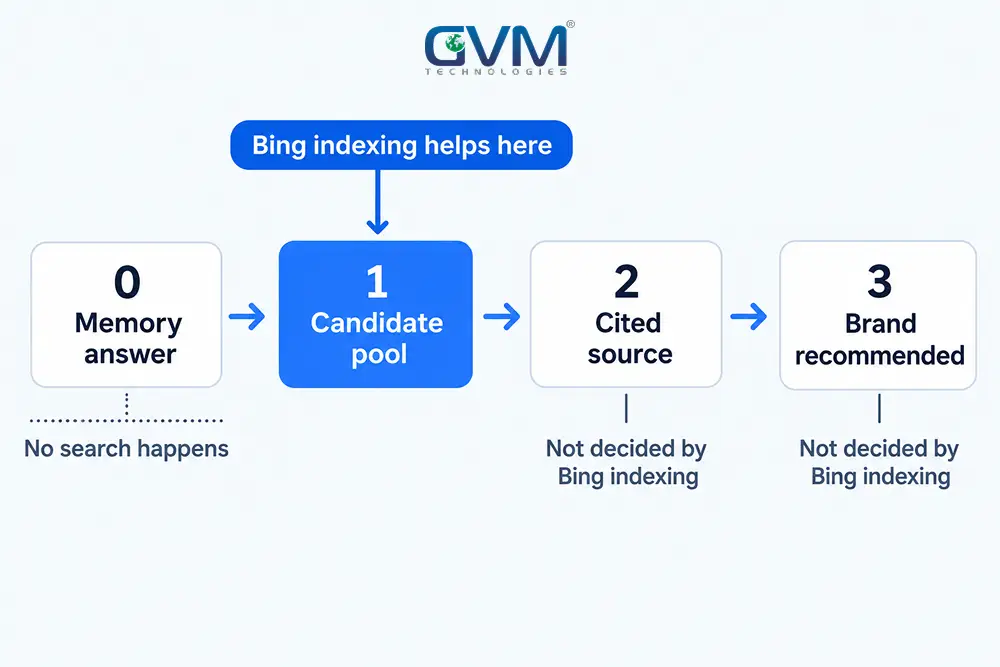
The 4 Doors Between Your Page and a ChatGPT Answer
We use a simple model when auditing why a page does or does not appear. A page must pass 4 doors, and Bing indexing only touches the second.
| Door | Question it answers | Does Bing indexing help? |
|---|---|---|
| 0. Memory | Did ChatGPT answer without searching at all? | No |
| 1. Candidate pool | Did a search return your page? | Yes, this is its job |
| 2. Cited | Did the model pick your page as a source? | No |
| 3. Recommended | Did the answer name your brand? | No |
1. Door 0: many answers never search
Public tests found ChatGPT answered a large share of keyword-style prompts from memory, mostly how-to and “what is” questions. Nothing is retrieved on those, so nothing can be ranked or cited.
2. Door 1: the pool is where Bing shows up
In one October test of 26 searched keywords, ChatGPT’s search returned a pool of 220 sites before choosing. About 18.6% of that pool sat on Bing’s first page, against 10% for Google.
That pattern fits Bing feeding retrieval while the model chooses from a much wider set.
3. Doors 2 and 3: a citation is not a recommendation
A page can be cited while a competitor gets named. We see this often in audits: the answer uses your explanation as evidence, then recommends another vendor.
Example: a software buyer asks for the best help desk tool. ChatGPT cites one vendor’s comparison page as evidence, then names 3 other products in the answer.
Fixing that takes authority and mentions elsewhere, as brand mentions versus citations explains.
What the Studies Say About Bing and ChatGPT Citations (and Why They Disagree)
Published analyses give very different numbers, and the gap is the lesson. Treat none as settled.
| Analysis | Finding | Main limit |
|---|---|---|
| Early-2025, about 100 queries | About 87% of citations matched Bing’s top results | Small, mostly commercial queries |
| 2026 replication, 400 questions | About 27% matched Bing, counting rewritten sub-queries | API run, domain-level matching |
| October test, 38 keywords | 25% on Bing’s first page, 24.5% on Google’s, 60.5% on neither | One run per keyword |
| 2025 single-page test | ChatGPT defined a made-up word found only on a Google-indexed page | One person, one test |
Why the numbers swing so widely
3 factors explain most of the spread:
- Query type: buying questions trigger search far more often than “what is” questions.
- Rewriting: ChatGPT searches its own rewritten queries, not the one you typed.
- Matching method: comparing domains is looser than comparing exact URLs.
How to read these numbers: compare the method, not the percentage. A study that counts rewritten queries and one that counts only your typed keyword will never agree.
What all of them agree on
Even the strongest Bing correlation falls short of 100%, and every analysis finds a large share of citations on neither engine’s first page. Therefore Bing page one is a weak predictor of anything.
Why Ranking on Bing Still Does Not Predict Your Citation
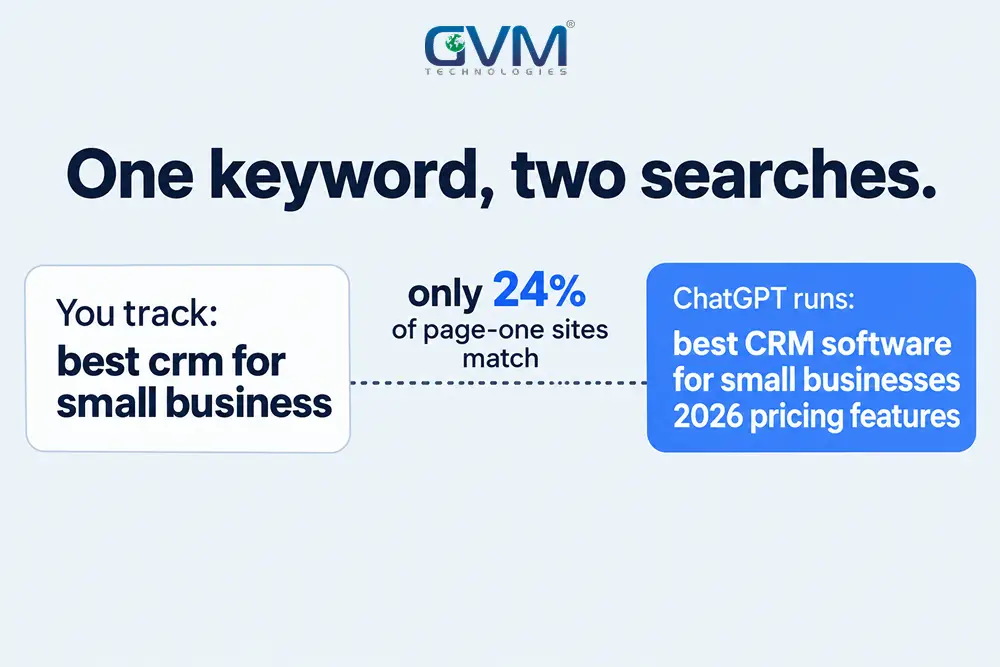
ChatGPT turns your prompt into several longer searches, then cites from those results. Your tracked keyword and the query it actually ran are often different searches with different winners.
1. The rewrite changes the result set
One public comparison ran 200 topics twice, as a 6-word keyword and a 22-word question. Only 24% of page-one sites matched between the 2 versions.
In a 12-question buyer test, rewrites often added “official” and the current year, and rarely added “best”. The system was checking vendor sources, not hunting for listicles.
2. Homepages and pricing pages get cited, not just blog posts
Public tests found most links went to company sites, with homepages and pricing pages heavily represented. A rank tracker built around blog keywords misses these entirely.
So the question changes from “do I rank?” to “does my pricing or help page state the answer in the first paragraph?”
3. The same prompt cites different pages on different runs
In the same buyer test, the top pick changed in 2 of 5 questions across 3 runs. That is non-determinism in AI answers, and it means one check proves nothing.
A 15-Minute Bing Indexing ChatGPT Check You Can Run Today
Start with a search, then verify ownership, then request what is missing. You need no paid tool.
- Search
site:yourdomain.comin Bing. A site with 40 pages that shows 3 has a problem. - Sign in to Bing Webmaster Tools and import your Google Search Console property, or add the site by hand.
- Verify the exact version you serve. The www and non-www versions count as separate properties.
- Submit your XML sitemap and wait for a Success status.
- Run URL Inspection on your 5 most important pages and request indexing for any not indexed.
- Turn on IndexNow so Bing is notified when you publish or edit.
- Confirm robots.txt allows Bingbot and OAI-SearchBot.
Tip: do step 1 before anything else. If
site:shows your pages, skip to step 5 and spend the saved time on content.
Allow the right OpenAI crawler
OpenAI’s documentation separates 3 agents. OAI-SearchBot handles search visibility, GPTBot handles training, and ChatGPT-User handles live fetches when a person asks.
You can allow search while blocking training. Robots.txt changes take about 24 hours to apply, per OpenAI.
Fix what the inspection shows
| What you see | Likely cause | Fix |
|---|---|---|
| Discovered, not indexed | Weak internal links, thin page | Link from a hub page, add substance |
| Blocked by robots.txt | Over-broad Disallow rule | Narrow the rule, retest |
| Indexed but empty snippet | Content loads only after JavaScript | Serve key text in raw HTML |
| Wrong URL indexed | Canonical points elsewhere | Fix the canonical tag |
| Sitemap submitted, 0 pages | Verified the wrong www version | Verify the version you serve |
Content that appears only after scripts run is a separate and common failure, covered in why JavaScript-heavy sites go unseen by AI crawlers.
5 Mistakes That Waste a Bing Indexing Project
Most failures come from believing a status message means more than it does. These show up repeatedly.
1. Treating an IndexNow 200 as “indexed”
A 200 response means the notification was received. Bing still decides whether the page deserves a place in its index.
Warning: a 200 response from IndexNow or a sitemap upload is a receipt, not a result. Check URL Inspection a few days later.
2. Paying a tool to force indexing
Third-party “indexers” can only ping Bing or submit URLs through the same public routes you have. They cannot make Bing store a thin page, so the money rarely beats a stronger internal link.
3. Submitting every URL
Queue pages that return 200, are self-canonical, sit in the sitemap, and have real internal links. A queue of 2,000 near-duplicate city pages tells Bing nothing useful.
4. Using Bing rank tracking as ChatGPT tracking
Tracking your Bing rank answers a Bing question. For ChatGPT, run a fixed prompt set and log the cited URLs instead.
5. Assuming Google indexed means Bing indexed
The 2 engines index independently. We find sites in audits that are fully indexed in Google and sparse in Bing because nobody ever verified Bing Webmaster Tools.
What to Do After Your Pages Are in Bing
Indexing gets you in the pool. Citation comes from how well a page answers the question ChatGPT is really asking.
- Pick 10 to 20 buyer questions and write them as full questions, not keywords.
- Run each at least 3 times on ChatGPT and 1 other platform, in a logged-out or temporary chat.
- Log the cited URLs and named brands, not only whether you appeared.
- Match each question to one page whose opening paragraph answers it directly.
- Re-run monthly and compare patterns, never single answers.
Our citation baseline guide walks through building that prompt set.
Write the page the rewritten query wants
If ChatGPT searches “best CRM software for small businesses 2026 pricing features”, a page that states current pricing and features in plain HTML fits. The structure of a standalone answer is what makes a paragraph quotable.
Read Bing’s own report, with the right expectation
Bing’s June 2026 update added Intents, Topics, Citation Share, and Compare views. They cover Copilot and Bing AI, and Bing does not say they include ChatGPT.
Still, grounding queries in that report are the only first-party view of what AI systems search for about your pages.
Where Bing Indexing Matters Most, by Site Type
Priority depends on who you are. This table is a starting point, not a rule.
| Site type | Bing priority | First move |
|---|---|---|
| Brand-new site | High | Verify Bing early, build internal links |
| Local business | High | Claim Bing Places, put hours in plain text |
| SaaS or service company | High | Pricing and help pages in raw HTML |
| Large publisher | Medium | Sitemap and IndexNow hygiene |
| JavaScript-heavy site | Highest | Fix rendering before anything else |
Quick decision guide:
- Pages missing in Bing: fix indexing first.
- Indexed but never cited: rewrite the opening paragraph of key pages.
- Cited but never named: build mentions on other sites.
New sites and the cold-start gap
A domain with no authority can sit at positions 40 to 90 in Google for weeks. Bing often surfaces such pages sooner, so it works as an early signal that the content is understood.
Local businesses and wrong facts
For a cafe or clinic, a stale directory listing can feed wrong hours into an AI answer. Fix Bing Places, your own location page, and every directory that repeats the same facts, consistent with entity clarity.
Example: a cafe with 2 locations had ChatGPT quoting a 6 pm closing time from a stale directory. Fixing it and printing hours as plain text on each location page corrected the answer.
FAQs
1. Does ChatGPT use Bing?
Public testing says Bing is a major feeder for ChatGPT search, alongside OpenAI’s own crawler and other providers. OpenAI does not name Bing in its crawler documentation, so treat Bing as likely, not guaranteed.
2. Is Google indexing enough for ChatGPT?
It may be enough sometimes, since some tests show Google-only pages being found. Still, verifying Bing costs nothing, so do both.
3. How long until Bing indexes a new page?
It varies from hours to weeks, depending on site authority and page quality. IndexNow and URL Inspection speed discovery but do not promise indexing.
4. Will Bing indexing get me cited?
No. Bing indexing ChatGPT eligibility only means your page can be retrieved. The model then chooses from a wider pool using relevance, structure, and corroboration.
5. Does Bing indexing help Perplexity or Gemini?
Perplexity runs its own crawler and several sources, and Gemini uses Google’s infrastructure. So Bing helps most for ChatGPT and Copilot, and little for Gemini.
6. Is the llms.txt file part of this?
No. It is not a documented factor, as our llms.txt analysis explains. Spend that time on indexing and answers instead.
Conclusion
Bing indexing opens 1 door of 4, and it is the cheapest one to open. It does not decide who gets cited or recommended, so treat it as groundwork, not the finish line.
Start with the count. Run site:yourdomain.com in Bing and compare it with your real page count, because that single number tells you whether indexing is your problem or your content is.
Then measure what happens next with a fixed set of buyer questions, logging cited URLs instead of rankings. Both OpenAI’s crawler documentation and Bing’s AI reporting changed in 2026, so recheck each before you change strategy.
Pages in Google but missing from Bing?
Most sites we audit have at least 1 gap between what Google knows and what AI tools can reach. GVM Technologies checks:
- Bing and Google indexation gaps, URL by URL
- Bingbot, OAI-SearchBot, GPTBot, and ClaudeBot access
- Content hidden behind JavaScript
- Answer-first structure on pricing and help pages
We have built SEO and GEO together since 2012, with ISO-certified process and named client case studies.