
An AI citation is a linked source that ChatGPT, Perplexity, Gemini, or Google’s AI Overviews show inside a generated answer.
To get cited by AI, a page must first be found by the engine’s own search. Then it must hold a clear, specific answer the engine can lift. That is the core of generative engine optimization.
Quick answer: The best-supported tactics are ranking for the sub-questions AI engines search, answering directly, adding specific sourced facts, and earning mentions on other sites. llms.txt, AI-specific schema, and word count have little evidence.
Key Takeaways
- Retrieval comes first. In a 2026 analysis of 468,037 ChatGPT citations, retrieval explained 32% of citation differences; page features explained 2.8%.
- In controlled tests, adding quotations, statistics, and cited sources raised visibility by up to about 40%.
- Pages whose titles match the user’s question are more likely to get cited by AI than broad pages.
- Only 38% of Google AI Overview citations came from top-10 pages in March 2026, down from 76% in 2025.
- In one 2026 sample, 62% of AI citations linked a site without naming its brand.
- No controlled test shows llms.txt, word count, or AI-specific schema earning citations.
The 4 Gates a Page Passes Before It Gets Cited by AI
Every citation passes 4 gates in order. A page that fails an early gate cannot win on a later one.
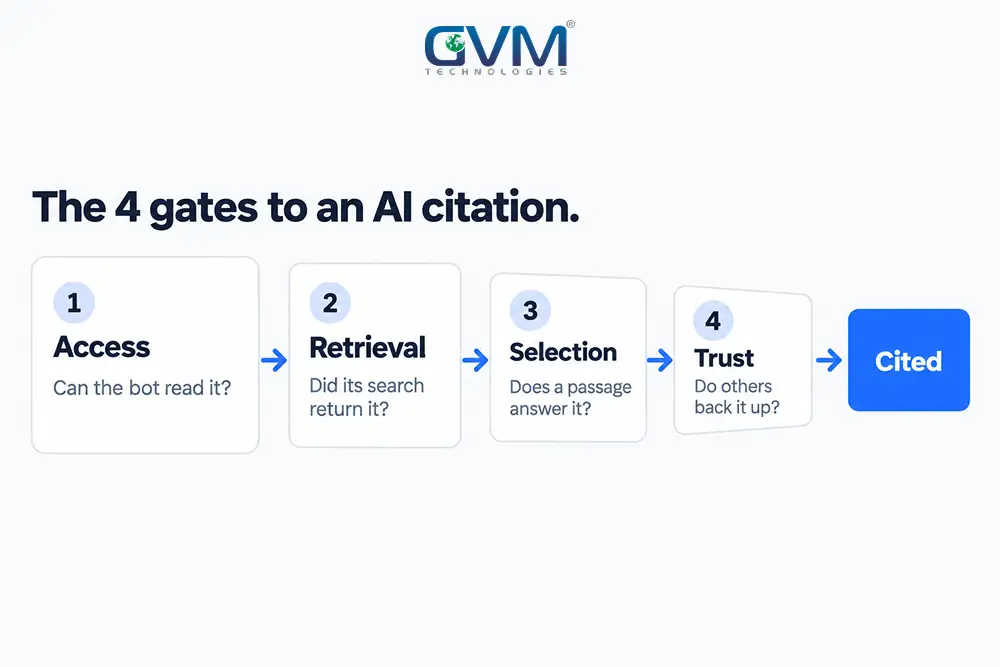
| Gate | What the engine checks | What you control |
|---|---|---|
| 1. Access | Can I fetch and read this page? | Crawler rules, indexing, server-rendered HTML |
| 2. Retrieval | Did my search return this page? | Rankings for the engine’s sub-searches |
| 3. Selection | Does one passage answer the question? | Direct answers, specific facts, clear headings |
| 4. Trust | Do other sources back this up? | Mentions, authorship, consistent facts |
Many owners trying to get cited by AI start at gate 3. They add FAQ blocks and rewrite headings while the page is blocked, unindexed, or absent from the results the engine pulls.
The technical layer behind gate 1 is covered in our guide to AI optimization (AIO).
How to Judge the Evidence Behind AI Citation Tactics
Most AI SEO advice comes from vendors selling a tool or a retainer. Most of the numbers are correlations, which show 2 things travel together, not that one causes the other.
At GVM Technologies, we grade a tactic before we recommend it to a client:
| Grade | What backs it | How to treat it |
|---|---|---|
| A | Controlled tests, repeated | Act on it |
| B | Large datasets that agree, no control group | Act, then measure |
| C | One dataset or one practitioner test | Test before scaling |
| D | Anecdote, logic, or a sales claim | Treat as unproven |
Grade A is rare in AI citation research. A 2026 review of 9,249 SEO documents found only 32 controlled A/B tests in total.
The Tactics That Help You Get Cited by AI, Ranked by Evidence
From the earliest gate to the last:
1. Rank for the sub-questions, not only your main keyword (Grade B)
AI engines split one prompt into several searches, a step called query fan-out. To get cited by AI, your page has to rank for one of those hidden sub-searches.
- Evidence: in 2025, 76% of AI Overview citations came from Google top-10 pages. By March 2026, across 863,000 keywords, that share was 38%, and 31% ranked outside the top 100.
- How: list the follow-up questions a buyer asks next, and cover each in its own section.
- Mistake: tracking only your head-term ranking and assuming AI visibility follows.
Our breakdown of how AI search ranks sources explains the retrieval step in more depth.
2. Match titles and paragraphs to the exact question (Grade B)
Pages whose titles and paragraphs mirror how people phrase a question get cited more than broader pages on the same site.
- Evidence: an October 2026 analysis of 158,099 AI answers found this match was one of the few page traits that mattered within a site. It works mainly by getting the page retrieved.
- Example: a “Payroll Services” page competes poorly for “how much does payroll cost for 10 employees.” A section headed with that question and a price range competes well.
- Mistake: keyword stuffing for AI search. In controlled tests, it gave little or no gain and did worse than baseline on Perplexity.
3. Open each section with a standalone answer (Grade B)
Engines lift passages, not whole pages. A passage only works if it makes sense with nothing around it.
- Evidence: a study of 304,805 AI-cited URLs (2025 data) found clarity and summarization had the strongest link to citation, about +33%. Q&A format, the heart of answer engine optimization, scored +25%.
- How: open each H2 with 40 to 60 words that answer it. Name the subject instead of writing “it.” Then add conditions, examples, and proof.
- Mistake: a brand story before the answer. A promotional tone showed a negative association, about -26%.
One practitioner reported a 280% lift from moving the answer above the evidence. That is a single test, so it rates Grade C.
4. Add specific numbers, named sources, and quotations (Grade A, with limits)
This is the only tactic group with controlled testing behind it. Researchers rewrote web sources and measured how often a generative engine used them across 10,000 queries.
| Change tested | Reported visibility effect |
|---|---|
| Best methods: quotations, statistics, cited sources | Up to about +41% |
| Citing sources, for pages ranked 5th | +115% |
| Quotations, tested on live Perplexity | About +22% |
| Keyword stuffing | Little or no gain |
The limit: these tests used a research engine, not live ChatGPT or Google. Trust the direction; treat the exact percentages as approximate.
To apply it, replace “most firms see savings” with the number, who measured it, and when. Name prices and competitors too; one 249-page test found pages naming a competitor retrieved 50% of the time, versus 19%.
5. Show who wrote the page and how they know (Grade B)
AI engines and Google both weigh E-E-A-T (experience, expertise, authoritativeness, and trust). In the 300,000-URL study, these signals ranked second only to clarity.
Google’s guide to optimizing for generative AI search says to “create the content yourself based on what you know about the topic.”
- How: name the author and their relevant experience. Add first-hand detail: a price you quoted, a test you ran, a mistake you fixed.
- Mistake: adding a bio to generic content. If any AI could write the page unaided, an engine has no reason to cite you.
6. Earn independent mentions where buyers already read (Grade B)
Engines cite more confidently when other sources describe you the same way, which is what entity clarity means. Review sites, trade press, roundups, forums, and video appear heavily in answers to “best X” questions.
- Evidence: across 75,000 brands, branded web mentions correlated 0.664 with AI Overview visibility; backlinks, 0.218. The October 2026 paper found ChatGPT favors brands it already knows.
- How: get listed on your category’s review platforms, pitch original data to trade press, and answer real questions in communities under your own name.
- Mistake: paying for automated forum posts. Moderators remove them, and Google says its systems filter inauthentic mentions.
7. Keep facts current (Grade C)
A 2025 analysis of 17 million citations found AI assistants cite content about 25.7% fresher than organic results. ChatGPT leaned hardest on fresh pages; Google AI Overviews barely did.
Update statistics, prices, and screenshots when they change, and say what changed. Changing only the date is not an update.
8. Make sure crawlers can read the page (prerequisite)
This is a gate, not a ranking factor, and the gap GVM Technologies finds most often in audits. Google states its AI features use “publicly accessible, crawlable content.”
- Allow the search crawlers you want in robots.txt, such as OAI-SearchBot, PerplexityBot, and Googlebot.
- Load key pages with JavaScript turned off. Content that only appears after scripts run can be invisible to some AI crawlers.
- On Cloudflare, check AI crawler settings. Since September 15, 2026, new domains block training bots on ad pages, which can catch search crawlers too.
AI Citation Tactics With Weak or No Evidence
These are sold as ways to win AI citations, with little proof. Most are harmless, but they eat hours.
| Tactic | What the evidence shows |
|---|---|
| llms.txt file | No controlled test; Google Search ignores it |
| AI-specific schema | Google says none is required |
| FAQ rich results | Deprecated by Google in May 2026 |
| Longer articles | 53.4% of cited pages ran under 1,000 words |
| Splitting content into tiny chunks | Google says it is not required |
| Buying or faking mentions | Filtered by spam systems |
Our test of whether llms.txt helps AI citations covers that file in detail.
Schema helps machines read a page, but the October 2026 paper found it mattered only between websites, not within one. Pick the right type, as covered in FAQPage vs. QAPage schema.
Why AI Citation Studies Seem to Contradict Each Other
This confusion usually happens because studies measure different things. That is how 76%, 38%, and 12% top-10 overlap can all be right.
- Different platforms: Google AI Overviews draw on Google’s index. ChatGPT search uses third-party providers and OpenAI’s own crawler.
- Different queries: comparison prompts cite mostly third-party pages, while brand questions cite more of your own pages. That explains why one study finds 84% earned media.
- Different outcomes: a link to your page and your brand named in the text are separate results. Track brand mentions and citations separately.
- Different dates: the AI Overview top-10 share halved between July 2025 and March 2026.
Where Pages Get Cited by AI: ChatGPT vs Perplexity vs Google
| Platform | Where sources come from | What it means for you |
|---|---|---|
| Google AI Overviews and AI Mode | Google’s index and ranking systems | Classic SEO carries over most directly |
| ChatGPT search | Third-party search providers and OpenAI’s crawler | Check Bing indexing and OAI-SearchBot access |
| Perplexity | Its own index, about 22 sources per answer | More slots, more chances to appear |
| Microsoft Copilot | Bing, about 2.5 sources per answer | Few slots, so ranking matters more |
The per-answer counts come from one analysis of 118,101 answers. Intent matters too: one 377-prompt test saw ChatGPT search for 72.4% of commercial prompts and 2.5% of informational ones.
How to Test Whether Your Pages Get Cited by AI
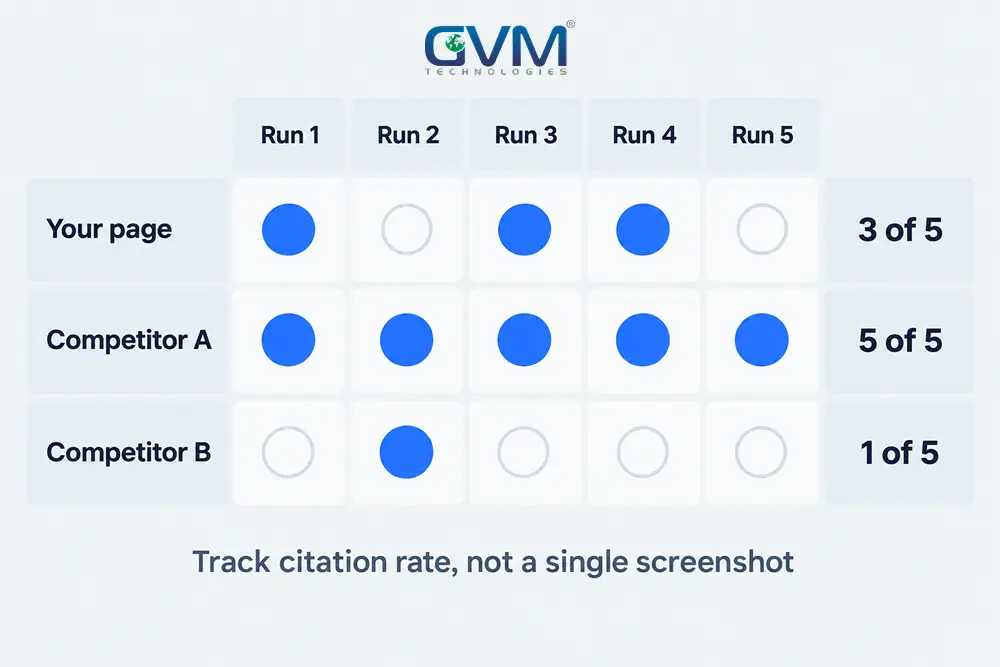
AI answers are non-deterministic: the same prompt can cite different sources each run. In one 2,961-run test, the same brand list came back twice less than once in 100.
- Write 20 to 30 prompts your buyers actually ask, mixing broad and specific.
- Run each prompt 5 times per platform and record the citation rate, such as 3 of 5.
- Change one thing on one group of pages, and leave a similar group untouched.
- Re-run the same prompts after 4 to 8 weeks.
- Check Google’s generative AI performance report in Search Console for AI Overview and AI Mode data.
A common mistake seen across SEO communities is claiming a win on a narrow prompt nobody else answers. Re-test on the broader version. If you disappear, you had no competition, not an advantage.
At GVM Technologies, we record this baseline before any GEO work starts. Ask for the same from any agency, as explained in how to request an AI-citation baseline.
Example: Applying the Evidence to a Small Business Page
A 6-person accounting firm wants to get cited by AI for “how much does small business bookkeeping cost.” Its services page says only “affordable plans for every business.”
| Gate | Evidence-based change |
|---|---|
| Access | Confirm the page renders without JavaScript and is indexed in Google and Bing |
| Retrieval | Add sections on monthly vs hourly pricing and catch-up bookkeeping |
| Selection | Open with a real price range and what drives it |
| Trust | Name the CPA author, date the prices, and gather reviews where locals look |
It skips llms.txt, extra schema, and a 3,000-word rewrite, none of which has the evidence.
How Long It Takes to Get Cited by AI, and What It Costs
Most work toward AI citations is editorial time. In our experience, rewriting 10 priority pages takes a skilled writer 1 to 3 weeks.
- Pages already ranking: changes can show in AI answers within a few weeks.
- New pages or new brands: expect several months, because rankings and third-party trust build slowly.
Our SEO and GEO pricing breakdown covers typical engagement costs. Anyone promising a citation by a fixed date is guessing; here is why a guaranteed AI citation is a red flag.
FAQs
1. Do I need to rank #1 on Google to get cited by AI?
No. In March 2026, 62% of AI Overview citations came from pages outside Google’s top 10. Ranking for the related sub-searches matters more than one top spot.
2. Does schema markup get you cited by AI?
Not on its own. Google says no special schema is required for its AI features. Correct schema helps machines parse a page, but it does not replace a clear, sourced answer.
3. Is Reddit really the most cited source in AI answers?
Reddit, Wikipedia, YouTube, and review sites are among the most cited domains, but their shares swing when platforms change retrieval. Join those communities only where you add real expertise.
4. Can a small business compete with big brands to get cited by AI?
Yes, on specific questions. In controlled tests, citing sources helped lower-ranked pages most. Broad category questions still favor brands the engine already knows.
5. Should I use AI to write content meant for AI search?
Google judges quality, not authorship, according to its guidance on AI-generated content. But content an AI could write unaided gives an engine no reason to cite you, so add what only you know.
What to Do Next
To get cited by AI, your page must be readable, retrieved, quotable, and backed by other sources, in that order. The tactics with real evidence all serve one of those 4 gates.
- Today: load your 5 most important pages with JavaScript off and confirm robots.txt allows the AI search crawlers.
- This week: write 20 buyer prompts and record a 5-run citation baseline.
- This month: rewrite those 5 pages to open with a direct answer and add 1 sourced fact per section.
- Every quarter: re-run the prompts, report what actually changed, and refresh facts.
The engines will keep changing how they retrieve, but answer-first pages with real evidence have held up through every change so far.
Ranking on Google but missing from AI answers?
If your reports show rankings and no AI citations, the gap usually sits at one of the 4 gates. GVM Technologies checks:
- Crawler access, rendering, and Google and Bing indexing
- Rankings for the sub-questions behind your buyers’ prompts
- Answer-first structure and missing evidence on priority pages
- Entity consistency and third-party mentions
We have run SEO and GEO from one team since 2012, under ISO-certified processes, with named client case studies.