
The GEO vs. AEO vs. SEO question keeps coming up in the same shape: are these 3 separate jobs, or the same job wearing new letters?
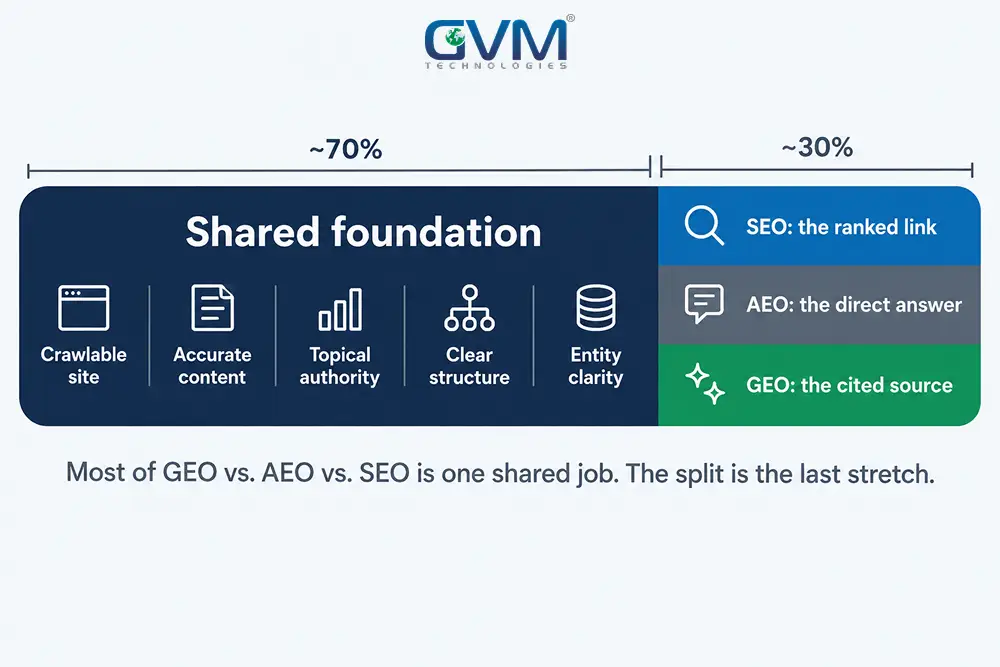
Short version: they run on the same foundation and split on one thing, the surface each one optimizes for.
- SEO (Search Engine Optimization) targets a ranked link.
- AEO (Answer Engine Optimization) targets being the direct answer.
- GEO (Generative Engine Optimization) targets being cited inside an AI-written answer.
That shared base is most of why GEO builds on SEO instead of replacing it, and why people asking whether GEO is just rebranded SEO have a fair point.
Key Takeaways
- GEO vs. AEO vs. SEO is not 3 disciplines. It is 3 targets for mostly the same work.
- The shared foundation is the large majority of the effort: a crawlable site, accurate content, real authority, clear structure.
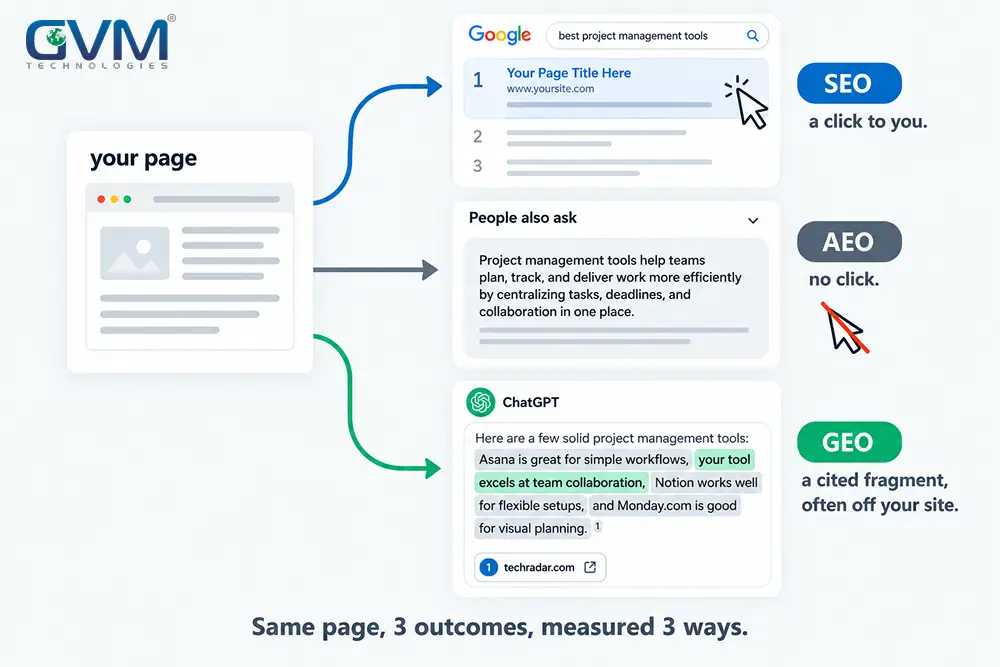
- The real split is the surface: a ranked link, a lifted answer box, and a cited sentence inside a chat reply are 3 outcomes measured 3 ways.
- AEO and GEO overlap so heavily that policing the boundary is usually a sales tell, not a strategy.
- AIO and LLMO name the same goal as GEO. SXO is a separate idea about on-page experience.
- You do not pick one. Build the foundation once, then weight the extra work toward where your buyers already are.
GEO vs. AEO vs. SEO in One Table
Each acronym in GEO vs. AEO vs. SEO names a different place you want to appear. The route to all 3 is mostly the same route.
| Term | Full name | What it targets | Plain version |
|---|---|---|---|
| SEO | Search Engine Optimization | A ranked position in a list of links | Be on the results page |
| AEO | Answer Engine Optimization | Being lifted as the short, direct answer | Be the featured snippet or the spoken reply |
| GEO | Generative Engine Optimization | Being cited inside a longer AI-written answer | Be a source the answer is built from |
These 3 mechanics run under all of it:
- Retrieval is how an AI answer engine finds sources before it writes. Most do not know your answer, they search for it live and synthesize a reply.
- Query fan-out is your 1 question split into several hidden searches before a combined answer is built.
- Non-determinism means the same prompt can return a different answer, citing different sources, on 2 separate runs.
What GEO vs. AEO vs. SEO Have in Common
Direct answer: the fundamentals that make a page rank are the same ones that make it eligible to be quoted or cited. Strong SEO gets you most of the way to AEO and GEO for free.
The GEO vs. AEO vs. SEO overlap is bigger than most comparisons admit. Here it is itemized, instead of reduced to a percentage nobody can reproduce.
| Shared building block | Why SEO needs it | Why AEO and GEO need it too |
|---|---|---|
| Crawlable, fast, server-rendered pages | Search engines cannot rank what they cannot read | AI crawlers cannot cite what they cannot fetch |
| Accurate, genuinely useful content | Google rewards helpful, people-first content | A thin or wrong page will not be built into an answer |
| Real topical authority | Depth lifts a whole cluster of rankings | AI systems reuse sources they trust on a topic |
| Clear structure and headings | Helps engines understand a page | Lets an AI lift a clean, standalone passage |
| Consistent entity clarity | Connects facts to the right business | Builds one confident picture before an AI repeats a claim |
| Accurate structured data | Clarifies content type for search features | Helps an AI parse a Q&A or article section cleanly |
In our own audits, the first 70% of GEO readiness is just SEO that was done properly. Google frames it the same way.
Its guide to optimizing for AI features says AI Overviews and AI Mode run on the same core ranking systems as regular Search.
Worth stating plainly: a page that cannot rank at all is unlikely to be retrieved and cited either. GEO without an SEO foundation is building on sand.
Where GEO vs. AEO vs. SEO Actually Splits
Direct answer: the differences are not in the fundamentals.
They are 4 things: the unit you optimize, where the win lands, how you measure it, and the shape the content takes.
1. The unit of optimization shrinks
SEO optimizes a page. You want the whole page to rank for a phrase.
AEO optimizes a passage. You want 1 or 2 sentences clean enough to lift into an answer box.
GEO optimizes a passage plus the web’s agreement about who you are. An AI answer is stitched from short blocks across several sources, so the sentence has to survive being pulled from its page.
2. Where the win lands changes
- SEO: the win is on your site. A ranked link, a click, a session you can see.
- AEO: the win is often a zero-click search. The user reads the answer and never visits.
- GEO: the win frequently lands on someone else’s property. In our tracking, the sources cited for commercial questions are often review platforms, directories, and community threads, not the brand’s homepage.
3. Measurement stops being a position
SEO measurement is stable enough to chart daily. You have a rank, it moves slowly.
AEO and GEO measurement is a rate, not a rank. You run a fixed set of buyer questions many times across platforms and record how often you appear and who gets cited.
One screenshot proves nothing, which is why GEO reporting has to go past a single score.
Google now shows a first-party view of this in Search Console’s AI performance reports.
4. The content shape flips to answer-first
SEO tolerated a slow build to the point. AEO and GEO reward the opposite.
The direct answer goes in the first sentence of the section. Headings match how people actually phrase questions. Each section stands on its own.
| Dimension | SEO | AEO | GEO |
|---|---|---|---|
| What you optimize | A page | A passage | A passage plus off-site signals |
| Where the win lands | Your site, a click | The results page, often no click | An AI answer, often a third-party source |
| How you measure it | Rank tracking, stable | Snippet presence, sampled | Citation rate across repeated runs |
| Content shape | Thorough, can build up | Answer-first, snippet-sized | Answer-first, self-contained, corroborated |
| Main surfaces | Google, Bing organic | Snippets, voice, AI Overviews | ChatGPT, Perplexity, Gemini, Copilot |
Is AEO Just GEO With Fewer Letters?
Direct answer: in day-to-day practice, mostly yes. This is the part of GEO vs. AEO vs. SEO that trips people up most, because the tactics to achieve both are close to identical.
Where people draw the line:
- AEO leans toward short, factual, single-answer queries: featured snippets, voice search, the 1-box answer.
- GEO leans toward broader, comparison-style questions where the AI names several sources.
That distinction shapes how you phrase a heading. It does not need 2 contracts, 2 teams, or 2 strategies. We treat AEO as the “be the direct answer” half of the wider GEO goal: be the clearest, most trustworthy source when a question gets asked.
A tell worth knowing: if a pitch spends more energy policing the AEO-versus-GEO line than explaining what it will change on your site, the line is doing the selling.
AIO, LLMO, and SXO, Decoded
Direct answer: AIO and LLMO name the same goal as GEO, and SXO is a separate idea about on-page experience. The acronym sprawl is a young field with no agreed names, and none of it changes the core GEO vs. AEO vs. SEO picture.
| Acronym | What people usually mean | How we treat it |
|---|---|---|
| AIO (AI Optimization) | Either “optimize for AI Overviews” or “use AI tools to do SEO faster” | Ambiguous, we ask which |
| LLMO (Large Language Model Optimization) | The same as GEO, framed around the models | A synonym for GEO |
| SXO (Search Experience Optimization) | Making a page easy to use once someone lands | Real and separate, also helps AI extraction |
| Search Everywhere Optimization | An umbrella label for all of it | Fine as framing, not a workstream |
When someone uses one of these terms, ask what outcome they mean. It almost always collapses to 1 of 2 things: rank in search, or show up in an AI answer.
Which One to Prioritize First
Direct answer: the GEO vs. AEO vs. SEO priority order is simpler than the debate makes it look. Build the shared SEO foundation first, then weight the extra AEO and GEO work toward the surface where your buyers already are. A generic 70/30 split is a guess, not an answer.
Work through these in order:
- Is your SEO foundation solid? Crawlable, indexed in Google and Bing, real content depth. If not, that is the whole job for now.
- Do people search your category, or your name? Category searches (“best [service] for [use case]”) are where GEO decides the next customer.
- Where do your buyers research? B2B and software buyers shortlist inside ChatGPT and Perplexity before a call. Local buyers ask AI to compare nearby options.
- Is your traffic informational content? Publishers feel AEO and zero-click pressure first.
- Are answer boxes eating your clicks? If impressions are flat but clicks are falling, an AI answer is intercepting the visit.
| Your situation | Build first | Then weight toward |
|---|---|---|
| Weak or unproven SEO | SEO foundation | Nothing else yet |
| Buyers search the category | SEO foundation | GEO, entity work, third-party presence |
| Local service business | Local SEO | GEO for “best in [city]” questions |
| B2B or SaaS, considered purchase | SEO foundation | GEO plus AEO, review-platform accuracy |
| Publisher or content site | SEO foundation | AEO structure, zero-click monitoring |
| People search you by name | SEO brand protection | GEO as a lower-priority layer |
The Conflict Test: What Breaks When 2 Teams Own It
Direct answer: when your SEO and your GEO come from different teams, their advice quietly contradicts, and you pay to undo one with the other.
We see the same collisions in almost every audit of a split setup:
| The SEO team says | The GEO team says | What breaks |
|---|---|---|
| Split this into 2 pages for keyword targeting | Merge into 1 so the answer is self-contained | Neither version ranks or gets cited cleanly |
| Drop the FAQ block, it does nothing for rankings now | Keep the Q&A, an AI lifts it directly | You lose the most extractable format on the page |
| Chase more backlinks | Chase more third-party brand mentions | Effort splits, neither reaches critical mass |
| Optimize for the keyword | Optimize for the question and the entity | The page reads half-tuned for each |
There is a second cost that is easy to miss. Engines often name the product, not the company. A tracking setup built only around your brand name undercounts you, and a split team rarely catches it.
Running GEO vs. AEO vs. SEO as 1 engagement removes that whole class of problem. One accountable team, one technical foundation, one set of recommendations that agree with each other.
The client case studies show that across insurance, real estate, and e-commerce.
How to Spot a Relabeled Service
Direct answer: the shared foundation makes it easy to point at ordinary SEO work and call it GEO. The tell is a missing AI-specific layer, not the presence of the shared one.
Run 3 quick checks:
- Ask what changes for AI work specifically. A real answer names concrete items: entity audits across listings, Bing indexation checks, multi-platform citation tracking, answer-first restructuring. “It is all connected” is a relabel.
- Ask what the first 30 days include beyond content. Real early GEO work is technical first. Our breakdown of what the first 30 days should cover sets the bar.
- Check price against scope. A combined SEO and GEO quote priced well below a normal SEO retainer is usually a single audit dressed as a program. Our SEO and GEO pricing is published so you can compare without a call.
If a pitch guarantees an AI citation or a ranking, stop there. The deeper version, including a 5-question test for any agency, is in our guide to spotting a real GEO specialist.
Get a straight read on where you stand. GVM Technologies has run SEO and GEO as one engagement since 2012, ISO-certified, with named client work in insurance, real estate, and e-commerce.
Book a free SEO and GEO audit and you get your current visibility across Google and AI answers, the gaps scored, and the fixes that move them. No guarantee, no lock-in.
FAQs
1. Is AEO the same as GEO?
In practice, mostly yes. AEO targets being the single direct answer, such as a featured snippet or a voice reply. GEO targets being cited as a source inside a longer AI answer. The tactics overlap so heavily that most practitioners treat AEO as the “be the direct answer” half of GEO.
2. What is the real difference in GEO vs. AEO vs. SEO?
SEO targets a ranked link. AEO targets being lifted as the short answer. GEO targets being cited inside an AI response. The fundamentals are shared. The differences are the unit you optimize, where the win lands, and how you measure it.
3. Do I need SEO, AEO, and GEO as separate services?
Usually not. They run on the same foundation, and 2 disconnected vendors often give contradictory advice. One team handling all 3 from the same base is stronger and cheaper to run.
4. Is SEO dead now that AI answers exist?
No. AI answer engines still lean on search retrieval underneath. A page that cannot rank is far less likely to be retrieved and cited, so SEO is the foundation the other 2 stand on.
5. In GEO vs. AEO vs. SEO, which matters most for a small business in 2026?
The SEO foundation first. After that, weight effort toward where your buyers research. If they compare options inside ChatGPT or ask AI for the best provider in your city, GEO is where the next decision happens.
6. How is measurement different across GEO vs. AEO vs. SEO?
SEO uses rank tracking, stable day to day. AEO and GEO have no fixed position. You run buyer questions repeatedly across platforms and track how often you appear and who gets cited, because the same prompt returns different answers on different runs.
7. Can I do GEO without doing SEO first?
Not effectively. If a page cannot be crawled, indexed, or trusted, it will not be pulled into an AI answer. The technical and authority work SEO covers is a prerequisite.
Conclusion
GEO vs. AEO vs. SEO is less a 3-way contest than 1 foundation with 3 targets on top of it.
Build a site that can be crawled and trusted, write pages that answer first, and keep one consistent story about who you are across the web. Do that and you are optimizing for all 3 at once.
The part that deserves your skepticism is the market, not the disciplines. When “GEO” and “AEO” on an invoice can mean anything from an FAQ block to weekly citation tracking, the questions you ask matter more than the labels.
So the GEO vs. AEO vs. SEO decision comes down to 2 moves: build the foundation, then follow your buyers.
If you want a clear read on where your site stands across Google and AI answers, GVM Technologies runs SEO and GEO as one engagement with no lock-in, from one team that has built both together since 2012.