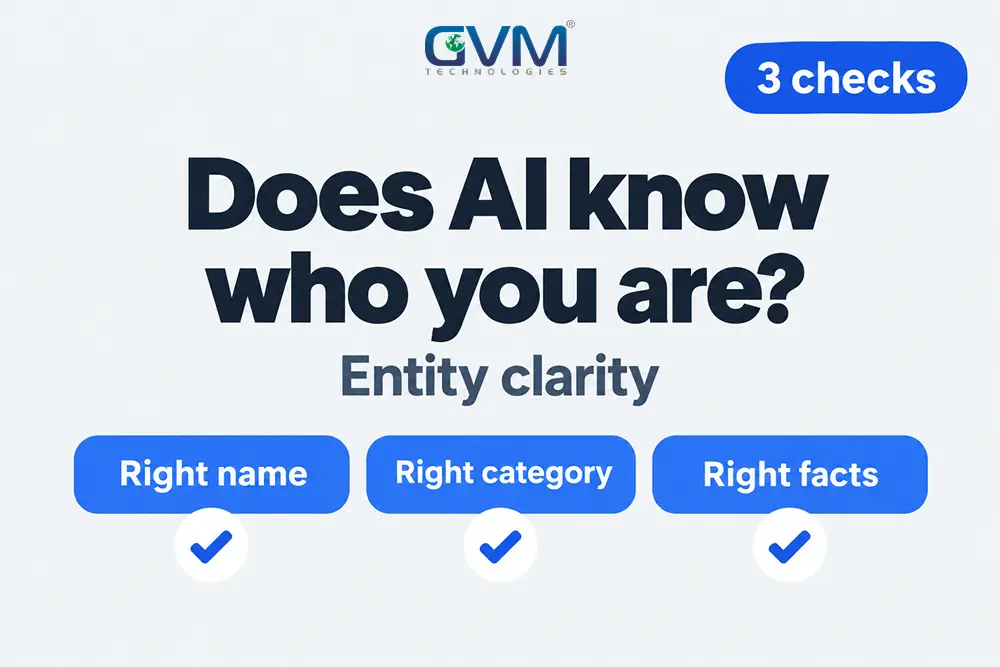
Entity clarity is how reliably search and AI systems can identify your business, place it in the right category, and confirm which facts about it are true. It underpins generative engine optimization.
Quick answer: entity clarity decides whether an AI names the right business with the right facts. It cannot force a citation, but a blurred name gets skipped or mixed up with another company.
Key Takeaways
- Entity clarity means 1 name, 1 category, and the same core facts on every page and profile that describes you.
- Google’s guide to AI features in Search never uses the word “entity”, so this is a practical aim, not a documented ranking factor.
- Google does say Organization markup helps it tell similar organizations apart in results.
- In our test, ChatGPT named the right parent company but listed SEO and GEO as 1 of 8 services and never named this site.
- The usual cause is drift: our own homepage showed 2 site names, 2 founding years across GVM pages, and 3 Organization entries with no shared ID.
- Fix owned pages first, then profiles, then earn independent coverage. Bought mentions and llms.txt do not produce AI citations.
What Is Entity Clarity, and Is It Just Entity SEO?
Entity clarity is the state you want: 1 identity that machines can match to the right facts. Entity SEO is the work that gets you there.
| Term | Plain meaning | Example |
|---|---|---|
| Entity | A distinct thing a system tracks | A company, author, product, or city |
| Entity clarity | How cleanly that thing is identified | Same name and category everywhere |
| Entity SEO | The work that improves it | Schema, profile cleanup, consistent copy |
| Disambiguation | Telling it apart from lookalikes | Your firm versus a same name firm |
| Knowledge graph | A database of entities and links | Wikidata or Google’s own graph |
People often assume “entity” means a Wikipedia page. It does not. Any business with a name, a category, and a website already has an entity, clear or blurred.
2 meanings get mixed up in search results:
- Brand entity: you, your business, and your authors. This guide covers it.
- Topic entity: the concepts a page discusses, such as schema or Wikidata. That is a content planning job, not an identity job.
You will also see this work filed under AEO, GEO, and LLMO. The labels differ, but GEO, AEO, and SEO all sit on the same identity layer.
Why Entity Clarity Matters for Getting Cited by AI
An AI answer can only name or link you if the system first matches your name to the right pages and facts. When that match is shaky, the answer names a competitor, hedges, or leaves you out.
The 3 Levels of Entity Clarity
Every AI answer about a business rests on 3 questions. Each fails in a different way.
| Level | Question the system faces | What breaks it |
|---|---|---|
| Resolve | Which thing does this name mean? | A same name rival or a renamed brand |
| Describe | What category and offer does it have? | Vague copy and 8 services with no lead |
| Corroborate | Do independent sources agree? | Old listings and stale profiles |
Rule of thumb: fix Resolve first, Describe second, and Corroborate third. Outreach before the first 2 only spreads a blurred name wider.
The same 3 questions come up on every AI surface, from ChatGPT to Claude to Google’s AI Overviews, though each retrieves differently. A name can resolve and still fail at Describe, which is where our test below broke.
Our reading: embedding based retrieval matches meaning, so 2 same name firms with similar copy can sit close together. Place and category words pull them apart.
What Google Confirms and What It Does Not
| Level | Claim | Proof |
|---|---|---|
| Confirmed | Organization markup helps Google disambiguate organizations | Google documentation |
| Confirmed | Google AI features need no extra markup beyond normal SEO | Google documentation |
| Confirmed | Inauthentic mentions help less than they appear to | Google documentation |
| Confirmed | llms.txt neither helps nor harms Google Search | Google documentation |
| Reported | Brands that resolve cleanly earn more AI citations | Small tests, cause unproven |
| Unknown | How much entity clarity is enough | No public causal test found |
Google’s guide to AI features in Search does not use the word entity, so entity clarity is an industry term, not a named Google factor. Organization structured data is the 1 place Google names disambiguation.
Caution: treat reported correlations carefully. A test on 1 new brand over a few weeks cannot separate a clear identity from the reputation that usually comes with it.
In our AI ranking algorithm test, Gemini listed entity clarity as a ranking factor. Google’s guide makes no such claim.
Our Entity Clarity Test: 1 Company, 2 Founding Years, 3 Organization Entries
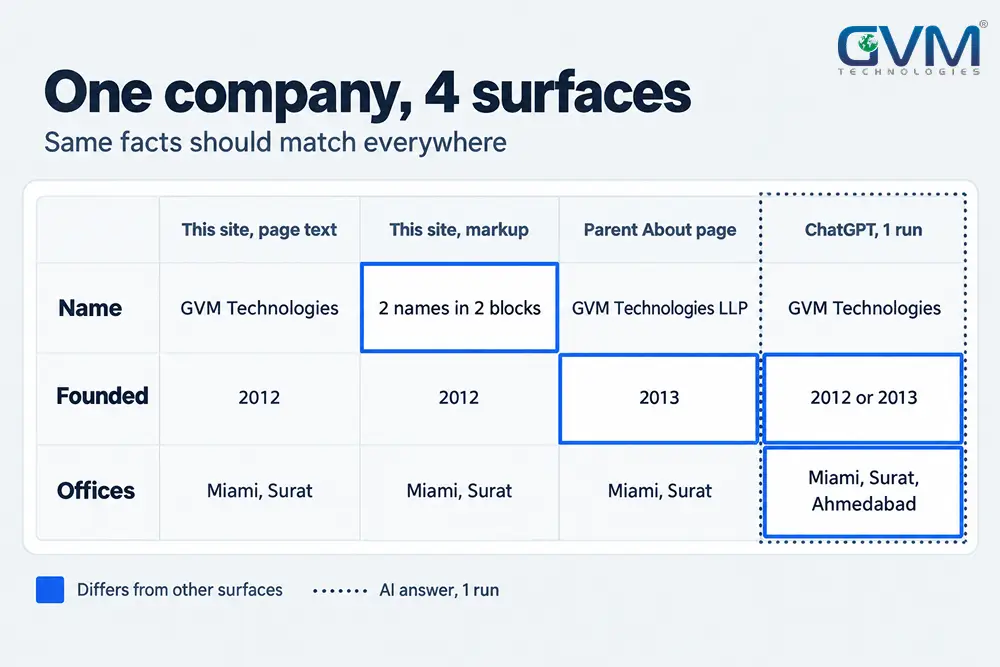
We checked GVM Technologies the way a buyer or an AI would, on 2026-10-07. The parent company resolved, but the category blurred and our own markup disagreed with itself.
What ChatGPT Said About GVM Technologies
We asked signed out ChatGPT “What is GVM Technologies and what does it do?” once. The answer cited 3 sources: the company’s own site, LinkedIn, and a university page.
| Check | Result |
|---|---|
| Right entity named | Yes, the parent company |
| Right category | Partly: SEO and GEO was 1 of 8 services |
| Right facts | Partly: gave 2012 or 2013, and added an Ahmedabad office |
| This microsite named | No |
What Our Own Markup Showed
The disagreement sat on our side. We compared the homepage text, its JSON-LD (the code block that labels facts for machines), and the parent company’s About page.
| Item | What we found |
|---|---|
| Names for 1 business | A plain name in 1 block, a longer site name in another |
| Page title | A third wording, with no company name |
| Founding year | 2012 on the homepage, 2013 on the About page |
| Organization entries | 3, with no shared @id |
| sameAs profiles | Listed in 1 entry, missing from the others |
Our reading: the answer hedged on the founding year because the sources disagreed. That is a guess, not a proven cause.
What This Test Cannot Prove
- It is 1 prompt, 1 run, and 1 platform. Answers change between runs.
- Every other platform went untested, from Perplexity and Claude to Copilot, Gemini, and Google AI Mode.
- The Ahmedabad office appears nowhere on the company’s contact page, and we do not know which source produced it.
A dated citation baseline repeats a prompt across weeks, which 1 run cannot do.
Where Entity Clarity Breaks: Symptoms, Causes, and First Fixes
Match what you see in the answer to a cause. Each symptom has a different first fix, and most start with a page you control.
| Symptom in the AI answer | Likely cause | First fix |
|---|---|---|
| A different company is named | Same name rival | Add place and category beside the name |
| Right company, old facts | Stale markup or listing | Rebuild markup from 1 source of truth |
| Right company, wrong category | Vague or mixed copy | Open every page with 1 category sentence |
| Facts conflict between answers | Drift between profiles | Run the drift check in step 2 below |
| Not named at all | No independent pages | Earn coverage and check crawler access |
| Parent named, sub brand missing | No shared ID or links | Point the sub brand at the parent @id |
Audits often turn up JSON-LD that nobody updated after the page text changed. Hours, prices, and founding years then disagree on the same URL.
Crawler access still comes first, because a clean identity on a blocked page reaches no buyer.
How to Build Entity Clarity in 6 Steps
These 6 steps are entity SEO at small business scale. Define 1 identity, fix the pages you own, add markup, align profiles, earn coverage, then recheck.
The loop: Define → Align → Mark up → Profile → Earn → Recheck, then repeat every quarter.
1. Write 1 Entity Statement
- Template: “[Name] is a [category] that [does what] for [whom] in [where].”
- Example: “GVM Technologies is an SEO and GEO agency with offices in Miami and Surat.”
- Keep it under 25 words, and reuse it as sentence 1 of your homepage, About page, and profiles.
2. Make Your Own Pages Agree
- List name, category, founding year, address, and phone in a spreadsheet, 1 column per surface.
- Surfaces to include: homepage, About, Contact, footer, JSON-LD, and author pages.
- Pick the correct value for each row, then change every other surface the same day.
3. Add Organization Markup With 1 Stable ID
Google lists name, url, logo, sameAs, address, description, alternateName, legalName, and foundingDate as recommended Organization properties. Give the organization 1 stable @id and refer to it from every other node.
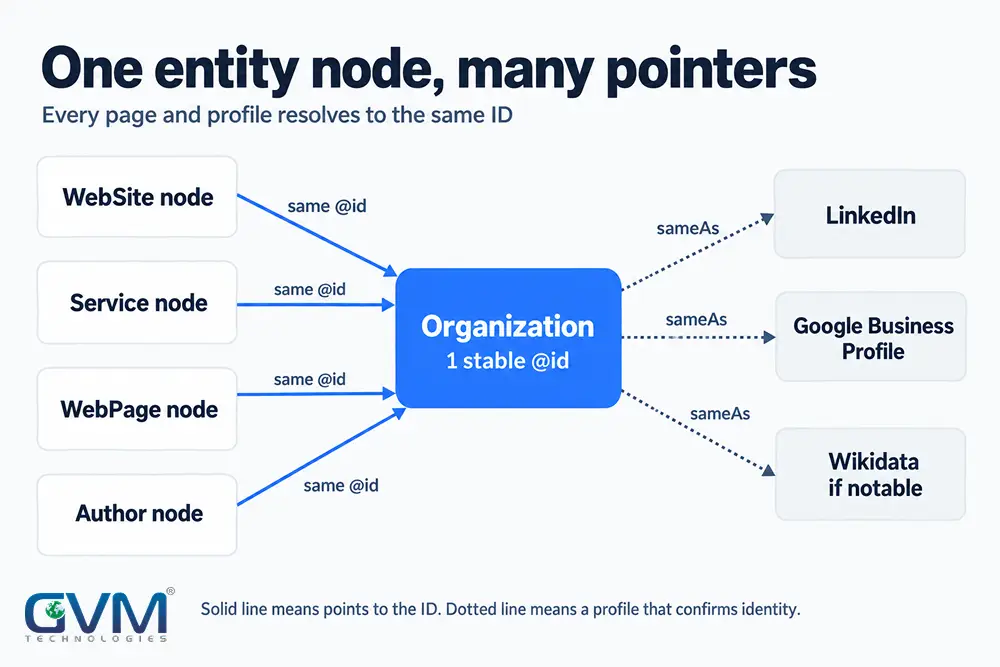
- The sameAs property points to a page that “unambiguously indicates the item’s identity.”
- Use the most specific subtype that fits, such as a LocalBusiness subtype for a shop with an address.
- A sub brand site points its WebSite and Service nodes at the parent’s @id.
4. Align Profiles and Listings
- Copy your entity statement and key facts to LinkedIn, Google Business Profile, and the directories in your category.
- Correct stale listings directly. Old profiles keep repeating the old name.
- Add a Wikidata item only if you meet Wikidata’s notability rules, which need a sitelink, serious public references, or a structural need.
5. Earn Independent Coverage
- Give reviewers and partners 4 facts to repeat: your name, category, location, and founding year.
- Skip bought placements. Google calls inauthentic mentions unhelpful, and a promised citation count is a warning sign.
- A name alone rarely earns a link, as our 3 run mentions test showed.
- Saying your name more often adds no fact, which is why repeating keywords for AI search fails.
6. Recheck With a Prompt Log
- Run 5 prompts 3 times each: what is [name], who is it for, where is it based, who founded it, and is it the same as [lookalike].
- Score each answer on 4 checks: right entity, right category, right facts, own site named.
- Repeat monthly, and report facts next to counts, using a GEO report that goes past citation tallies.
Entity Clarity by Situation: Local Business, Freelancer, Startup, Agency
Entity SEO looks different for a shop than for a freelancer. Your entity is whatever the AI must name, and the first fix differs for each.
| You are | Your entity is | First step |
|---|---|---|
| Local business | 1 business at 1 address | Match name, address, phone on site and profile |
| Freelancer or blogger | You as an author | Build 1 author page with Person markup |
| Startup | A new brand, few mentions | Publish the statement, then earn coverage |
| Parent with sub brands | 1 parent, several sites | Give the parent 1 @id and link each site |
| Agency | Your clients, not you | Audit each client’s drift before writing |
A new brand gains little from markup alone, because markup only repeats what the page says. SEO still underpins GEO, so crawlable, indexed pages come first.
Entity Clarity Pitfalls, Tools, Cost, and Timing
Most entity clarity pitfalls come from touching the markup before the page. The table pairs each pitfall with a better first move.
| Pitfall | Why it backfires | Better first move |
|---|---|---|
| Adding schema to a blurred brand | Markup repeats the page | Fix page copy first |
| Renaming without updating profiles | Old listings keep the old name | Update all profiles that week |
| Counting on llms.txt | Google says it changes nothing | Spend the hour on drift |
| Buying mentions | Google calls them unhelpful | Earn coverage instead |
- Tools: a spreadsheet, the Schema Markup Validator, and your prompt log.
- Cost: the core fixes take hours, not licences. Paid tracking tools are extra, and typical retainer ranges sit in what a retainer typically costs.
- Timing: no platform gives a schedule. We plan to retest monthly for 3 months and treat results as a pattern, not a promise.
FAQs
1. Is entity clarity the same as entity SEO?
No. Entity clarity is the condition of being clearly identified. Entity SEO is the set of tasks, such as markup and profile cleanup, that improves it.
2. Do I need a Wikipedia page or Wikidata entry?
No. Wikidata needs public references or a sitelink, so many small businesses do not qualify. Build consistent owned pages and independent coverage first.
3. Does schema alone fix entity clarity?
No. Google says AI features in Search need no extra markup. Markup repeats what the page says, so fix the copy first.
4. Why does ChatGPT describe my business wrongly?
The sources it retrieved usually disagree or are stale. Compare your site, markup, and profiles 1 fact at a time, then fix the mismatched source.
5. Does entity clarity help classic rankings too?
Possibly in part, but no source we found proves a ranking lift. Consistent names and clear page purpose help users and crawlers either way.
6. Can a brand new business get cited at all?
Yes, if its pages are crawlable and state checkable facts. Progress is slower, because few independent pages describe it yet.
Conclusion
Entity clarity is the work of making 1 identity easy to match to the right facts. It does not guarantee AI citations, but a blurred identity weakens every other GEO effort.
- Today: write your entity statement and run 5 prompts 3 times each.
- This week: list 5 facts across 6 surfaces and fix the odd ones.
- This month: add Organization markup with 1 @id and align profiles.
- Every quarter: rerun the prompt log and refresh stale facts.
Retrieval systems will keep shifting, yet a consistent identity stays easy to match. When hiring help, ask an AI SEO specialist these questions and use a checklist for judging agencies on drift.
Stop Letting AI Guess Who You Are
You search your own name in ChatGPT and get the wrong category, the wrong year, or a competitor. A buyer who reads that answer may shortlist someone else.
GVM Technologies runs 4 identity checks inside its free SEO + GEO audit:
- Identity: your name, category, and key facts across site, markup, and profiles
- Markup: Organization, Person, and sub brand nodes sharing 1 stable ID
- Answers: what AI platforms say about you across repeated runs
- Sources: which independent pages describe you, and where they disagree
With 13+ years of SEO behind it, GVM Technologies now delivers generative engine optimization services from that same foundation, plus ISO certified processes and case studies from 3 industries, covering trucking insurance, real estate, and floral e-commerce.