
An AI search ranking algorithm would be a published formula that orders sources for an AI-written answer, the way PageRank orders links.
Quick answer: partly. Every AI search engine has its own answer-selection layer, but only some own an index, and none has published an AI search ranking algorithm. That is why GEO builds on SEO instead of replacing it.
Key Takeaways
- “Own” means 3 different things: own index, own retrieval ranking, and own answer selection. Most claims blur them.
- Google’s AI features rely on its core ranking systems, not a separate AI search ranking algorithm. Other AI search engines mix their own crawlers with outside sources.
- Query fan-out is a rewrite step, not an AI search ranking algorithm. It explains most “AI ranks differently” complaints.
- Ranking and citation are separate wins in every AI search engine. A page can win the first and lose the second.
- Nobody outside the labs knows how selection weighs passages, so treat any claimed AI search ranking algorithm formula as marketing.
What Is an AI Search Ranking Algorithm?
An AI search ranking algorithm would be a documented system that scores and orders sources for an AI answer. No AI search engine has published one.
What exists is a pipeline called retrieval-augmented generation (RAG): the AI rewrites your question, fetches current pages, then writes from them.
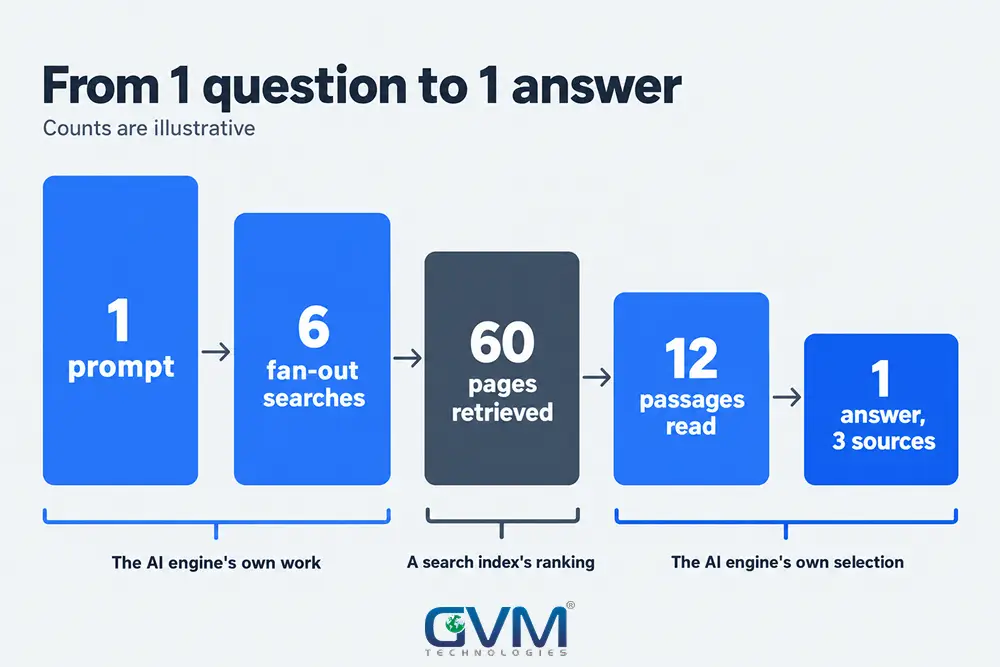
Most claims go wrong because “own” is not 1 thing. It is 3:
- Index: the engine crawls and stores the web itself.
- Retrieval ranking: the engine scores pages for each search.
- Selection layer: the model picks which passages and sources to quote.
Many website owners test 1 prompt, see a brand list unlike Google’s page 1, and decide the AI runs new ranking math. The cause is usually query fan-out.
The labels add noise. AI Optimization (AIO), GEO, AEO, and LLMO mostly name 1 goal.
Who Owns Each Layer of the AI Search Ranking Algorithm
Every AI search engine owns the selection layer. Ownership of the index and the retrieval ranking varies by platform, and no vendor publishes a full AI search ranking algorithm.
Vendors confirm less than marketers claim, so the table marks confidence as of 2026-10-01.
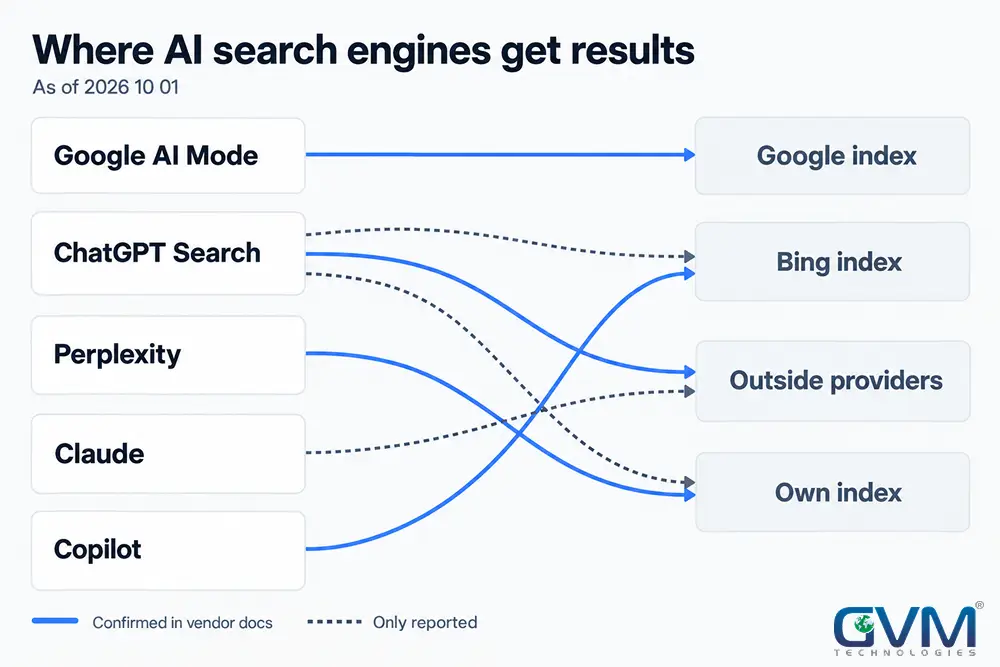
| Platform | Index | Retrieval ranking | Selection | Confidence |
|---|---|---|---|---|
| Google AI Overviews, AI Mode | Google’s | Core ranking systems | Gemini | Confirmed in Google’s docs |
| ChatGPT Search | Own index reported | Outside providers, partners | OpenAI model | Partly confirmed |
| Perplexity | Own crawler and API | Own ranked results | Perplexity model | Mostly confirmed |
| Claude | Not disclosed | Outside vendor reported | Claude | Crawlers confirmed |
| Microsoft Copilot | Bing’s | Bing ranking | GPT models | Documented in 2023 |
1. What vendors confirm about AI search ranking algorithms
- Google: AI features rely on core Search ranking systems, such as neural matching, passage ranking, RankBrain, and PageRank.
- Google, eligibility: a page must be indexed and snippet-eligible. No extra markup is required.
- OpenAI: OAI-SearchBot surfaces sites in ChatGPT search. GPTBot is a separate training crawler.
- Perplexity: PerplexityBot surfaces and links sites, and its Search API returns ranked web results.
- Anthropic: Claude-SearchBot improves search result quality. Blocking it may reduce visibility.
2. What is only reported about the AI search ranking algorithm
- ChatGPT results overlap heavily with Bing.
- ChatGPT runs a first-party retrieval index beside several outside providers. OpenAI has not confirmed this.
- Some AI products buy results from vendors that scrape Google, so a Google ranking can arrive second-hand.
- Claude’s search backend is Brave.
- Fresh pages on trusted sites can enter AI answers within days, because engines retrieve live results.
Treat each as a hypothesis. Checking Bing still costs nothing with Bing Webmaster Tools.
Whatever the backend, the work splits across the 3 targets of SEO, AEO, and GEO.
3. What AI search engines say about their ranking algorithm
We asked 4 AI search engines this exact question on 2026-10-01, signed out, from the US. All 4 answered yes.
- Google AI Mode listed 5 stages, including cross-encoder re-ranking and an authority filter. Google’s public documentation names neither.
- ChatGPT split the answer into retrieval ranking and answer selection, the 2 layers above.
- Perplexity answered yes in 2 sentences.
- Gemini listed schema markup as a ranking factor. Google says AI features need no special schema.
- Google AI Overviews did not appear for the question.
All 4 said yes because “own” is ambiguous. ChatGPT’s answer sits closest to vendor documentation.
4. What nobody outside the labs knows about the AI search ranking algorithm
- How selection weighs authority against freshness and clarity.
- How many fan-out searches each engine runs.
- Which passages the model drops, and why.
With 3 unknowns that large, a guaranteed AI citation is a red flag.
Query Fan-Out Is Not an AI Search Ranking Algorithm
Query fan-out is an AI search engine rewriting your question into several related searches before retrieval. Google describes AI Mode as issuing a multitude of queries at once.
It is a rewrite step, so it cannot be an AI search ranking algorithm. A model writes them when you ask, so they change between runs.
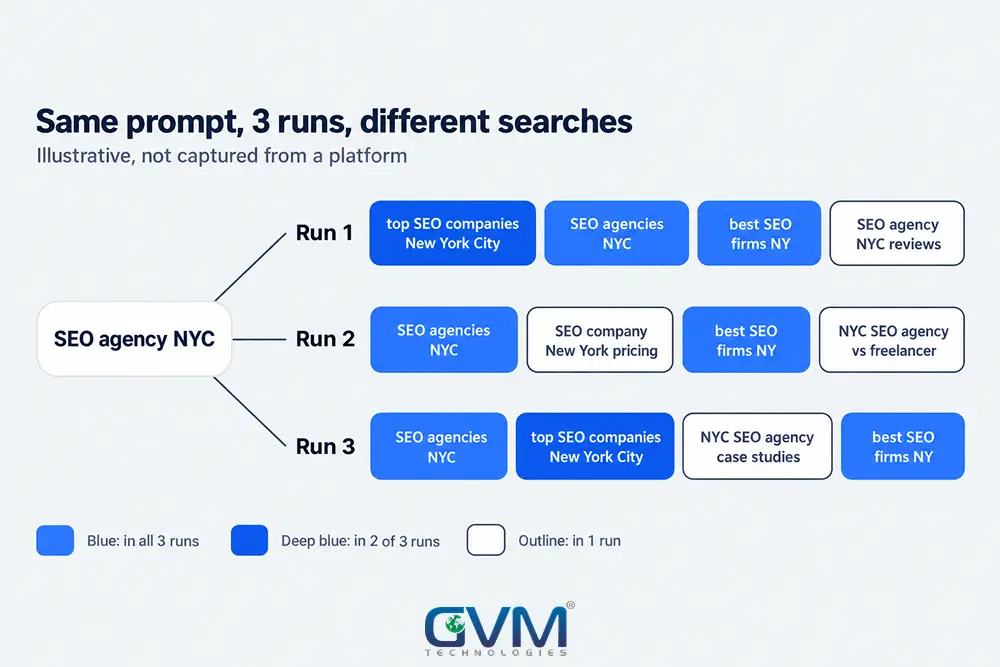
The 5 query fan-out rewrite patterns
These examples are illustrative, not captured from a platform.
| Pattern | Typed prompt | Fan-out search | Your page needs |
|---|---|---|---|
| Synonym swap | SEO agency NYC | top SEO companies New York City | Your wording variants |
| Added modifier | skincare for teen skin | best skin care 2026 | A fresh, dated answer |
| Constraint split | accountant for freelancers | accountant cost for freelancers | A section per constraint |
| Added comparison | CRM for 5 people | CRM vs spreadsheet small team | A comparison block |
| Trust check | hire a roofer | roofer reviews | Third-party reviews |
The query fan-out keyword-list trap
Sub-queries vary between runs, so a page per sub-query chases a moving target.
Group them into subtopics and cover each on 1 strong page. In our experience, 1 strong page per subtopic outlasts 6 thin variants.
Why keywords matter again in query fan-out
Prompts are conversational, but the fan-out searches are usually shorter and more literal.
Write natural answers, then put the literal phrases buyers search into your headings and first sentences.
Why a #1 Ranking Can Still Miss the AI Citation
A page can rank first for your typed query and still miss the AI answer, because the engine runs query fan-out and searches its rewrites.
The page must also be fetchable and quotable. Ranking enters you in the pool for 1 search, not all of them.
1. The 2-search test
Run each fan-out search in Google and Bing, then read the result:
- Ranks in neither: a retrieval problem. Fix coverage and authority.
- Ranks in both, never cited: a selection problem. Fix extraction and corroboration.
- Ranks in 1 only: an indexing gap. Fix the other index.
Log each result in a real AI-citation baseline so you can compare runs.
2. A worked example
Prompt: “Which accountant should a new freelancer in Austin hire for taxes?”
| Fan-out search (illustrative) | Who tends to win |
|---|---|
| freelance tax accountant Austin | Local firm pages |
| best CPA for self-employed Texas | Directories, roundups |
| accountant cost for freelancers | Pricing explainers |
| Austin accountant reviews | Review platforms |
A firm ranking #3 for the first line can be absent from the other 3. The answer tends to name sources that appear across several searches.
3. Citations can come from beyond page 1
Google says AI features identify more supporting pages, for a wider and more diverse set of links. A page ranking 14th for the typed query can win 1 sub-query and get cited.
GVM Technologies often sees the reverse gap: a page that ranks for the headline phrase and ignores the follow-up questions. A baseline across repeated runs shows which case you are in.
4. The symptom-to-layer map
| Symptom | Likely layer | First fix |
|---|---|---|
| Absent, ranking page 3 or lower | Retrieval | Cover the missing subtopics |
| Ranking top 5, never cited | Selection | Open sections with the answer |
| Cited with wrong facts | Source pages | Correct the pages retrieval returns |
| Cited on 1 AI product only | Index gap | Check Bing and crawler access |
| Cited once, gone next run | Non-determinism | Track the pattern, add corroboration |
If you see wrong facts, GVM Technologies starts with the source pages, not the AI answer.
AI Search Ranking Algorithm Myths, Checked
Both loud camps are partly wrong. “The AI search ranking algorithm has secret criteria” has no public evidence.
“AI is only Google with a chat window” ignores the selection layer and the AI search engines that run their own crawlers. The table scores 5 common claims.
| Claim | Verdict | Why |
|---|---|---|
| A secret AI search ranking algorithm replaced classic ranking | Unproven | No vendor has published one |
| AI search is just Google or Bing | Too strong | Selection is new; some run own crawlers |
| Rank #1 and you will be cited | Unreliable | Engines search rewrites, then select |
| Schema, llms.txt, or chunking gets you cited | Not required | Google says AI features need none |
| Fan-out is a fixed keyword list | Misleading | The searches change between runs |
“Unproven” is the honest label, because selection logic stays closed. That is also why people ask whether GEO is just rebranded SEO.
How to Optimize for the AI Search Ranking Algorithm
Optimize each layer of an AI search engine on its own: make pages reachable, win the fan-out searches, then make passages easy to select.
Start with access, because a blocked crawler beats every content fix. No separate budget or tool is needed to begin.
Rule of thumb: rank decides whether you are retrieved. Clarity decides whether you are quoted. Corroboration decides whether you are believed.
1. Fix access so the AI search ranking algorithm can reach you
- Index key pages in Google and Bing, and verify both.
- Allow OAI-SearchBot, Claude-SearchBot, and PerplexityBot in robots.txt.
- Check your CDN and security plugins. Some block AI crawlers by default.
- Remove nosnippet and tiny max-snippet limits from pages you want quoted.
- Keep key answers in the HTML, not behind JavaScript.
This layer is dull, checkable, and often broken. At GVM Technologies it is the first thing we test.
2. Run a query fan-out audit in 5 steps
- List 10 prompts your buyers type.
- Run each 3 times on 1 platform and note the searches shown.
- Group repeated query fan-out searches into subtopics, including buyer constraints like budget.
- Search each subtopic in Google and Bing, and record who ranks.
- Expand 1 existing page per gap. Build a new page only when none fits.
3. Audit what AI answers say about you
Grounded answers repeat what retrieval returns, including outdated or wrong pages about you.
- Run 10 prompts that name your brand.
- List every claim about pricing, services, and location.
- Trace each wrong claim to its source page, then fix or replace it.
- Keep brand and product names identical everywhere, because engines often name the product, not the company.
4. Measure the pattern, not 1 run
Run the same prompts weekly and track how often you appear, as GEO reporting beyond citation counts explains.
Google also reports AI-feature visibility in Search Console’s generative AI performance reports.
Mistakes, Timelines, and Costs
Most wasted effort comes from chasing an AI search ranking algorithm formula, judging from 1 run, and buying a tool before checking access.
Expect crawler fixes within days and authority gains over months. The first checks cost hours, not budget.
| Mistake | Why it fails | Do this instead |
|---|---|---|
| 1 page per query fan-out search | Searches change between runs | 1 strong page per subtopic |
| Blocking GPTBot to hide from search | OAI-SearchBot is separate | Set each crawler on purpose |
| Buying a visibility tool first | A score hides access gaps | Audit first, then pick tools |
- Access fixes: OpenAI says robots.txt changes take about 24 hours to reflect.
- Ranking gains: these follow normal SEO timelines, so expect weeks to months.
- Cost: Search Console and Bing Webmaster Tools are free. Paid tools are optional.
If a vendor sells you only a rank report, you are blind to 2 of the 3 layers. See the first 30 days of GEO work and SEO and GEO pricing for what a real engagement includes.
Before signing anyone, vet a GEO or SEO agency. GVM Technologies treats all 3 layers as 1 job, so SEO and GEO advice stays consistent.
FAQs
1. Do AI search engines have their own ranking algorithm?
Partly. Each has its own selection layer, but no public AI search ranking algorithm exists. Google’s AI features rely on core Search ranking systems, and other engines pair their own crawlers with outside or first-party sources.
2. Does ChatGPT use Google or Bing?
OpenAI has described outside search providers plus its own crawler. Earlier tests found heavy Bing overlap, and recent analysis reports a first-party index. The mix is shifting, so verify both indexes.
3. Is query fan-out the same as keyword research?
No. Keyword research starts from phrases people type, while query fan-out starts from searches the AI writes. Use it to find missing subtopics, not to build a page per query.
4. Can I influence an AI search ranking algorithm?
You cannot change the weights, but you can improve every input: be indexed, rank for fan-out searches, and write standalone answers.
No one can guarantee a citation, and hiring an AI SEO specialist should not change that.
5. Does an AI search ranking algorithm need schema or an llms.txt file?
Google says its AI features need no special schema, AI text files, or chunking, and ties them to helpful, people-first content. Keep schema for rich results, and treat llms.txt as optional.
Conclusion
No public AI search ranking algorithm exists, but AI search engines are not just Google with a chat box. They add a query rewrite before retrieval and a passage pick after it, and both stay closed.
The fix is a sequence, not a trick. Work through it in order:
- Today: confirm key pages are indexed in Google and Bing.
- This week: test robots.txt, your CDN, and nosnippet limits against the 4 search crawlers.
- This month: run the fan-out audit and the brand-fact audit.
- Every quarter: recheck the platform table, because vendors keep changing sources.
The sites that get cited are rarely the ones that guessed a formula. They are the ones that fixed the 3 layers while everyone else debated it.
Stop Guessing Which Layer Is Failing
You rank on Google, yet AI answers name someone else, and nobody can explain how the AI search ranking algorithm treats your site. Each month of guessing hands that answer to a competitor.
In your free SEO + GEO audit, GVM Technologies checks:
- Retrieval: indexing and crawler access across Google and Bing
- Fan-out: the buyer searches your pages miss
- Selection: whether your answers are built to be quoted
- Source pages: what AI answers say about your brand today
GVM Technologies has built SEO and generative engine optimization together since 2012, with ISO-certified processes and named client results in insurance, real estate, and e-commerce.
You leave with a clear answer on which layer to fix first.