llms.txt is a Markdown file at your site root that lists the pages you most want AI tools to read.
On current evidence, llms.txt AI citations are a myth: no study shows the file gets a site cited by ChatGPT, Gemini, Perplexity, or Google. Before paying anyone to build it, vet the agency pitching it.
Quick answer: No. Large log and citation analyses find no lift in llms.txt AI citations, and Google says its AI features ignore the file. Treat it as optional housekeeping, mainly for developer docs.
Key Takeaways
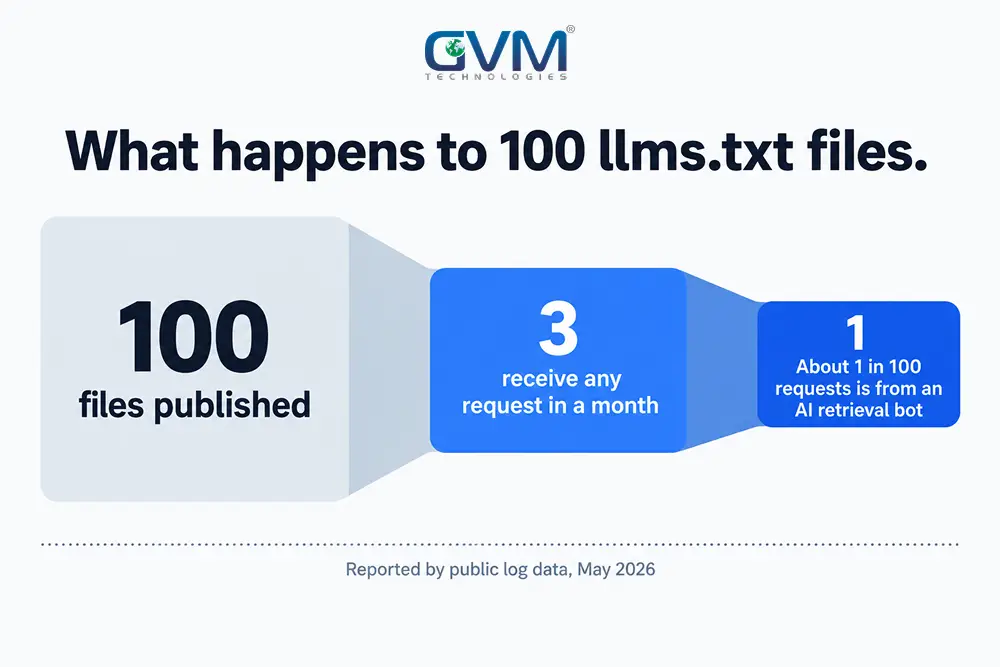
- Server logs across 137,000+ domains show 97% of llms.txt files get zero requests in a month.
- A citation analysis of about 300,000 domains found no relationship between having the file and being cited.
- Google’s guidance says no special AI files are needed and that such files neither help nor hurt.
- The file has 2 real uses: developer documentation and assistants you build yourself.
- A broken file is the only way it can hurt you, so test that it returns plain text with HTTP 200.
- Citations come from access, standalone answers, original evidence, and mentions on other sites.
What llms.txt Is and How It Relates to AI Citations
llms.txt is a proposed convention, published in September 2024, for a plain Markdown file at your domain root. The file gives AI agents a curated map of your site.
Think of it as a navigation aid for agents that fetch pages on demand. But it is not a ranking signal, and it does not allow or block anything.
1. What the file contains
The llms.txt specification requires only an H1 with the site name. Most files add a one-line summary and grouped lists of links.
# Acme Docs
> Developer documentation for the Acme payments API.

## Guides
- [Quickstart](https://acme.com/docs/quickstart.md): Send a first payment

## Optional
- [Changelog](https://acme.com/docs/changelog.md)
2. Who the file was designed for
The format targets agents working at answer time with a small context window, such as a coding assistant reading docs a developer points it to.
Search engines are a different case, because they already crawl and index your whole site. Agencies often bundle the file into generative engine optimization retainers, but that is a separate job.
3. How it differs from robots.txt and sitemap.xml
Many site owners assume these 3 files overlap. They do not, and only one of them controls access.
| File | Job | Enforces anything? |
|---|---|---|
| robots.txt | Allows or blocks crawlers | Voluntary, but major bots honor it |
| sitemap.xml | Lists indexable URLs | No |
| llms.txt | Curates priority pages in Markdown | No |
What the Evidence Says About llms.txt AI Citations
Three kinds of evidence agree. Server logs show bots rarely request the file, and citation analyses show no lift for sites that publish it.
Google’s documentation also says the file is ignored. Still, none of this proves the file is useless forever, and none of it shows a benefit today.
1. Server logs: almost nobody requests the file
A log analysis of 137,000+ domains in May 2026 found that 28% published a file. Of those files, 97% received no requests at all that month.
- About 1% of requests came from AI retrieval bots, the kind that fetch pages for live answers, as covered in how AI search ranks sources.
- Roughly 12% came from tools that audit or study the file.
- No AI bot requested files that did not exist.
2. Citation analyses: no link between llms.txt and AI citations
A separate analysis of roughly 300,000 domains compared citation frequency with file presence. About 10% had the file, and no relationship appeared.
Notably, dropping the file as a variable made the prediction model slightly better, which points to noise, not signal.
3. What Google and OpenAI document
Official documentation is the strongest evidence tier available. It also says less than most marketing posts claim.
| Source | What it says | What it does not say |
|---|---|---|
| Google’s AI optimization guide | No new AI text files needed; they neither help nor harm | Nothing about other AI platforms |
| OpenAI’s bots documentation | OAI-SearchBot controls ChatGPT search visibility | No mention of llms.txt as a citation factor |
| Chrome’s Lighthouse audit | File is optional; a missing file is Not Applicable | Nothing about ranking or citations |
4. What these studies cannot prove about llms.txt and AI citations
An honest answer needs its limits. “No evidence of a benefit” is not the same as “proven to have no effect.”
- Log studies count requests, not whether a bot used what it fetched.
- Citation studies are correlational and measured at domain level.
- Sites that publish the file skew technical, which could bias results either way.
- Platforms change, so a null result in 2026 is not a promise for 2028.
Why llms.txt AI Citations Stay Flat
Citations come from retrieval, ranking, and corroboration. A self-published manifest touches none of them.
AI search tools pull pages from an index they already built, select passages that answer the question, and check those passages against other sources. That pipeline has no step where a self-declared file earns trust.
1. The index already holds your pages
Search-backed assistants retrieve from a search index plus their own crawler. A curated list adds little when your pages are already discoverable.
Also, one question fans out into several sub-searches, a mechanism covered in what AI optimization means.
2. A self-declared file cannot be trusted alone
Anyone can list anything in a text file. So a system that believed it would be gamed within months, as the old meta keywords tag was.
But to check the claims, a bot must fetch the real page, which makes the file redundant.
3. AI citations come from signals llms.txt cannot carry
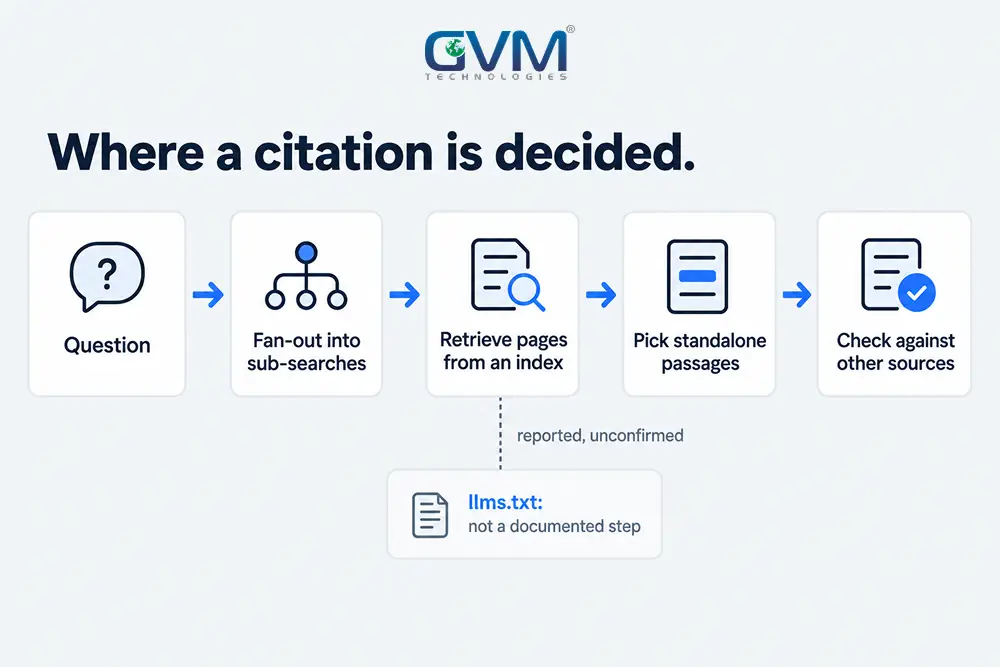
We use a 4-layer stack when auditing why a page is or is not cited. The file only points at pages, so it adds nothing to layers 2, 3, or 4.
| Layer | Question it answers | Does llms.txt help? |
|---|---|---|
| 1. Access | Can the right bot fetch and read the page? | Partly, as a pointer |
| 2. Understanding | Can one passage stand alone as an answer? | No |
| 3. Evidence | Does the page say something found nowhere else? | No |
| 4. Corroboration | Do other sources confirm the same facts? | No |
When llms.txt Is Worth Publishing Without AI Citations
Publish it when a tool that reads the file will actually use it: developer documentation, API references, or an assistant you run yourself.
For everyone else, it is optional housekeeping. It costs about 10 minutes, yet it changes no citation outcome.
1. Developer docs and API references
Coding assistants fetch the file when a developer points them at your docs. OpenAI publishes its own docs index this way, but that makes it a publisher using the format, not proof its search crawler reads yours.
2. Sites running their own assistant or agent
If you build a help bot or internal agent, a clean Markdown index saves tokens and reduces wrong-page answers. You control the consumer, so the benefit is real and testable.
3. A 3-question decision test for everyone else
Answer these in order. Publish only if all 3 are yes.
- Can you name a tool or agent that will read this file?
- Do you have slow-changing pages, such as docs or guides, worth a curated list?
- Are crawl access, content, and entity basics already clean?
A “no” on question 3 means fixing those basics first. We do not push the file on clients as a quick win, because an honest audit, like the first 30 days with a GEO agency, finds bigger gaps.
How to Publish llms.txt Without Creating New Problems
Write a short, accurate Markdown file at /llms.txt and confirm it returns HTTP 200 as plain text. Then keep it synced with your site.
However, most failures come from CMS redirects and stale links, not from the format itself. The format is easy; the upkeep is where files go wrong.
1. Five steps that cover it
- Pick 10 to 30 priority pages. Skip tag pages, search results, and staging URLs.
- Write the H1, a one-line summary, and grouped link lists with short notes.
- Upload the file to your domain root so it loads at
/llms.txt. - Open the URL in a browser, then check headers with
curl -I. Expect status 200 and a text or Markdown content type. - Review it every quarter and remove dead URLs.
2. Mistakes that turn a harmless file into a liability
These 5 errors show up most often.
| Mistake | Why it hurts | Fix |
|---|---|---|
| CMS redirects it to the homepage | Serves HTML with a 200 status | Whitelist the path |
| Listing every URL | Duplicates sitemap.xml | Curate 10 to 30 pages |
| Stale links | Sends agents to dead pages | Review quarterly |
| Marketing claims inside | Invites inaccurate summaries | State facts and limits |
| Reporting it as a GEO result | Misleads the client | Log it as housekeeping |
If a vendor promises citations from this file, that is a guarantee red flag.
3. What the Lighthouse audit flags
Chrome’s agentic browsing audit flags a server error when it tries to fetch the file. A missing file returns 404 and is marked Not Applicable.
So skipping the file carries no penalty, but a 5xx error on that path gets flagged.
How to Test Whether llms.txt Changed Your AI Citations
Check your server logs for requests to /llms.txt by user agent over 30 days. Then compare llms.txt AI citations on a fixed prompt set before and after.
If no retrieval bot ever requested the file, nothing inside it could have shaped an answer.
1. Start with the logs
Filter requests to the path and group them by user agent. Separate training crawlers such as GPTBot from retrieval bots such as OAI-SearchBot.
Also exclude audit tools, which made about 1 in 8 requests in public log data.
2. Then compare llms.txt AI citations on a fixed prompt set
Pick 20 to 30 prompts your buyers actually ask, across 3 or more platforms. Then run each several times.
The same prompt can cite a different source on a different run, so record the pattern, not one answer. Instead of guessing, use our citation baseline guide and GEO reporting breakdown explain how.
3. Change one thing at a time
If you add the file, a schema block, and 5 new pages in one week, you cannot credit any of them. Publish the file alone, wait 4 to 6 weeks, then judge.
What Earns AI Citations Instead of llms.txt
Citations follow the work a file cannot replace: non-commodity content, answer-first structure, open access to rendered HTML, and mentions on other sites.
This is mostly SEO fundamentals applied to passages, as the rebranded SEO question explains.
1. Original, non-commodity content
Google’s guide separates commodity content, which anyone could write from common knowledge, from content with unique expert takes. A model already writes the commodity version.
For example, we have watched original numbers and first-hand tests get cited with no change in rank.
2. A direct answer at the top of each section
Engines lift the sentence that answers the prompt, so state it first and explain after. Self-contained passages beat padding, which is why keyword stuffing in AI search backfires.
3. Open access and rendered HTML
Check the basics that decide layer 1:
- Allow OAI-SearchBot, since opted-out sites do not appear in ChatGPT search answers. GPTBot is a separate training crawler.
- Serve key content in HTML, not only after JavaScript runs.
- Confirm Bing indexation, because some assistants lean on its index.
4. Mentions and consistency off your own site
AI systems build a picture of a brand from reviews, directories, publications, and community threads. Finally, keep your name, description, and facts identical everywhere.
Our generative engine optimization service treats these signals as core work, not an add-on.
Note: Structured data is not required for AI features, and Google says no special markup exists for them. Schema still clarifies what a page is, but it is a clarity aid, not a citation switch.
FAQs
1. Should I add llms.txt to my website?
Only if you run developer docs or your own assistant. Otherwise it is optional, cheap, and unlikely to change citations. Fix access, content, and mentions first.
2. Does Google use llms.txt?
No. Google’s AI optimization guide says Google Search ignores such files and that they neither help nor harm visibility. Its Lighthouse audit only checks for server errors.
3. Will llms.txt hurt my SEO?
A valid file does not hurt. But a broken one that redirects to your homepage or returns a server error creates noise, so test the response status.
4. Does llms.txt improve AI citations in ChatGPT?
OpenAI documents OAI-SearchBot for search visibility and does not list llms.txt as a factor. Some crawlers request the file, but fetching is not the same as citing.
5. Is llms-full.txt worth creating?
The same logic applies. A full-content version can help coding agents ingest docs in one fetch, but no search platform has documented using it for citations.
6. Why do so many agencies still recommend llms.txt?
Because it is binary, fast to implement, and easy to show on a report, it makes an easy deliverable. It does not make an effective one.
7. Could llms.txt AI citations improve in the future?
Possibly. Standards can gain support, and waiting costs little. Adopt it when a named platform documents using it, not before.
Conclusion
Today, llms.txt AI citations are a myth for search platforms. The file is a harmless navigation aid, with real use for developer docs and your own agents.
Here is a plan that spends effort where citations come from:
- Today: Check that
/llms.txtreturns a clean 404 or a valid text file, never a redirect. - This week: Confirm robots.txt allows OAI-SearchBot, and that key pages render without JavaScript.
- This month: Rewrite your 5 most important pages to lead with a direct answer and 1 original fact.
- Every quarter: Re-run your fixed prompt set and refresh any file you publish.
Expect the standards to keep shifting, so revisit this when a named platform documents support.
Paying for llms.txt instead of AI citations?
If your last audit ended in a checklist of files, you paid for activity, not outcomes. GVM Technologies audits what decides citations:
- Crawler access for GPTBot, OAI-SearchBot, ClaudeBot, and PerplexityBot
- Rendered-HTML and Bing indexation gaps
- Answer-first structure and original-evidence gaps on priority pages
- Entity consistency and off-site mentions
We have built SEO and GEO together since 2012, with ISO-certified process and named client case studies. We will tell you plainly when a tactic, including this one, is not worth your budget.