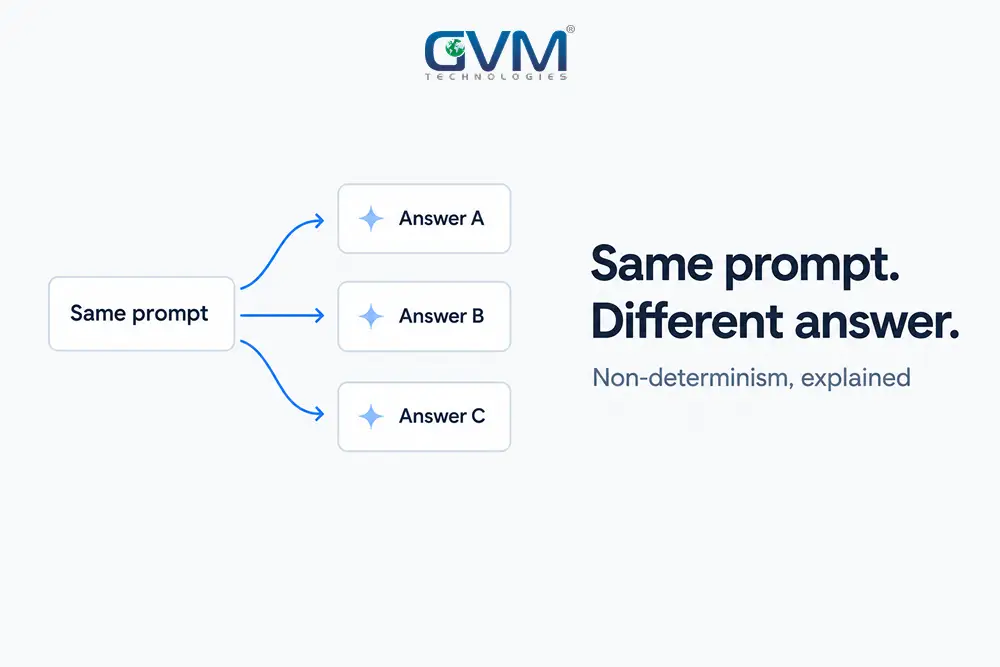
Non-determinism means the same input can produce a different output on each run. Every major AI assistant works this way by design.
When AI gives different answers to one prompt, it is usually not broken. It is sampling words, reading hidden context, and pulling live sources, all of which shift, as in our guide to how AI search ranks sources.
Quick answer: AI gives different answers because it picks each word from a list of likely options, not a stored reply. Hidden context, live web sources, server load, and model updates add more variation.
Key Takeaways
- Language models predict probabilities for the next word, then draw one. That draw is the main reason the same prompt gets different answers.
- Temperature 0 reduces variation but does not remove it. Anthropic’s own API docs confirm identical inputs can still return different outputs.
- In a 2025 lab test, one prompt run 1,000 times at temperature 0 produced 80 different answers.
- Your visible prompt is never the only input. Chat history, memory, location, and the system prompt change it.
- For brands, a single AI answer proves nothing. Measure how often you appear across repeated runs.
What Non-Determinism Means When AI Gives Different Answers
A calculator is deterministic: 2 + 2 returns 4 every time. A large language model (LLM) is probabilistic: it calculates how likely each possible next word is, then chooses one.
The model itself is fixed after training. The variation enters around it: in how words get picked, what context gets added, and which sources get retrieved.
This confusion usually happens because 2 true statements sound like a contradiction:
- The math is deterministic. Same weights, same input, same random seed, same hardware conditions: same output.
- The product is not. You rarely control the seed, the hidden context, or the server, so in practice the same prompt gets different answers.
Whether the randomness is “true” or “pseudo” random does not matter here. Either way, you cannot predict the next run.
Why AI Gives Different Answers: The 5-Layer Variation Stack
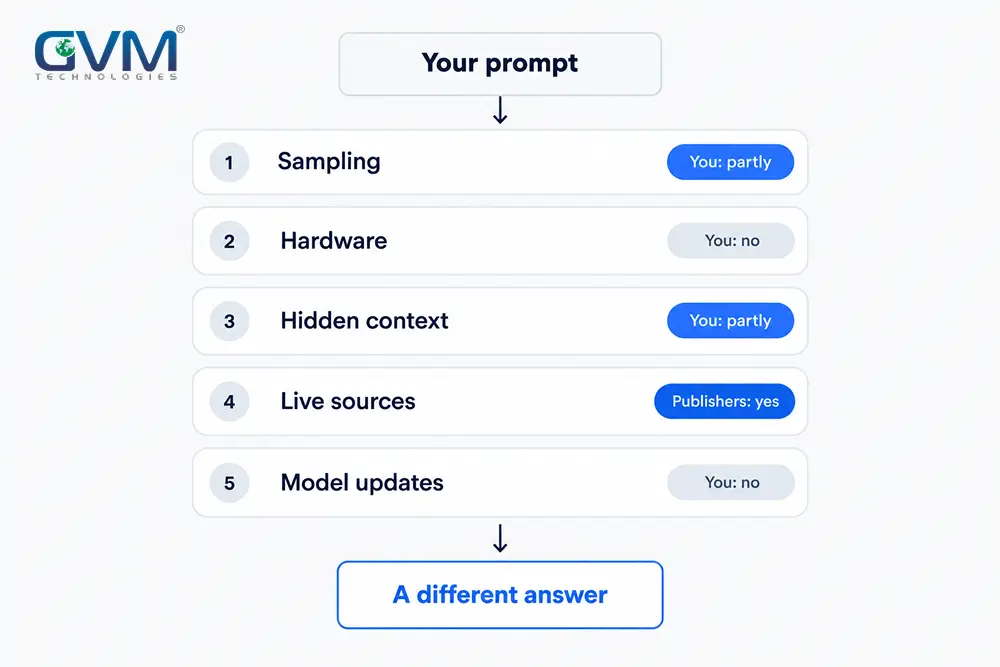
At GVM Technologies, we group every cause into 5 layers. Each one can change the answer on its own, and they stack.
| Layer | What changes between runs | Can you control it? |
|---|---|---|
| 1. Sampling | Which likely word gets picked | Partly, in API tools |
| 2. Hardware | Tiny rounding differences on busy servers | No |
| 3. Hidden context | History, memory, location, system prompt | Partly |
| 4. Live sources | Which web pages get retrieved | Indirectly, as a publisher |
| 5. Model updates | The model or its instructions | No |
1. Sampling: the model draws each word
Each word (technically a token, a word or word fragment) is drawn from a probability list. If “roses” scores 60% and “lilies” scores 20% as the next word, “lilies” still wins sometimes.
One different word early on changes everything after it, because each new word depends on the words before. That is how 2 runs share a first sentence and then split.
Two settings shape the draw:
- Temperature: low values favor the top choice; high values spread the odds.
- Top-p: limits the draw to the smallest set of options that covers most of the probability.
2. Hardware: busy servers change the math
Computers round decimal numbers, and adding the same numbers in a different order can give a slightly different total. Usually that changes nothing.
When 2 candidate words score almost the same, that tiny gap flips the winner. A 2025 lab experiment traced this to server load: your request is batched with other users’ requests, and batch size changes the rounding.
What that looks like: in that test, all 1,000 runs matched for the first 102 tokens. They split on a birthplace: “Queens, New York” in 992 runs, “New York City” in 8.
3. Hidden context: the prompt is not the only input
A mistake we often see in client screenshots is comparing 2 answers as if the prompt was the only variable. The model actually reads much more:
- Earlier messages in the same chat
- Saved memory and custom instructions, if turned on
- The provider’s hidden system prompt (standing instructions you never see)
- Your location, language, and whether you are logged in
- Small wording changes, even an extra line break
Language matters too. The same question asked in Spanish and in English can draw on different training patterns and sources.
4. Live sources: retrieval changes the evidence
Search-connected tools, such as ChatGPT search, Perplexity, and Google AI Overviews, use retrieval: they search the web first, then write from what they found.
They often split your prompt into several hidden searches, called query fan-out. Those searches can return different pages each run, and new pages get published daily. Different evidence produces a different answer.
For brands, this is the most important layer, because you can influence it by publishing pages worth retrieving.
Before this layer: pages AI crawlers cannot read never enter it. That technical side is covered in our guide to AI optimization (AIO).
5. Model and product updates
Providers update models, safety rules, and system prompts, often without renaming the product. Free and paid plans may also run different models.
So “the same ChatGPT” in March and in October may be 2 different systems answering your saved prompt.
Why AI Gives Different Answers on Different Days
Run-to-run variation explains small differences. Day-to-day changes usually add a bigger shift from layers 3 to 5.
| What changed overnight | Typical effect |
|---|---|
| Model or system prompt update | Tone, length, or stance shifts |
| New pages in the search index | Different sources and facts cited |
| Memory gathered from recent chats | Answers tailored to you differently |
| Different server load at a different hour | Small wording splits |
| You edited the prompt slightly | The task itself changed |
That last row matters most. For one of our real estate marketing clients, “best real estate marketing agency” and “cheapest real estate marketing” in the same city are different tasks, so different shortlists are the correct result.
The new-pages row is why a stable Google ranking can sit beside a shifting AI answer. The two systems overlap but are not the same, as covered in GEO vs. AEO vs. SEO.
Why AI Gives Different Answers Even at Temperature 0
Temperature 0 is often sold as the “make it consistent” switch. It helps, but 4 limits remain:
- Hosted APIs still vary. Anthropic’s API glossary says that even at 0, “the results will not be fully deterministic.”
- Batching still changes the math. The 80-answers result above was at temperature 0.
- Chat apps hide the dial. ChatGPT, Gemini, and Claude apps do not let you set temperature, and many reasoning models reject it in the API too.
- Lower is not smarter. Temperature 0 picks the safest word, not the correct one. It can still be wrong, and it can repeat itself.
Seeds have the same catch. A fixed seed repeats results on your own computer with a local model. On a shared cloud service, server conditions still vary.
When AI Gives Different Answers: Different Words or Different Facts?
Not every difference is a problem. When AI gives different answers, sort the change into one of 3 kinds before you lose trust in the tool.
| Kind of variation | Example | Risk level |
|---|---|---|
| Wording | Same advice, different phrasing | Low |
| Structure | Bullets one run, paragraph the next | Medium if code reads it |
| Substance | Different numbers, facts, or verdict | High |
Wording changes are normal and harmless. Structure changes break spreadsheets, scripts, and parsers. Substance changes mean the question is ambiguous, or the model is guessing.
From our client reporting: traffic for one of our US flower e-commerce clients peaks in February and March. In early March, “last month” can mean calendar February or the last 30 days, with different totals.
How to Get More Consistent Answers From AI Tools
You cannot make a chat app fully deterministic. You can remove most of the guessing that causes big swings:
- State the goal and 1 constraint. “Write 5 FAQ answers on bulk wedding roses for US buyers, under 50 words each” leaves far less to guess than “write some FAQs.
- Define fuzzy terms. Spell out date ranges, what counts as a lead, and which currency.
- Fix the output format. “Answer in 5 steps, one line each” makes runs easier to compare.
- Ask for assumptions first. “List what you are assuming before you answer” shows where it is filling gaps.
- Show 1 or 2 examples of the output you want.
- Test in fresh chats. Old messages and memory leak into new answers.
- Check facts that matter. Consistency is not accuracy; a model can repeat the same wrong number.
For teams using the API, add a low temperature, a JSON or schema output mode, and a validation step that rejects broken output.
What It Means When AI Gives Different Answers About Your Brand
This is where non-determinism becomes a marketing problem. Your company may appear in an AI answer at 9 a.m. and vanish by noon, which is why generative engine optimization is measured in odds.
The odds in numbers: in a January 2026 study of 2,961 AI responses, 2 runs returned the same brand list about 1 time in 100. The same list in the same order: about 1 in 1,000.
That has 3 practical effects:
- One screenshot proves nothing, whether it shows you winning or missing.
- Anyone guaranteeing a placement is guessing. Here is why a guaranteed AI citation is a red flag.
- Your lever is layer 4. Pages that are crawlable, specific, and consistent across the web get retrieved more often.
At GVM Technologies, we treat the goal as raising your odds, not winning one run. Our evidence review of what gets content cited by AI covers which tactics move those odds.
Consistent facts help too. When your name, services, and prices match everywhere, engines retrieve the same picture more often, which is the idea behind entity clarity.
How to Test AI Answers Without Fooling Yourself
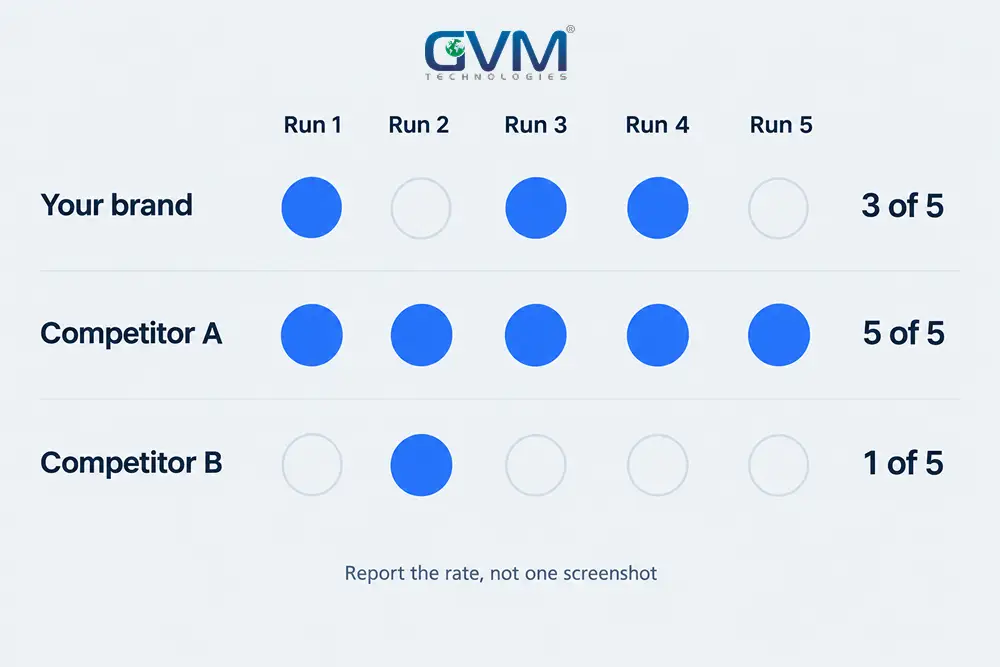
Treat each answer as one roll of the dice and measure the pattern instead. Because AI gives different answers on every run, GVM Technologies uses this method before any GEO work starts:
- Write 20 to 30 prompts your buyers actually ask, from broad to specific. For a floral store, that runs from “where to buy flowers online” to “bulk baby’s breath for a June wedding.”
- Run each prompt 5 times per platform, in fresh logged-out sessions where possible.
- Record mentions and linked citations separately, as explained in brand mentions vs citations.
- Report a rate, such as “named in 3 of 5 runs,” not a yes or no.
- Repeat on the same weekday each month, so changes reflect your work, not noise.
| Result across 5 runs | How to read it |
|---|---|
| 5 of 5 | Strong, stable presence |
| 2 to 4 of 5 | Real but contested; worth improving |
| 1 of 5 | Edge case; do not report it as a win |
| 0 of 5 | Not retrieved; check access and content first |
Ask any agency for this baseline before you sign, using our guide to requesting an AI-citation baseline. Then track it over time with GEO reporting beyond citation counts.
FAQs
1. Is AI non-determinism the same as hallucination?
No. Non-determinism means answers vary between runs; hallucination means an answer states something false. They overlap when one run invents a fact and another does not, so substance changes deserve a fact-check.
2. Why does ChatGPT give a different answer when I hit regenerate?
Regenerate runs the same prompt with a new random draw, so the AI gives different answers by design. ChatGPT sometimes shows 2 versions and asks which you prefer, which also feeds model improvements.
3. Does AI give different answers to different people?
Yes. AI gives different answers to different people because memory, custom instructions, location, language, and plan type all change the input. Two people typing identical words rarely send identical prompts.
4. Can I make ChatGPT give the same answer every time?
Not in the app. You can narrow variation with a precise prompt, a fixed format, and examples. Full repeatability needs a local model with fixed settings.
5. If AI gives different answers every time, which one should I trust?
Trust the parts that stay stable across 3 or more runs, and verify the parts that change. Stable answers can still be wrong, so check anything you will act on.
What to Do Next
AI gives different answers because sampling, hidden context, live sources, server load, and updates all shift between runs. You control some layers, influence one, and should measure the rest.
- Today: rerun your most important prompt 3 times in fresh chats, and note what changed.
- This week: rewrite it with a goal, a constraint, defined terms, and a fixed format.
- This month: run 20 buyer prompts 5 times each, and record your brand’s mention rate.
- Every quarter: repeat that test and compare rates, not single answers.
AI tools will keep changing how they answer. Reading patterns across many runs will stay the honest way to judge them.
Seeing your brand in AI answers one day and gone the next?
That swing usually means you sit on the edge of retrieval, not that the work failed. GVM Technologies checks:
- AI crawler access, rendering, and Google and Bing indexing
- How often you appear across repeated runs of your buyers’ prompts
- Whether your key pages give engines a clear, liftable answer
- Whether your facts match across the web
We have run SEO and GEO from one team since 2012, under ISO-certified processes, for clients across e-commerce, real estate, insurance and many more.